

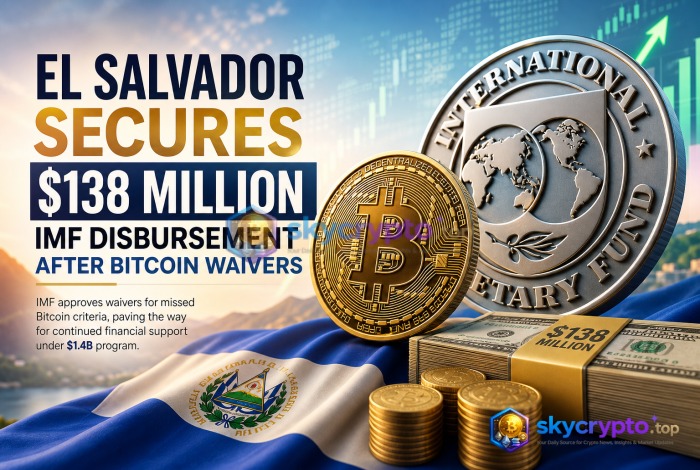
El Salvador has received a $138 million disbursement from the International Monetary Fund after the lender granted waivers for missed performance criteria related to Bitcoin accumulation. The approval, part of a $1.4 billion financing program, underscores the country's ongoing efforts to reduce state involvement in cryptocurrency and strengthen regulatory frameworks. This move comes amid renewed scrutiny of El Salvador's Bitcoin adoption strategy and its compliance with international financial standards.
- IMF approved $138 million disbursement despite El Salvador missing Bitcoin accumulation targets. Waivers were granted based on corrective measures and renewed commitments to reduce state crypto involvement.El Salvador's Chivo Bitcoin wallet has been transferred to private operator control.No further Bitcoin accumulation is planned beyond documented private donations.Progress was made in financial reforms, fiscal transparency, and AML/CFT compliance.
Market Reaction
The announcement of the IMF disbursement had immediate implications for Bitcoin's market dynamics, though the direct price impact was muted compared to the broader sentiment shift. Bitcoin (BTC) traded in a narrow range around $65,000 in the hours following the news, reflecting a market that had largely priced in the likelihood of waivers being granted. Traders focused instead on the nuanced signals from the IMF's statement, particularly the emphasis on reducing state involvement and enhancing transparency. The overall sentiment remained cautiously optimistic, with analysts noting that El Salvador's continued engagement with Bitcoin, albeit in a restructured manner, provides a degree of validation for the asset class in emerging markets.
Market participants also reacted to the confirmation that El Salvador's Bitcoin accumulation post-first review was funded through private donations rather than public resources. This clarification addressed concerns about potential fiscal risks and reinforced the narrative of Bitcoin as a speculative asset rather than a sovereign reserve liability. The derivatives market showed increased open interest in Bitcoin futures, with a slight uptick in funding rates suggesting bullish positioning. However, volume metrics indicated that the news did not trigger a significant retail trading surge, as investors awaited more concrete macroeconomic cues.
Why This Happened
The IMF's decision to grant waivers and proceed with the disbursement stemmed from El Salvador's demonstrated commitment to corrective measures and the strategic importance of maintaining financial stability in the region. The country missed certain performance criteria, particularly around Bitcoin accumulation limits, but implemented reforms in financial sector governance, fiscal transparency, and anti-money laundering/countering the financing of terrorism (AML/CFT) frameworks. These efforts convinced the IMF Executive Board that the program's objectives remained achievable despite the deviations.
The macro backdrop involved El Salvador's reliance on the $1.4 billion Extended Fund Facility (EFF) to address balance of payments needs and sustain economic reforms. With Bitcoin adoption posing unique challenges to traditional fiscal management, the IMF sought a middle ground: allowing El Salvador to retain some Bitcoin exposure while ensuring public resources were not misallocated. The waiver mechanism served as a pragmatic tool to avoid program collapse, especially given El Salvador's role as a test case for cryptocurrency integration in developing economies. The absence of further planned Bitcoin accumulation reflects a compromise between the government's digital asset ambitions and the IMF's oversight requirements.
Institutional and Whale Activity
On-chain data revealed that El Salvador's Bitcoin holdings, which stood at approximately 1,090 BTC valued at around $100 million as of late 2025, remained unchanged following the IMF review. The government's wallet activity showed no new acquisitions, aligning with the IMF's directive to halt public-funded purchases. Large holders, or whales, appeared to take a wait-and-see approach, with minimal movement in known government-related addresses. The transfer of majority ownership and operational control of the Chivo wallet to a private operator marked a significant shift in institutional dynamics, reducing direct state influence over day-to-day crypto transactions.
Futures markets reflected cautious institutional positioning, with open interest in Bitcoin perpetual swaps holding steady near recent highs. The basis trade—long spot, short futures—narrowed slightly, indicating reduced arbitrage opportunities and a more balanced market structure. Whale alert trackers noted a modest increase in large-volume transfers to cold wallets, possibly signaling long-term accumulation by entities independent of El Salvador's government. This activity suggested that while sovereign involvement was curtailed, private capital continued to view Bitcoin as a viable store of value amid global monetary uncertainty.
Historical Context
El Salvador's Bitcoin journey began in September 2021 when it became the first country to adopt Bitcoin as legal tender, a move that drew both praise and criticism. The policy faced significant hurdles, including technical limitations, price volatility, and resistance from international lenders. The IMF had consistently warned against using Bitcoin for sovereign transactions, citing risks to financial stability. The current disbursement and waiver approval represent a culmination of years of negotiation, where El Salvador's government balanced its desire for cryptocurrency innovation with the practical need for IMF funding.
Comparisons can be drawn to previous IMF programs in other nations where conditionalities were adjusted due to unforeseen circumstances. For instance, during the 1997 Asian financial crisis, several countries received waivers for missed fiscal targets after implementing rapid corrective measures. El Salvador's situation is unique, however, due to the novel nature of Bitcoin as a sovereign asset. The precedent set here could influence how international financial institutions approach cryptocurrency-related conditions in future lending agreements, particularly in emerging markets exploring digital asset adoption.
What Traders Are Watching
- Price Levels: Traders are monitoring Bitcoin's ability to hold above the $64,000 support level, with a break lower potentially triggering a retest of the $60,000 psychological barrier. Resistance remains at $68,000, where profit-taking has been observed in recent sessions.
- Indicators: The Relative Strength Index (RSI) on the daily chart hovers around 55, suggesting neutral momentum. On-chain metrics such as the MVRV Z-score indicate that Bitcoin is neither overbought nor oversold, leaving room for directional movement based on macroeconomic catalysts.
- Upcoming Catalysts: The next IMF review under El Salvador's EFF is scheduled for mid-2026, with particular attention to further reductions in state crypto involvement. Additionally, global regulatory developments, such as the implementation of MiCA in the European Union, could impact market sentiment.
- Whale Movements: Any significant transfers from El Salvador's remaining Bitcoin wallets or large accumulations by private entities will be closely tracked as indicators of institutional confidence.
- Macroeconomic Data: Upcoming U.S. Federal Reserve policy decisions and inflation reports are expected to influence Bitcoin's trajectory, especially in the context of its correlation with risk assets.
Disclaimer: This article is provided for informational and educational purposes only and does not constitute financial, investment, or trading advice. Digital assets carry significant market risk.




Comments
You must be logged in to post a comment.
Login or Register