

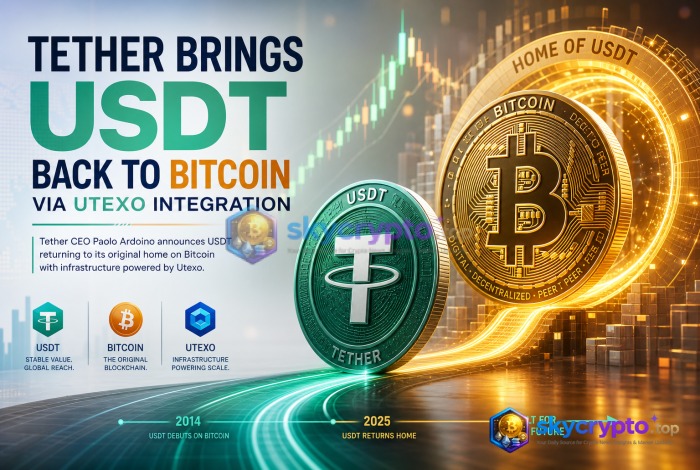
Tether Chief Executive Officer Paolo Ardoino announced the homecoming of the world's dominant stablecoin to the Bitcoin network this month. Backed by infrastructure firm Utexo, USDT will return to the original blockchain where it debuted in 2014 before migrating to alternative networks like Ethereum and Tron.
This strategic integration relies on the RGB protocol and client-side validation to enable private transfers, native swaps, and direct lending using Bitcoin as collateral. The move connects the nearly $190 billion stablecoin supply directly to the premier cryptocurrency network, shifting the operational landscape for liquidity providers.
- Tether's USDT is returning to the Bitcoin network through infrastructure provider Utexo.
- Utexo raised $7.5 million and secured commercial licensing to issue USDT on Bitcoin using the RGB protocol.
- The integration introduces client-side validation, keeping transaction data off the public Bitcoin ledger.
- Primary use cases include private USDT transfers, direct native BTC-to-USDT swaps, and unwrapped bitcoin lending collateral.
Market Reaction
Market participants greeted the announcement with intense speculation regarding liquidity flows across decentralized finance networks. Traders immediately began assessing how native stablecoin issuance on Bitcoin might siphon liquidity away from Ethereum and Tron, where transaction fees and congestion frequently frustrate high-frequency participants. Speculative capital chased infrastructure tokens associated with Bitcoin scaling layers, while major derivatives desks noted an uptick in inquiries concerning native Bitcoin yield generation.
Sentiment across retail and institutional trading desks remains broadly optimistic about expanding utility on the Bitcoin base layer. Analysts point out that traders often prefer keeping capital within the Bitcoin ecosystem rather than bridging assets to alternative networks carrying bridge-hacking vulnerabilities. Order books on localized decentralized exchanges began pricing in the anticipation of direct swaps, signaling a structural shift in how traders manage cross-asset exposure.
Volatility metrics for secondary Bitcoin layer tokens experienced sharp intraday spikes as market makers positioned themselves ahead of the official rollout. While spot price action for bitcoin itself remained tethered to broader macroeconomic data releases, the derivatives market reflected growing interest in yield-bearing products tied to native bitcoin collateral. Traders are aggressively modeling the cost savings of eliminating wrapped tokens from their balance sheets.
Why This Happened
The strategic return to Bitcoin stems from Tether's deep-rooted institutional philosophy regarding asset security and monetary sovereignty. Tether holds approximately 100,000 bitcoin valued at roughly $8.4 billion on its balance sheet, treating the asset as a core stability haven alongside physical gold. Bringing USDT back to the network aligns corporate treasury holdings with operational product offerings, completing a circular vision that began on the Omi protocol more than a decade ago.
Technological maturation catalyzed this integration, specifically the deployment of the RGB protocol and client-side validation frameworks. Traditional account-based architectures on competing networks expose every transfer detail on public ledgers, creating privacy hurdles for enterprise users. Utexo solved this bottleneck by anchoring ownership in unspent transaction outputs while keeping transaction payloads entirely off-chain between participating counterparties.
Commercial demand for confidential settlement rails accelerated the timeline for this deployment. Institutional trading desks require privacy guarantees that match traditional financial markets without sacrificing the settlement finality inherent to proof-of-work systems. By leveraging Bitcoin's robust security assumptions, Tether positions its flagship product to capture institutional volume seeking regulatory clarity paired with cryptographic discretion.
Institutional and Whale Activity
Large-scale holders and corporate treasuries are actively evaluating the credit implications of native bitcoin lending mechanisms. Previously, participants had to wrap bitcoin into tokens like WBTC to access decentralized finance liquidity, introducing third-party custodian risks and smart contract attack surfaces. The new infrastructure permits direct collateralization of native bitcoin for USDT loans, bypassing centralized wrapping intermediaries entirely.
On-chain analytics firms report subtle accumulation patterns among early-stage Bitcoin venture funds and infrastructure backers following Utexo's $7.5 million funding round. Whales are positioning capital within channels that support client-side validation protocols, anticipating a surge in transaction volume once API and SDK tools roll out to payment providers and wallet applications. Open interest in Bitcoin futures showed steady growth, correlating with institutional preparations for native stablecoin liquidity.
Liquidity providers on alternative chains are monitoring bridging outflows as capital prepares to migrate toward Bitcoin-native yield opportunities. Market makers managing large books across centralized exchanges are testing API integrations with Utexo infrastructure to ensure seamless arbitrage execution between native assets and traditional stablecoin pools.
Historical Context
When Tether launched on Bitcoin in 2014 via the Mastercoin and Omi protocols, the broader asset class lacked the infrastructure to support high-velocity retail trading. Ethereum subsequently captured the lion's share of stablecoin issuance due to its programmable smart contract environment, followed by Tron due to its high throughput and low gas costs. For over a decade, Bitcoin functioned almost exclusively as a store of value while stablecoin velocity concentrated elsewhere.
Previous attempts to bring tokens to Bitcoin, such as early colored coin implementations or rudimentary counterparty protocols, struggled with scalability, user adoption, and developer mindshare. The Ordinals and Runes craze of recent years proved that Bitcoin users possess an appetite for base-layer issuance, paving the way for more sophisticated financial engineering like RGB and client-side validation.
This transition mirrors the evolution of gold from a passive bullion asset into a rehypothecated monetary instrument in traditional finance. By enabling native lending and private transfers, the Bitcoin network is reclaiming the financial tooling that migrated to alternative chains during the initial decentralized finance boom of 2020.
What Traders Are Watching
- Utexo Rollout Timelines: Specific dates for exchange and wallet API integrations going live this month.
- Volume Migration Metrics: Weekly tracking of USDT issuance volume moving from Ethereum and Tron to Bitcoin-backed channels.
- Collateral Utilization Rates: Growth in native bitcoin lending demand compared to wrapped token alternatives.
- RGB Protocol Adoption: Developer commits and wallet compatibility metrics for client-side validation tools.
- Derivatives Open Interest: Changes in futures positioning as market makers adapt to native cross-asset margin requirements.
Disclaimer: This article is provided for informational and educational purposes only and does not constitute financial, investment, or trading advice. Digital assets carry significant market risk.










Comments
You must be logged in to post a comment.
Login or Register