

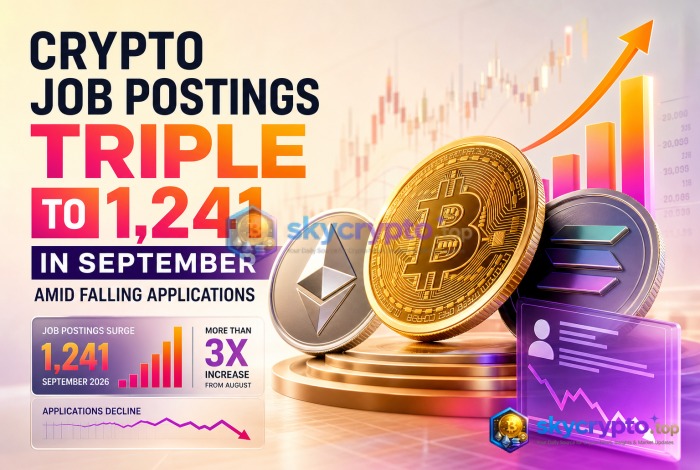
Cryptocurrency companies sharply accelerated hiring in September, posting 1,241 job openings—the highest level seen in 2026 so far, according to data from recruitment platform CryptoJobsList. The surge represents a more than threefold increase from July’s 382 listings and follows a similarly strong August, where 886 roles were advertised. Despite the spike in demand, job applications declined during the same period, signaling tightening competition for talent in the sector.
- Crypto job postings jumped from 382 in July to 1,241 in September.
- Applications fell from 25,700 in July to just under 20,000 in September.
- Finance became the largest job category, ahead of engineering and trading.
- Bitcoin, Ethereum, and Solana were the most sought-after blockchain skills.
- APAC is emerging as a key region for stablecoin integration and regulation.
Market Reaction — Price Action and Trader Sentiment
The sudden surge in crypto hiring activity has injected fresh optimism into market sentiment, particularly among traders and analysts tracking workforce dynamics as a proxy for long-term confidence. While crypto asset prices have remained range-bound since mid-August, the uptick in job listings suggests that firms are preparing for renewed growth, potentially anticipating improved macroeconomic conditions or regulatory clarity. Traders on social media platforms like X and Reddit have interpreted the data as bullish, noting that companies typically expand teams ahead of product launches or market expansions.
On-chain data shows minimal movement in major tokens over the past week, but futures markets have seen increased positioning in altcoins tied to hiring trends, such as those involved in decentralized finance (DeFi) infrastructure and Layer 2 scaling solutions. The divergence between rising job demand and falling applications has raised concerns about wage inflation, which could impact profit margins for smaller startups. Meanwhile, institutional desks are reportedly increasing allocations to crypto-focused venture funds, reinforcing the perception that the industry is gearing up for another leg of development.
Why This Happened — Catalyst and Macro Backdrop
Several factors appear to be driving the sharp rise in crypto job postings, including a stabilization in token prices after months of volatility and renewed interest from traditional financial institutions exploring digital asset adoption. The Federal Reserve’s pause on rate hikes earlier this year reduced uncertainty in global markets, encouraging risk-on behavior across tech sectors, including blockchain-based companies. Additionally, recent regulatory developments in the U.S., EU, and Asia have clarified operational frameworks for digital assets, making it easier for firms to scale operations without fear of sudden enforcement actions.
Another contributing factor is the growing emphasis on stablecoin integration within legacy banking systems. As central banks worldwide explore central bank digital currencies (CBDCs), private-sector stablecoin issuers are racing to build compliant infrastructure and expand their teams accordingly. This trend is especially pronounced in APAC, where countries like Singapore and Japan are leading the charge in formalizing stablecoin regulations. The convergence of these macroeconomic and geopolitical shifts has created a fertile environment for expansion, prompting firms to secure top-tier talent well before launching new products or entering new markets.
Institutional and Whale Activity — Large Player Moves and On-Chain Trends
Data from blockchain analytics firm Chainalysis indicates that large holders—or whales—have been relatively inactive in terms of transferring coins, suggesting they may be holding steady amid price consolidation. However, there has been a notable increase in smart contract deployments related to hiring platforms and HR tools built on Ethereum and Solana blockchains, reflecting internal investments by major players to streamline recruitment processes. Publicly traded crypto firms such as Coinbase and Ripple have also disclosed plans to add dozens of new roles in engineering, compliance, and business development divisions over the coming quarters.
Futures markets show mixed signals, with open interest in Bitcoin ETF options fluctuating slightly while altcoin contracts—including those linked to DeFi protocols—have experienced modest inflows. Notably, several Layer 1 networks have announced strategic hires in legal and compliance departments, aligning with broader industry efforts to meet evolving regulatory standards. These moves underscore a shift toward institutional-grade governance structures, further legitimizing the space and attracting experienced professionals from traditional finance backgrounds.
Historical Context — Comparing to Prior Cycles
The current hiring boom mirrors patterns observed during previous bull runs, particularly the late 2020 to early 2021 cycle when Ethereum-based projects dominated talent acquisition. During that period, job listings surged alongside rising token values, driven by retail speculation and massive inflows into initial coin offerings (ICOs). Today’s landscape differs in key respects: instead of ICO mania, the focus has shifted to sustainable business models grounded in real-world utility, such as cross-border payments, tokenized securities, and enterprise-grade custody solutions.
In contrast, the 2022 downturn saw widespread layoffs following the collapse of TerraUSD and Three Arrows Capital, resulting in a sharp contraction in job openings. Now, with many surviving firms flush with capital raised during the previous cycle, they’re positioned to rehire aggressively while competitors remain cautious. Unlike past recoveries, however, today’s hiring is concentrated in specialized areas like risk management, cybersecurity, and regulatory affairs—indicating a maturation of the industry beyond pure speculative growth.
What Traders Are Watching — Key Levels and Upcoming Catalysts
- $60,000 BTC Support: A break below this psychological level could signal short-term bearish momentum.
- Ether Staking Yields: Changes in ETH staking returns influence investor appetite for DeFi assets.
- Stablecoin Reserve Growth: Increases in USDT and USDC reserves often precede bullish phases.
- Q4 Regulatory Deadlines: New frameworks in Europe and Asia may unlock fresh institutional flows.
- AI + Blockchain Integrations: Projects combining AI with distributed ledger tech are attracting premium valuations.
Disclaimer: This article is provided for informational and educational purposes only and does not constitute financial, investment, or trading advice. Digital assets carry significant market risk.


Comments
You must be logged in to post a comment.
Login or Register