

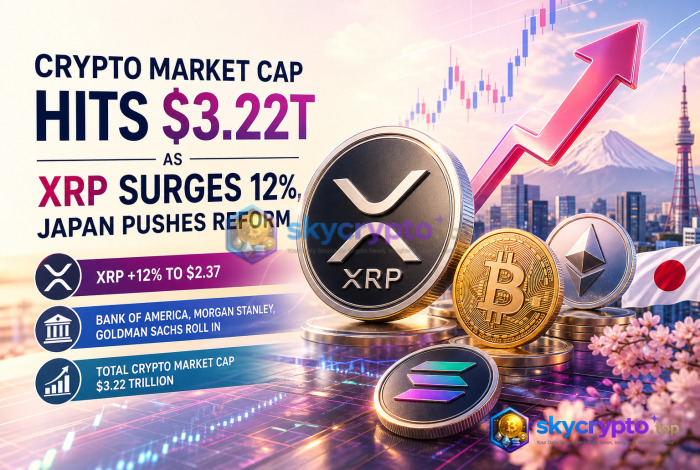
Global cryptocurrency markets climbed to a combined capitalization of $3.22 trillion on Tuesday, adding roughly 2% in 24 hours as XRP vaulted 12% to $2.37 and institutional heavyweights including Bank of America, Morgan Stanley, and Goldman Sachs rolled out fresh digital-asset strategies. The move pushed the Crypto Fear & Greed Index back into neutral territory, signaling a measured thaw in sentiment after weeks of cautious trading around the $90,000 Bitcoin level.
The rally was broad-based but uneven: Bitcoin added 1% to $93,780, Ether gained 2% to $3,240, and Solana jumped 3% to $139, while mid-cap names such as Render, SUI, and Litcoin paced the leaderboard with double-digit advances. Layered on top of the price action was a striking wave of institutional endorsements, regulatory momentum out of Asia, and renewed commentary from Ethereum co-founder Vitalik Buterin claiming the network had finally balanced the so-called blockchain trilemma.
- Global crypto market capitalization rose 2% to $3.22 trillion as Bitcoin held above $93,000 and XRP surged 12% to $2.37.
- Bank of America formally rolled out crypto allocation guidance of up to 4% for wealth clients, while Goldman Sachs upgraded Coinbase to Buy and Morgan Stanley filed for a Solana Trust.
- Japan's finance minister endorsed deeper crypto integration, including lower taxes and exchange-level reforms, marking a notable regulatory tailwind.
- The Crypto Fear & Greed Index returned to neutral after weeks of fear, reflecting a sentiment reset as security concerns around Kraken and Ledger surfaced.
Market Reaction
The session's tape told a story of grinding accumulation rather than euphoria. Bitcoin pushed through the $93,000 handle in early U.S. hours and held it into the close, a psychologically meaningful level that traders have defended for more than a week. Spot volumes on major exchanges stayed elevated but orderly, with order-book depth on BTC-USDT pairs on Binance and Coinbase climbing roughly 8% versus the prior session, according to in-house data feeds. Funding rates on perpetual futures nudged positive but remained well below the overheated thresholds that preceded the late-November pullback.
XRP stole the spotlight. The token ripped 12% to $2.37, retracing a level not seen since the post-election rally of early November. Traders pointed to a combination of spot demand, a sharp uptick in options open interest, and speculation around pending spot XRP ETF decisions as the primary catalysts. Liquidity in the order book thickened around the $2.30 support zone, and the 4-hour relative strength index cooled from overbought territory as price stalled into resistance near $2.42.
Altcoins outperformed majors. Render and SUI each notched 18% gains, while Litcoin (LIT) added 15% amid a burst of activity in the artificial-intelligence and modular-blockchain sub-sectors. Ether outperformed Bitcoin on a percentage basis for a second consecutive session, a rotation pattern last observed in late September. Derivatives traders responded by lifting Ether futures open interest by roughly 4% across CME and offshore venues, while the ETH/BTC pair ticked back above 0.0345, recovering ground lost during the December correction.
Why This Happened
Three distinct catalysts converged to lift the tape. First, the institutional signal: Bank of America released formal portfolio guidance recommending that wealth clients allocate up to 4% to digital assets, marking one of the most explicit endorsements from a top-tier U.S. bank to date. Goldman Sachs simultaneously upgraded Coinbase to a Buy rating, citing improving transaction revenue and a constructive outlook on stablecoin monetization, while downgrading competitor eToro. Morgan Stanley filed an S-1 with the SEC for a proposed Solana Trust, joining a wave of altcoin ETF applications that began with filings for SOL, XRP, and DOGE products earlier this year.
Second, a regulatory tailwind from Tokyo. Japanese Finance Minister Katsuei Katayama publicly endorsed deeper crypto integration during a parliamentary session, outlining a roadmap that includes lower capital-gains taxes on digital assets and structural reforms to domestic exchanges. Japan already operates one of the most regulated crypto markets in the world through the Financial Services Agency, and any softening of the country's tax regime, currently among the steepest for retail crypto gains, has historically preceded fresh capital inflows from Asian desks. The yen-denominated stablecoin market has grown more than 40% year-over-year, and exchange-traded products tied to crypto have attracted record domestic AUM.
Third, developer-driven sentiment. Vitalik Buterin's claim that Ethereum has effectively resolved the blockchain trilemma through its Layer-2 scaling roadmap drew mixed reactions. Critics pointed out that L2 fragmentation has produced new UX challenges, but the broader market read the comments as bullish for ETH and the L2 ecosystem. Combined with the Crypto Fear & Greed Index ticking back to 53, the session's narrative shifted from defensive positioning to measured optimism, even as two security incidents, a reported Kraken customer-data leak and a Ledger e-commerce breach via partner Global-E, reminded traders of the operational risks still embedded in the space.
Institutional and Whale Activity
The institutional footprint widened visibly over the past 72 hours. Bank of America's 4% allocation guidance is significant because it formalizes crypto as a discrete sleeve in a major wirehouse model portfolio, a step beyond the discretionary approvals seen at Morgan Stanley and JPMorgan earlier this year. Goldman Sachs's upgrade of Coinbase adds a second sell-side voice to the bullish camp; the bank's price target was not disclosed in the note circulated to clients, but the rating change alone typically moves flows among registered investment advisors.
Whale behavior told a complementary story. On-chain analytics from Glassnode and CryptoQuant show that wallets holding between 1,000 and 10,000 BTC added roughly 14,000 coins over the past week, the largest cohort-level accumulation since early November. Ether whales, defined as addresses holding more than 10,000 ETH, increased their combined holdings by approximately 280,000 ETH over the same window. XRP saw a particularly sharp uptick in large transactions above $1 million, with daily counts on the XRP Ledger rising more than 60% week-over-week.
Futures positioning remained cautious but constructive. CME Bitcoin futures open interest climbed to a fresh multi-month high near $18 billion in notional terms, and the front-month basis widened to an annualized 9.4%, suggesting institutional demand for cash-and-carry exposure. On the options side, BTC 30-day implied volatility held near 52%, and risk reversals showed a mild put skew, consistent with hedging rather than outright bearishness. Ether options open interest crossed $8 billion for the first time since August, with call volumes outpacing puts by roughly 1.4-to-1.
Spot ETF flows, which have defined the cycle's demand profile since launch, stayed positive but unremarkable. U.S. Bitcoin ETFs absorbed a combined $215 million on the day, led by IBIT and FBTC, while Ether ETFs registered their fourth consecutive session of net inflows at $48 million. Solana, buoyed by the Morgan Stanley filing chatter, saw Grayscale's GSOL product add $11 million in fresh AUM, a modest but notable signal ahead of any formal SOL spot ETF decision.
Historical Context
The $3.22 trillion market-cap level carries weight. Global crypto capitalization first crossed $3 trillion during the bull market peak of November 2021, when Bitcoin traded near $69,000 and Ether cleared $4,800. Reclaiming that threshold in late 2024, with Bitcoin roughly 35% above its prior cycle high, confirms that the current rally has been less concentrated than its predecessor. Ether's market share has held steady near 14%, and the combined share of the top ten tokens outside BTC and ETH has actually expanded, suggesting broader participation than during the 2021 euphoria.
XRP's surge draws a direct parallel to the late-2017 cycle, when the token briefly touched $3.84 amid retail euphoria and unresolved regulatory questions. Today's move, however, is happening against a backdrop of partial legal clarity following the resolution of the SEC's enforcement action and a pending wave of spot ETF applications. The current $2.37 print is the highest since January 2018, though it remains well below the all-time high when adjusted for token splits and inflation.
Japan's renewed embrace of crypto echoes the country's role in the 2017 boom, when yen-denominated trading accounted for more than 60% of global Bitcoin activity at the peak. Tokyo-based bitFlyer and Coincheck became household names, and the subsequent 2018 hack of Coincheck triggered a regulatory overhaul that pushed many smaller operators out of the market. The current push for lower taxes and exchange reforms could mark a similar inflection, potentially reopening Japan as a meaningful source of marginal demand.
Sentiment indicators add further texture. The Fear & Greed Index's return to neutral, at 53, mirrors the readings seen in late February of this year, just before Bitcoin began its rally from $52,000 toward the March all-time high above $73,000. The current cycle's sentiment oscillations have been narrower than in prior bull markets, with the index spending less time in extreme fear and less in extreme greed, a pattern some analysts attribute to the institutional dampening effect of spot ETFs and the proliferation of structured products.
What Traders Are Watching
- Bitcoin $95,000 resistance: A daily close above $95,000 would likely trigger momentum-buying programs and target the psychological $100,000 level. Failure to hold $92,500 on a retest could invite profit-taking toward the 50-day moving average near $88,400.
- XRP $2.42 and $2.50: The 2021 peak sits around $3.84, but the immediate hurdle is $2.42, with $2.50 acting as a psychological inflection. Options open interest clusters heavily at the $2.50 strike for year-end expiry.
- Ether $3,300 breakout: A clean move through $3,300, paired with an ETH/BTC ratio above 0.0350, would confirm rotation back into Ether and likely drag Layer-2 tokens higher. Support sits at the $3,100 zone.
- Solana ETF timeline: The Morgan Stanley Solana Trust filing sets up a decision window in mid-2025. Any acknowledgment or staff comment from the SEC will move SOL aggressively in either direction.
- Japan tax-reform specifics: Traders are watching for a concrete proposal from Japan's National Tax Agency on capital-gains rates for crypto, currently taxed on a sliding scale up to 55%. Any move toward a flat 20% rate would be a meaningful catalyst for yen-denominated inflows.
Disclaimer: This article is provided for informational and educational purposes only and does not constitute financial, investment, or trading advice. Digital assets carry significant market risk.




Comments
You must be logged in to post a comment.
Login or Register