

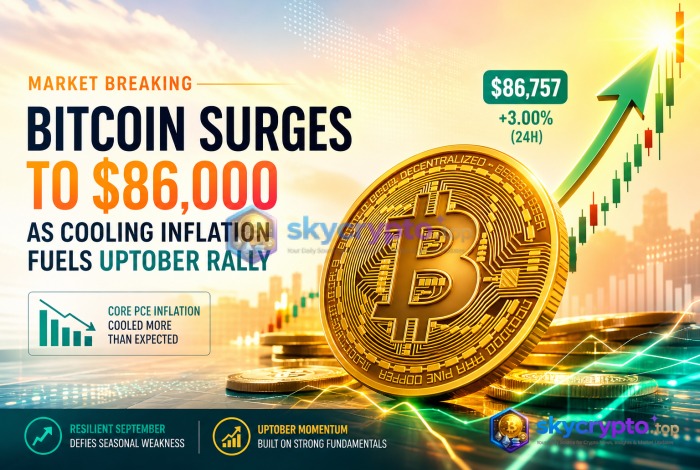
Bitcoin climbed to $86,757 on Friday, marking a 3% gain over 24 hours and capping a resilient September that defied traditional seasonal weakness. The sudden upward push was sparked by lower-than-expected core PCE inflation data, which prompted market participants to dramatically reprice expectations for the Federal Reserve’s upcoming policy decisions. With interest rate futures now pricing in a high probability of a Fed pause on October 28, the flagship cryptocurrency expanded its weekly gains to 2% while breaking out of a tight trading range.
- Bitcoin reached $86,757 following a cooler August core PCE inflation print of 3.0%, shifting Federal Reserve rate pause expectations to nearly 75%.
- Institutional demand rebounded sharply, with spot Bitcoin ETFs absorbing $2.65 billion in September and driving third-quarter total net inflows to $6.34 billion.
- Slowing payroll growth and downward employment revisions have heightened debates around labor market softness ahead of the October 14 CPI print.
Market Reaction
Bitcoin displayed aggressive buying pressure through Friday's trading session, surging past structural resistance to reach $86,757. The move represented a 3% surge over a 24-hour window and pushed seven-day performance into positive territory at 2%. This price expansion successfully extended gains from a surprisingly firm September performance, historically known as a difficult calendar month for digital assets. Despite this upward trajectory, the digital currency still trades roughly 31% below the record high registered one year ago, highlighting both the scale of the past year's market correction and the scope for potential recovery.
Derivatives desks reported a pronounced short squeeze as spot prices cleared recent overhead supply. According to trading firm analysts, high Treasury yields had previously capped Bitcoin within a well-defined consolidation band. Once prices breached this technical range, systematic buy stops and short-covering orders triggered a cascade of forced buying. Traders who had built defensive positions around the lower bound were caught flat-footed, accelerating the momentum toward the $86,000 handle and forcing liquidity providers to adjust order books higher across major international exchanges.
Sentiment across order books has tilted decisively bullish, though underlying positioning metrics present a nuanced picture. Analysis from digital asset brokerage Nexo revealed that futures open interest dropped roughly 12% from its September 22 peak, placing margin metrics in the bottom decile of its one-year historical band. This reduction suggests the recent price rally was driven primarily by spot demand rather than speculative borrowing. Meanwhile, options market metrics reflect a balanced setup, where market participants maintain downside protection at $80,000 while aggressively buying call options targeting the $89,000 to $92,000 price window.
Why This Happened
The immediate catalyst for the sudden repricing was Wednesday's release of the August Personal Consumption Expenditures (PCE) price index. Core PCE, the Federal Reserve’s preferred measure of underlying inflation, cooled to 3.0% year-over-year, coming in noticeably below consensus forecasts of 3.3%. This downside surprise provided immediate relief to risk assets, as lower inflationary pressures afford central bankers room to halt monetary tightening. Market participants swiftly adjusted their macroeconomic projections, shifting away from aggressive rate-hike scenarios that had weighed heavily on financial markets throughout the quarter.
Expectation shifts were reflected across interest rate markets. CME FedWatch data indicated that the implied probability of the Federal Reserve holding interest rates steady at its October 28 meeting surged to 74%, up dramatically from 35.8% just one week prior. Prediction markets echoed this sentiment, with traders on the Myriad platform pricing a pause at 75%, a stark departure from the evenly split probabilities recorded as recently as late September. Speeches from central bank officials reinforced this cautious sentiment; New York Fed President John Williams indicated there was no pressing urgency for immediate policy actions, while Vice Chair Philip Jefferson stressed that future adjustments would remain strictly data-dependent.
The macroeconomic backdrop received further complexity from conflicting labor market indicators. Earlier in the week, initial jobless claims dropped to 197,000 for the week ending September 26, while ADP private payrolls added 90,000 jobs, topping forecasts. However, Friday's official Bureau of Labor Statistics nonfarm payroll report painted a starkly softer picture, showing only 29,000 jobs created in September against expectations of 90,000. Combined with downward revisions of 60,000 jobs for July and August, the unemployment rate ticked up to 4.2%. This divergence between cooling inflation and weakening employment data strengthens the argument for a central bank pause while raising broader questions regarding macroeconomic growth.
Institutional and Whale Activity
Institutional appetite for digital assets demonstrated renewed strength throughout the third quarter, providing structural capital support to the spot market. Data from SoSoValue reveals that spot Bitcoin exchange-traded funds (ETFs) logged $2.65 billion in net inflows during September. While this figure trails the record $3.52 billion recorded in August, it completes a solid quarterly performance of $6.34 billion. Aggregate net assets held across these vehicle products now stand at $109.3 billion, reflecting a massive concentration of institutional capital across institutional asset management platforms.
The third-quarter surge effectively reversed significant capital redemptions recorded earlier in the year. Spot vehicles suffered net outflows of $4.97 billion in the second quarter and $490 million in the first quarter, leaving total net inflows for 2026 just under the $1 billion threshold. Analysts emphasize that the recent acceleration in buying occurred despite 10-year Treasury yields pushing above 5%, a level traditionally restrictive for non-yielding risk assets. This persistent intake indicates that institutional capital allocations are driven by long-term strategic mandates rather than short-term yield differentials.
A prominent illustration of this institutional adoption is Morgan Stanley's spot ETF, which accumulated more than $200 million in inflows over the past month alone. Market commentators note that the integration of crypto investment vehicles into traditional wealth management distribution networks marks a structural evolution in asset allocation. Furthermore, analysis of daily flow trends reveals positive net inflows in 10 of the last 11 trading sessions, totaling nearly $3 billion. However, some industry executives urge caution, pointing out that as major institutions acquire positions at elevated price tiers, the potential for explosive upward velocity might moderate compared to earlier market cycles.
Historical Context
October has historically served as a strong calendar month for digital asset performance, giving rise to the widespread market narrative referred to by traders as "Uptober." Quantitative performance data over the past decade demonstrates that October yields an average gain of 18% for Bitcoin, frequently kicking off multi-month structural rallies. The broader fourth quarter has generated an average return of 46% over the same ten-year period, making it statistically the most profitable stretch for the asset class across macroeconomic cycles.
The current market setup shares key structural similarities with previous post-halving transition cycles, where extended periods of summer consolidation gave way to fourth-quarter expansion. In prior cycles, periods characterized by low margin exposure in derivative markets combined with rising spot accumulation paved the way for sustained trend developments. With options skew currently indicating strong demand for $89,000 to $92,000 call strikes, professional trading desks appear to be positioning for historical seasonal patterns to repeat over the coming weeks.
Nevertheless, macro conditions present distinct headwind factors that separate this cycle from previous environments. The 10-year Treasury yield remains near its highest levels since 2002, creating an elevated risk-free benchmark that penalizes risk-seeking capital. Furthermore, central bank projections maintain the possibility of one final rate increase before the end of the year if inflation prints reverse course. While seasonal patterns provide a strong historical tailwind, traders remain aware that sudden macroeconomic shifts could interrupt the traditional fourth-quarter expansion.
What Traders Are Watching
As Bitcoin consolidates near the $86,000 level, market participants are watching key technical hurdles and economic data releases that will dictate the market's trajectory heading into late October. Liquidity clusters and options open interest concentrations outline critical boundaries for short-term price discovery, while macroeconomic data will determine whether the Federal Reserve validates current rate-pause expectations.
Desk analysts emphasize that significant sideline capital remains available, waiting for confirmation of a favorable monetary backdrop. A continued softening of macroeconomic figures without severe employment destruction could trigger rapid capital deployment across major crypto assets. Conversely, unexpected inflation spikes would likely reignite rate-hike fears, re-establishing high Treasury yields as a dominant headwind for digital assets.
Key levels and catalysts include:
- $80,000 Support Band: Heavy options put volume forms a significant structural floor, making this a critical line of defense for buyers during any pullbacks.
- $89,000 to $92,000 Resistance Zone: A major cluster of call options contracts concentrated in this region represents the immediate target zone for momentum traders looking for a breakout.
- October 14 CPI Release: The upcoming Consumer Price Index report will provide vital insight into inflation trends, directly impacting Federal Reserve rate projections for late October.
- October 28 FOMC Meeting: Central bank interest rate decisions and forward guidance will determine whether borrowing costs remain stable or tick higher.
- 10-Year Treasury Yield Fluctuations: Benchmark bond yields near multi-decade highs continue to act as a primary macro headwind for non-yielding assets like Bitcoin.
Disclaimer: This article is provided for informational and educational purposes only and does not constitute financial, investment, or trading advice. Digital assets carry significant market risk.










Comments
You must be logged in to post a comment.
Login or Register