

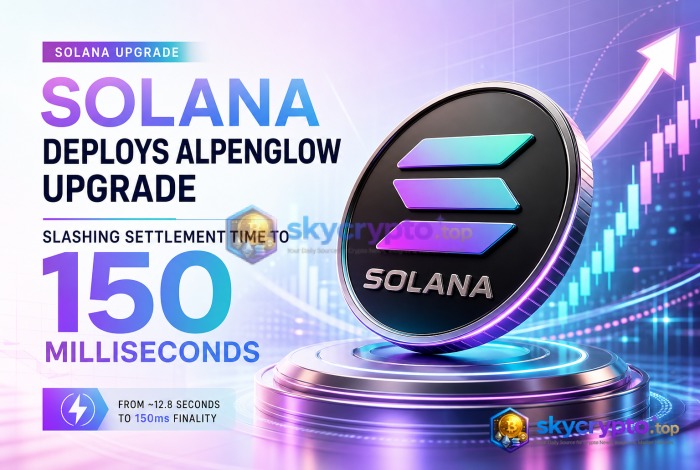
Solana core developers deployed the Alpenglow consensus upgrade to the public developer network on September 25, advancing the network toward sub-second transaction finality. The architecture revision compresses settlement time from roughly 12.8 seconds to a simulated 150 milliseconds by decoupling validator voting messages from regular block production. If executed successfully across mainnet clusters, the overhaul will align the blockchain's operational speed with traditional high-frequency financial venues.
- The Alpenglow upgrade entered devnet testing following its September 24 transition on the stress-focused testnet.
- Validator consensus moves to direct peer-to-peer transmission, shrinking confirmation latency down to an estimated 150 milliseconds.
- Total transaction metrics displayed on data dashboards will register an apparent decline as consensus votes are extracted from standard block space.
- Core developer Anza has not finalized a mainnet deployment schedule, citing ongoing simulation reviews and latency benchmarking.
Market Reaction
Solana traders absorbed the deployment report with calculated optimism, maintaining support above the $145 mark while spot volumes showed disciplined accumulation across major order books. Derivative markets reacted swiftly to the development, with perpetual contract funding rates shifting into positive territory across Binance and Bybit. Speculators interpreted the devnet milestone as concrete progress toward eliminating execution latency, an issue that previously exposed automated trading desks to slippage and toxic order flow during peak volatility.
Options market activity signaled increased demand for out-of-the-money call contracts expiring in the fourth quarter. Traders concentrated open interest around the $160 and $180 strike prices, betting that the compression of settlement times will attract algorithmic liquidity providers who previously hesitated to commit capital to slower layer-1 networks. Implied volatility readings tilted upward, reflecting expectations of sharp price discovery as network validators begin publishing live telemetry metrics from the devnet tests.
Decentralized exchange volumes across the Solana network held steady at $1.8 billion in daily turnover following the announcement. Automated market makers and liquidity pool providers viewed the technical change as an operational boost. Rapid finality shields liquidity providers from the cross-market arbitrage latency that occurs when off-chain centralized exchanges update price books faster than an underlying decentralized ledger can lock in execution balances.
Why This Happened
The push for 150-millisecond settlement stems from fundamental limitations in Solana's legacy consensus pipeline. Under the existing configuration, validators transmit their votes as standard network transactions packed inside newly minted blocks. This structure forces consensus confirmations to compete directly with user transfers, decentralized finance swaps, and non-fungible token mints, stretching final settlement times out to 12.8 seconds through successive confirmation layers.
Anza, the engineering firm stewarding Solana core software development, architected Alpenglow to reroute validator communication into a dedicated peer-to-peer channel. By stripping voting traffic away from user-facing block space, validators reach definitive consensus within one or two communication rounds. This design modification eliminates the need for applications to wait through multiple block cycles before treating deposits, cross-chain transfers, or retail payment settlements as mathematically irreversible.
Macro competition among base-layer protocols also accelerated the engineering schedule. Layer-2 rollups on alternative networks continue to market single-digit millisecond soft confirmations to automated trading firms and institutional payment channels. Solana's engineering leadership recognized that maintaining its market share required bringing deterministic, base-layer finality into direct parity with centralized financial exchange engines, without relying on fragmented off-chain sequencers.
Institutional and Whale Activity
Institutional desks tracked the testnet deployment closely, with on-chain tracing tools revealing large-scale wallet balances consolidating into staking accounts rather than shifting toward exchange deposit addresses. Addresses holding between 100,000 and 1,000,000 SOL demonstrated net accumulation over the 48 hours surrounding the developer network transition. This accumulation signals confidence that the software changes will not jeopardize network continuity or trigger the operational stalls seen during previous developmental phases.
Proprietary trading shops and institutional liquidity syndicates view 150-millisecond finality as a prerequisite for deploying enterprise balance sheets. Market makers operating on central limit order books require rapid settlement guarantees to mitigate adverse selection risks. When finality lags by twelve seconds, market makers must widen their bid-ask spreads to price in the danger that market prices move before a transaction settles. A 150-millisecond settlement cycle permits tighter liquidity spreads, potentially driving higher structural spot trading volume.
Institutional payment rails also stand to benefit from the reduced confirmation window. Payment networks examining public blockchains for merchant settlement require sub-second terminal confirmation to match point-of-sale consumer habits. Corporate treasury desks monitoring the network noted that sub-second settlement eliminates the merchant counterparty risk inherent in accepting zero-confirmation transfers, establishing a credible technical foundation for institutional enterprise pilots.
Historical Context
Solana's performance narrative has undergone multiple revisions since the mainnet beta launched in 2020. The network initially captured market share by promoting raw throughput metrics of thousands of transactions per second. However, persistent congestion episodes in 2022 and early 2023 exposed critical architectural choke points, forcing developers to integrate the QUIC messaging protocol, localized fee markets, and stake-weighted quality of service safeguards to preserve network uptime.
The Alpenglow transition also addresses a long-running statistical controversy surrounding Solana's reported throughput. Historically, public blockchain trackers grouped validator consensus votes alongside legitimate user transactions, inflating raw metrics to several thousand transactions per second while obscuring true organic economic demand. Because Alpenglow strips votes out of user-facing blocks, dashboard readings will inevitably register a sharp drop in headline volume, compelling institutional analytics desks to rely on economic throughput rather than gross message counts.
Past network iterations achieved consensus improvements iteratively, but none targeted the structural latency of finality with this level of aggressiveness. Traditional settlement benchmarks highlight this contrast: Bitcoin demands an average of sixty minutes across six blocks for secure settlement, while Ethereum requires twelve to fifteen minutes to achieve deterministic Casper finality. By dropping confirmation to a tenth of a second, Solana departs completely from standard proof-of-stake finality timelines.
What Traders Are Watching
Market participants are focusing on specific technical indicators, on-chain dynamics, and support barriers as developers analyze data from the dual-network test run. The transition from devnet testing to mainnet deployment requires clean software releases, error-free client coordination, and sustained network stability under simulated load conditions.
- The $162 Technical Resistance: Spot market bulls face a cluster of sell orders around the $162 level, which coincides with the 200-day exponential moving average and represents a critical barrier to reclaiming local summer highs.
- Support Floor at $134: Downside liquidations remain concentrated below the $134 horizontal zone, making this price band a primary defense line for momentum traders should broader market liquidity tighten.
- Developer Network Telemetry Releases: Market makers are tracking Anza's engineering repository for confirmation that test cluster latency matches the projected 150-millisecond simulation under high-concurrency spam tests.
- Data Aggregator API Updates: Traders are monitoring analytics platforms as they separate validator voting overhead from user transactions, guarding against unwarranted algorithmic sell-offs triggered by falling gross transaction totals.
- Mainnet Client Activation Timetable: Attention remains fixed on whether core maintainers greenlight feature flags around the upcoming software releases, offering market participants an official window for the live network rollout.
Disclaimer: This article is provided for informational and educational purposes only and does not constitute financial, investment, or trading advice. Digital assets carry significant market risk.









Comments
You must be logged in to post a comment.
Login or Register