

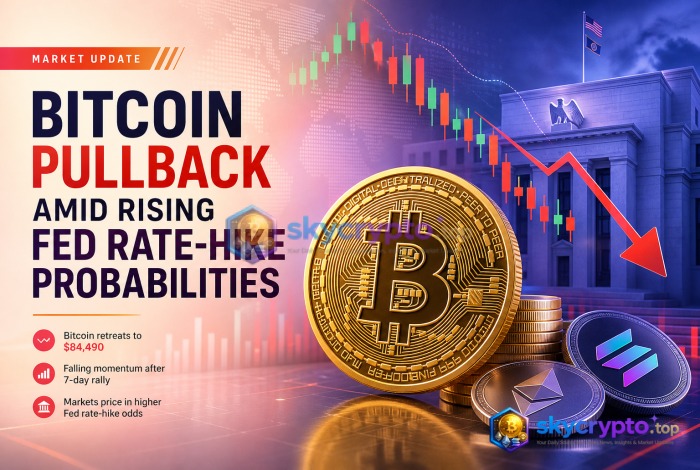
The cryptocurrency market experienced a notable correction on Thursday as Bitcoin struggled to sustain momentum despite a strong seven-day rally. Trading near $84,490, the digital asset retreated from its August milestone of $87,397, reflecting growing skepticism around continued demand. This pullback comes as institutional investors recalibrate their exposure to volatility amid heightened macro uncertainty. With the Federal Reserve hinting at yet another rate increase, Bitcoin's appeal as a yield-generating alternative diminishes, pushing prices lower against a resilient dollar.
- Bitcoin fell to $84,490, breaking below its eight-month high reached earlier in the week.
- Rate-hike probabilities climbed significantly, with October move odds reaching approximately 75% on CME's FedWatch tool.
- Broader crypto market softened as altcoins like Ethereum and XRP also faced downward pressure.
- Institutional positioning shifted toward safer assets due to elevated Fed activity and sticky inflation readings.
- On-chain metrics show reduced whale accumulation, contributing to the broader bearish sentiment.
Market Reaction
Bitcoin's move to $84,490 represented a clear sign that the initial euphoria from the rapid rally had given way to caution. The price action unfolded in stages, with intraday resistance being repeatedly tested and ultimately broken only in limited fashion. Retail and institutional buyers stepped back as the narrative shifted from speculative mania to value-oriented assessment. Volume dried up dramatically compared to the frenzied trading of the previous week, signaling profit-taking across the board. Technical analysts noted that the drop triggered multiple pullbacks along key support levels previously considered critical, forcing many position managers to reassess their risk tolerance.
The trader sentiment reflected this uncertainty, with social media platforms showing increased concern about macroeconomic headwinds rather than underlying technology fundamentals. Many participants cited the combination of sticky core PCE inflation at 3.4% and the anticipation of another rate increase as primary drivers of the sell-off. Short-term traders who had positioned aggressively long on Bitcoin saw their positions taken off the open, creating additional selling pressure. The market's breadth indicator also declined, revealing that not only did Bitcoin retreat but that most altcoins followed suit, compounding the overall bearish shift within the wider crypto ecosystem.
Why This Happened
The catalyst behind Bitcoin's decline lies squarely in the Federal Reserve's evolving monetary policy stance. Rate-hike expectations surged after Wednesday's announcement, which raised the federal funds target to 3.75%-4%. This represents the first increase since July 2023 and signals a renewed commitment to curbing inflation that has shown signs of stubborn persistence. Fed Chair Kevin Warsh emphasized the need for continued policy adjustments as he spoke after the meeting, reinforcing the message that the central bank views inflation as still too high relative to its 2% goal. When markets interpret such guidance through the lens of data, it creates a self-reinforcing cycle of risk-off behavior.
The macro backdrop amplifies the impact of these rate moves. Higher interest rates automatically strengthen the U.S. dollar, making dollar-denominated assets more expensive for holders of foreign currencies. Simultaneously, bond yields rise as borrowing costs climb, offering more attractive fixed-income alternatives. For equity markets, this environment tends to be challenging, but for digital assets like Bitcoin—which lacks intrinsic cash flow—the trade-off becomes particularly painful. Without yield generation, crypto investors face a stark choice between holding volatile assets or moving capital into safer, income-producing vehicles. This dynamic explains why Bitcoin's appeal eroded even as traditional risk assets remained relatively stable.
Institutional and Whale Activity
Large institutional players adjusted their positions in response to the shifting landscape, often executing large orders that contributed to the price decline. Hedge fund managers who had been amassuing Bitcoin for long-term growth began to trim exposures, citing the weakening macro foundation. Similarly, major custody providers witnessed increased redemptions from retail accounts seeking stability. The effect was visible on the order book, where massive sell walls were placed ahead of key technical levels, absorbing buying attempts and driving the price downward further.
On the blockchain level, on-chain analysis revealed diminished whale activity. Large holdings that had accumulated Bitcoin during the earlier surge were gradually sold off, reducing on-chain supply pressure and signaling a retreat from aggressive accumulation strategies. The reduction in whale net purchases marked a turning point, suggesting that even the most influential actors were aligning with the broader trend of de-risking. Exchange reserves also showed a modest decrease in Bitcoin held as collateral, indicating that institutions were unwinding exposure to the asset class. These coordinated movements from both institutional and decentralized pools collectively dragged the market price lower.
Historical Context
Comparing this episode to previous cycles reveals striking parallels. The September 2023 rate hike coincided with Bitcoin struggling to break its previous highs, and that period also saw the asset retreat from above $90,000 territory. In both cases, data-driven concerns about inflation and persistent core PCE readings—whether at 3.4% in late 2024 or higher figures in the preceding cycle—triggered sharp sell-offs. However, the current situation differs in some critical ways. Today's macro environment features an even higher pace of Fed tightening, with the probability of a November or December increase rising well above the levels observed in September. Additionally, global economic uncertainties, including geopolitical tensions and mixed labor market dynamics, add layers of complexity absent in past cycles.
Historically, Bitcoin's behavior during periods of aggressive Fed rate hiking has always been temperamental. During the 2018–2019 tightening cycle and the early 2022 reset, Bitcoin experienced substantial drawdowns even when central banks pursued contractionary policies. The key difference here is the extent and speed of rate increases combined with the real-time monitoring of inflation data. Traders today have more sophisticated tools to model these scenarios, meaning the potential for sharp reversals is even greater. The historical pattern suggests that once the market perceives a sustained path of rate increases, Bitcoin's valuation tends to compress rapidly until new upside catalysts emerge.
What Traders Are Watching
Traders remain vigilant on several key developments that could either reverse the downturn or deepen the correction. First, watch for changes in the FedWatch Tool as new data points come in; a significant spike in October or December rate-hike odds would likely reignite bullish sentiment. Second, the directional movement of the 25-day moving average is critical—if it breaks below the current price, it would confirm a longer term weakness. Third, any surprise release from the Bureau of Labor Statistics showing an acceleration in inflation would trigger immediate repricing of the rate-hike outlook. Fourth, on-chain metrics such as exchange outflows and the hash rate are closely monitored, as declining exchange reserves might indicate capitulation among retail holders.
- Bitcoin price action crossing below $82,500 support level on daily candles
- CME FedWatch Tool updating October move probability past the 50% threshold
- Release of Core PCE inflation data showing whether it moves closer to or further from 2%
- Major wallet address activities indicating large-scale sell-offs from exchanges
- Upcoming earnings calls from major spot market participants and ETF issuers
Disclaimer: This article is provided for informational and educational purposes only and does not constitute financial, investment, or trading advice. Digital assets carry significant market risk.




Comments
You must be logged in to post a comment.
Login or Register