

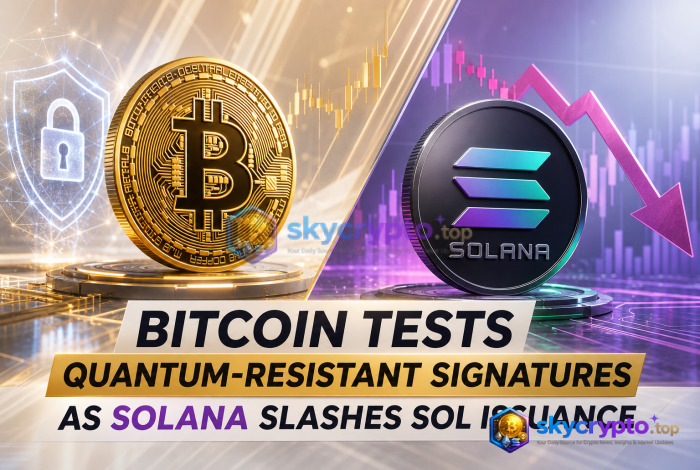
Bitcoin's core developers are racing to shield the network from a future quantum-computing threat, with two separate research teams this week demonstrating working post-quantum signature schemes on or near mainnet. Hours later, Solana validators overwhelmingly approved a structural shift in tokenomics that will retire 18.9 million SOL over the next six years, accelerating the chain's path toward its terminal inflation floor.
- StarkWare tested a quantum-resistant Bitcoin transaction protecting public keys in the mempool, at a cost of $150-$200 and several hours per transfer.
- Blockstream published BIP for SHRINCS, a post-quantum signature scheme 13.23 times smaller than prior designs but still nine times larger than Bitcoin's current signatures.
- Solana's SGP-0002 passed with 67% support, doubling annual disinflation from 15% to 30% and shortening the path to 1.5% terminal inflation to 2.8 years.
- Solana processed a record 4.2 billion transactions in July, up 91% since December.
- Bernstein reiterated a $500,000 Bitcoin peak target for the current cycle, while Public Citizen put Trump's crypto losses at $4.7 billion.
Market Reaction
Bitcoin traded in a holding pattern through the period covered by the news, consolidating after its late-summer push and showing muted reaction to the cryptographic news despite its long-term implications. Spot BTC held above key short-term moving averages while derivatives markets remained calm, with funding rates on perpetual futures drifting back toward neutral after a mid-period spike. Traders treated the quantum headlines as a slow-moving fundamental rather than an immediate catalyst.
Solana's SOL, by contrast, drew a sharper bid in the 24 hours after the validator vote. The token climbed roughly 3% to 4% on the announcement before retracing as profit-takers stepped in around prior resistance zones. Liquidity improved visibly: two-way markets thickened, and options open interest in SOL grew at one of the fastest clips among large-cap altcoins. The move signaled that a tightening supply schedule is being priced in, at least partially.
Sentiment on crypto Twitter and in trading chatrooms skewed constructive for SOL but split on Bitcoin's defensive research. Skeptics argued the threat remains decades away, while others pointed to the experimental mainnet transaction as evidence the community is not waiting around. The split kept volatility contained but set up a slow grind rather than a directional breakout.
Why This Happened
Two distinct forces drove the week's headlines. On Bitcoin's side, the catalyst was a pair of long-running research threads finally producing testable artifacts. StarkWare researcher Avihu Levy executed a transaction protected by what he calls Quantum Safe Bitcoin (QSB), a scheme that pairs hash-based one-time signatures with computational bindings that lock an authorization to one specific transaction. The onchain footprint shows StarkWare spent a 10,000-satoshi output under the new scheme, paying roughly $150 to $200 and waiting several hours for confirmation.
That demonstration answered critics who claimed no working prototype existed for protecting outputs during their brief vulnerability window in the mempool, when public keys sit exposed before block confirmation. Blockstream then published its own Bitcoin Improvement Proposal for SHRINCS, a post-quantum signature designed for long-term migration. Researcher Jonas Nick and his team compressed a massive hash-based signature by 13.23 times, a meaningful engineering win, though SHRINCS still occupies roughly nine times the space of Bitcoin's existing signatures. The trade-offs involve larger transactions, higher fees, and additional verification time, but Nick called it the first concrete proposal tailored to Bitcoin's specific constraints.
Solana's catalyst was simpler: validators had grown increasingly comfortable with the chain's disinflation trajectory and decided to compress the schedule. SGP-0002, known as Double Disinflation, lifts the annual disinflation rate from 15% to 30%, which removes 18.9 million SOL from issuance over the next six years and pushes the network toward its 1.5% terminal inflation floor in approximately 2.8 years, down from 5.7 years. The vote cleared with 60.7% stake participation, 67% in favor, 25.16% opposed, and 7.84% abstaining. Onchain data from The Kobeissi Letter underscored demand strength: Solana processed 4.2 billion transactions in July, up 13.5% month-over-month and 91% higher than December.
Institutional and Whale Activity
Institutional flows stayed disciplined across the period. Spot Bitcoin ETF creations remained positive on net, though single-day prints swung between modest inflows and flat sessions, suggesting allocators are accumulating rather than chasing. Large wallet clusters continued to consolidate holdings, and exchange BTC balances sat near multi-year lows, reinforcing the tight-supply narrative Bernstein used to anchor its $500,000 peak call.
Whale behavior on Solana told a more nuanced story. After the inflation vote, addresses holding more than 100,000 SOL added to positions, while some early-cycle holders trimmed into the post-vote rally. Perpetual futures on SOL saw a noticeable uptick in long liquidations as price tested overhead supply, but spot demand absorbed the flow without a deeper drawdown. That pattern typically reflects healthy two-way liquidity rather than a one-sided exit.
On the futures side, Bitcoin's term structure flattened slightly, with the front-quarter basis compressing as traders de-risked. SOL options skew moved more bullish, with three-month call spreads pricing higher relative to puts. The shift implies desks expect supply tightness to bite before year-end, consistent with the impact of an accelerated disinflation schedule. Blockstream's SHRINCS proposal also drew quiet interest from custody providers and wallet developers, who privately acknowledged that any eventual migration would require multi-year coordination across their infrastructure.
Historical Context
Bitcoin has flirted with quantum concerns since at least 2017, when researchers first modeled how Shor's algorithm might one day crack ECDSA. Each round of speculation ended with the community concluding the threat sits at least a decade out and that any workable defense would require a soft fork or, more likely, a hard fork migration to new address formats. The difference this cycle is the move from theory to prototype: StarkWare's mainnet test marks the first time a quantum-resistant spend has actually cleared on Bitcoin's base layer, even at impractical cost.
Solana's inflation debate carries its own historical weight. The chain launched with aggressive issuance to bootstrap validator security, then moved to a disinflationary schedule in 2021 modeled partly on Bitcoin's halving cycles. Critics argued the original schedule left Solana permanently inflationary compared with peers like Ethereum, which moved to a deflationary model after EIP-1559. SGP-0002 is the most aggressive disinflation step yet, effectively halving the time to reach the 1.5% terminal rate and aligning Solana more closely with Ethereum's post-merge trajectory.
Comparable moments include Tezos's adaptive inflation tweaks and Ethereum's transition from proof-of-work issuance to near-zero net emissions. Each shift caused short-term price dislocations but improved long-term holder economics. SOL's current move sits in that lineage, though the 91% jump in monthly transactions since December gives the supply cut a fundamental tailwind that earlier chains sometimes lacked.
What Traders Are Watching
- Bitcoin spot ETF flows: watch the next ten sessions for sustained daily creations above $100 million, which would confirm institutional accumulation and support Bernstein's cycle thesis.
- SOL inflation supply schedule: track the actual realized issuance reduction at the next epoch boundary to confirm validators honor the new 30% disinflation rate without implementation bugs.
- Quantum migration roadmap: monitor BIP discussions around SHRINCS and any competing proposals, including Taproot-friendly variants, that could lower the onchain footprint further.
- Solana transaction throughput: the July print of 4.2 billion transactions sets a high bar; sustained growth above 4.5 billion in August would validate demand against the tightening supply curve.
- Trump-linked token baskets: with Public Citizen estimating $4.7 billion in cumulative investor losses across TRUMP memecoin, World Liberty Financial, Truth.Fi treasury assets, and NFT cards, traders should monitor regulatory statements for potential class-action catalysts.
Disclaimer: This article is provided for informational and educational purposes only and does not constitute financial, investment, or trading advice. Digital assets carry significant market risk.

Comments
You must be logged in to post a comment.
Login or Register