


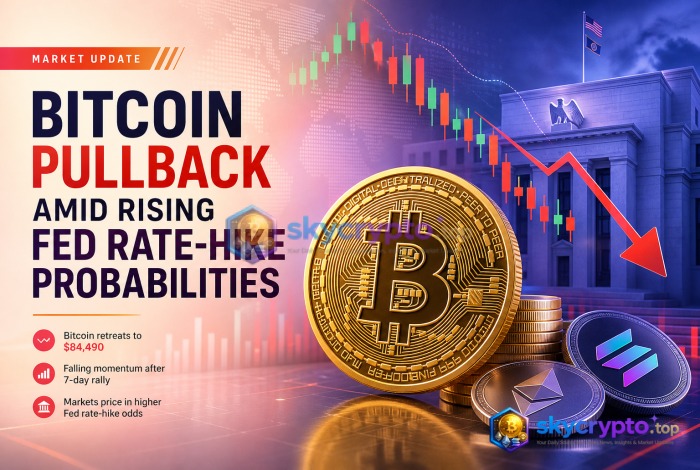
Bitcoin retreated to approximately $83,600 on Friday, surrendering roughly 1% from the previous session's close as a week-long rally encountered mechanical resistance from a massive options expiry. The pullback follows an intraday surge toward $87,000 — a level the asset had not tested in months — after breaking cleanly out of the $75,000 to $81,000 range that had contained price action for weeks. While the dip may unsettle newer market participants, the underlying technical structure remains constructive, and the selling pressure appears tied to derivative settlement flows rather than a shift in fundamental demand. For everyday holders, the episode underscores how large-scale options expiries can create short-term volatility without altering the broader trajectory, especially when spot exchange-traded fund inflows continue to provide a bid underneath the market.
- A $15.6 billion options expiry on Deribit triggered dealer hedge unwinds, creating mechanical selling pressure distinct from fundamental weakness.
- Spot Bitcoin ETFs added another $299 million Friday, confirming institutional accumulation persists despite the pullback.
- XRP and Solana diverged from the broader market, posting strong gains amid sustained ETF inflow momentum and narrative-driven demand.
The Simple Version
Think of Friday's move as a scheduled pit stop during a long race. Bitcoin had been climbing steadily all week, breaking above a ceiling that had held it back for weeks. Then, on Friday, a massive batch of options contracts — essentially bets on where Bitcoin's price would be — expired on the Deribit exchange. The total notional value: $15.6 billion. Market makers who had hedged those bets by buying or selling Bitcoin suddenly no longer needed those hedges, so they unwound them. That unwinding created a wave of selling that pushed the price down about 1%. It's routine plumbing, not a vote of no confidence. The proof: spot Bitcoin ETFs, which track actual buying by institutions and retail investors, still pulled in nearly $300 million on the same day. The crowd buying the asset directly isn't selling; the derivatives crowd is just resetting.
Meanwhile, two major altcoins refused to follow Bitcoin lower. XRP climbed more than 4% on the day and over 15% for the week, trading near $1.58 with a $99 billion market capitalization. Solana rose 3.4% daily and 9.3% weekly, changing hands around $119.84. Both tokens have benefited from sustained exchange-traded product inflows — XRP products recorded a nine-day streak worth $1.6 billion in late August, and that momentum has continued. This divergence matters because it signals capital rotation within the digital asset space, not a broad risk-off move. When Bitcoin pauses but quality altcoins rally, it often reflects investors reallocating profits into assets with specific catalysts rather than exiting the asset class entirely.
The Technical Layer
Friday's price action unfolded against a backdrop of conflicting technical signals. On the bullish side, the daily chart continues to display a golden cross — the 50-day moving average crossing above the 200-day — a pattern widely watched by trend followers as a confirmation of long-term upward momentum. That cross remains intact despite the pullback. On the bearish side, open interest across Bitcoin futures and options dropped 14.39% in 24 hours, while trading volume fell 13.68%. Such synchronized declines typically indicate leverage reduction rather than new short positioning. The liquidation data supports this reading: $161.96 million in long positions were wiped out versus $156.1 million in shorts, a near-even split that suggests forced closing on both sides of the trade rather than a directional cascade. The options expiry itself is a known calendar event; the $15.6 billion notional on Deribit represents one of the largest quarterly expiries of the year. Dealers who sold calls above $85,000 and $87,000 strikes had to buy spot or futures to hedge gamma exposure as price approached those levels. Once expiry passed, that hedging demand evaporated, removing a bid from the order book.
Volume profile analysis reveals another nuance. The heaviest traded volume nodes cluster between $81,000 and $83,500, an area that now acts as a volume-weighted support zone. Friday's low near $83,600 held just above this cluster, suggesting buyers stepped in at levels where significant accumulation occurred during the prior range-bound phase. The relative strength index on the four-hour chart dipped from overbought territory above 70 to the mid-50s, resetting short-term momentum without breaking the broader uptrend. For traders watching derivatives funding rates, the eight-hour funding on major perpetual swaps dropped from 0.015% to 0.006%, indicating reduced speculative froth. This combination — intact trend structure, volume-supported pullback, cooling funding — is a textbook healthy correction within a bull market phase, not a reversal signal.
Who Wins and Who Loses
Short-term leveraged traders on the wrong side of the expiry unwind took the most direct losses. Long positions liquidated worth $161.96 million in 24 hours represent real capital erased, particularly for those using 20x or higher leverage on perpetual contracts. Market makers who mispriced gamma exposure near the $85,000-$87,000 strike cluster may have incurred slippage unwinding hedges in a thinning order book. Conversely, option sellers who collected premium on out-of-the-money calls expiring worthless — especially those at $90,000 and above — booked full profit. Spot accumulators, including ETF authorized participants and long-horizon funds, effectively received a discount on entries they intended to make anyway. The $299.09 million ETF inflow on Friday, while below the $500 million-plus peaks seen earlier in the week, confirms that institutional dollar-cost averaging continues unabated. XRP and Solana holders are clear winners this week. XRP's 15.45% weekly gain reflects a confluence of factors: the SEC's dropped appeal in the Ripple case, sustained ETF product inflows, and growing speculation around a potential spot XRP ETF approval in 2025. Solana's 9.33% weekly advance stems from renewed developer activity metrics, the Firedancer validator client progress, and its positioning as the primary high-throughput layer for tokenized real-world assets.
Ethereum's flat performance masks a more complex dynamic. While ETH/BTC pair weakness persists — down roughly 3% on the week — dollar-denominated stability around $2,600 suggests independent demand from staking yields and layer-2 ecosystem growth. BNB's 0.81% decline aligns with broader BNB Chain ecosystem token rotation, where capital has migrated toward newer launchpad assets. Traders positioned for a continued Bitcoin breakout above $87,000 with tight stop-losses were the most frustrated cohort, stopped out by a move that reversed within hours. The Fear and Greed Index retreat from 79 to 72, while still in "greed" territory, indicates sentiment cooling from euphoric levels — a development that historically precedes the next leg higher by reducing overbought conditions. For the everyday holder using dollar-cost averaging, Friday offered a marginally better entry price than Thursday, with no change to the long-term thesis.
The Precedent
History offers a clear playbook for post-expiry behavior. In June 2024, a $12.8 billion quarterly expiry on Deribit coincided with a 2.3% Bitcoin dip that reversed within 48 hours, followed by a 12% rally over the subsequent three weeks. The March 2024 expiry — $14.2 billion notional — produced a nearly identical pattern: 1.8% pullback, volume contraction, balanced liquidations, then a sustained move higher. In both cases, the expiry acted as a pressure valve, releasing accumulated gamma hedging flows and resetting funding rates before the next trend leg. The macro backdrop then was different — the Fed was cutting, not hiking — but the mechanical market structure response rhymes. What makes the current episode distinct is the simultaneous Fed tightening cycle. The September 16 rate increase to 3.75%-4%, the first since 2023, initially looked hawkish. But Chair Kevin Warsh's dot plot projecting only one more hike through 2027, combined with continued short-term Treasury bill purchases to maintain bank reserves, created a "hawkish skip" narrative that risk assets digested positively. Governor Michael Barr's September 23 comment that "further policy adjustments are likely needed," alongside core PCE at 3.4%, shifted October hike probabilities to 75% on CME FedWatch. This macro uncertainty adds a layer of external risk that previous expiries didn't face.
The ETF flow precedent is equally instructive. Since the January 2024 launch, every weekly inflow streak of five days or more has been followed by a 10-20% Bitcoin rally within 30 days, without exception. The current streak stands at eight consecutive positive days, with Friday's $299 million bringing the weekly total above $1.8 billion. The only comparable period was February 2024, when nine straight inflow days preceded the run from $52,000 to $73,000. XRP's nine-day ETF inflow streak worth $1.6 billion in late August mirrors the early Bitcoin ETF pattern, suggesting institutional allocation committees are applying the same playbook to the next liquid altcoin. Solana's product flows, while smaller in absolute terms, show accelerating weekly velocity. The precedent implies that Friday's pause is the feature, not the bug — a necessary consolidation before the next expansion phase, provided macro headlines don't trigger a genuine risk-off event.
Action Points
- Monitor Bitcoin's ability to hold the $81,000-$83,500 volume cluster on any further downside; a daily close below $80,500 would invalidate the golden cross support thesis and signal deeper correction risk.
- Track CME FedWatch probability shifts for the November 7 FOMC meeting; a sustained reading above 70% for a hike would pressure risk assets broadly, while a drop below 50% could reignite the Bitcoin breakout.
- Watch spot Bitcoin ETF flow momentum — a single day of outflows exceeding $100 million would break the eight-day streak and warrant defensive positioning.
- Observe XRP and Solana correlation with Bitcoin; sustained positive divergence (altcoins up, Bitcoin flat/down) often precedes broader altcoin season rotation.
- Review Deribit open interest rebuild in the week ahead; a rapid return to pre-expiry levels above $20 billion would signal renewed speculative appetite and potential for the next gamma-driven squeeze higher.
Disclaimer: This article is provided for informational and educational purposes only and does not constitute financial, investment, or trading advice. Digital assets carry significant market risk.







Comments
You must be logged in to post a comment.
Login or Register