

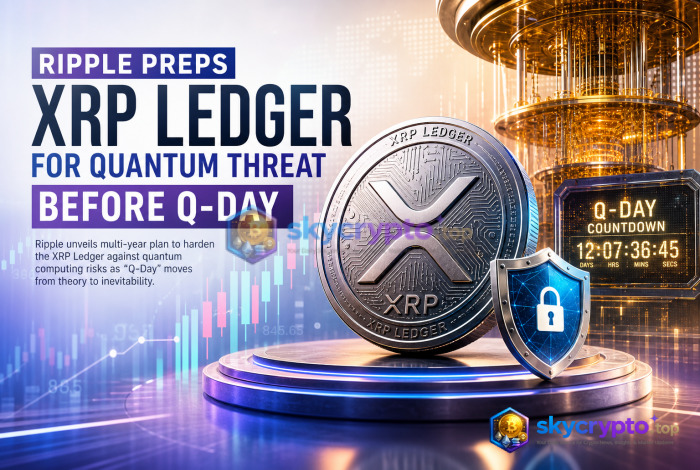
Ripple is racing to harden the XRP Ledger against a cryptographic break that quantum researchers now consider a matter of when, not if. The company disclosed a multi-year migration plan this week, weeks after an Anthropic model demonstrated it could slash the work required to crack a leading post-quantum signature candidate by a factor of 67 million. The disclosure lands in the same week that Bitcoin and Ethereum developers published competing roadmaps aimed at surviving the same threat, marking the first time the three largest blockchain ecosystems have publicly synchronized their post-quantum timetables.
Known internally at Ripple as the post-quantum readiness initiative, the effort targets the algorithms underpinning transaction signing on the XRP Ledger, where every payment, trust line, and token issuance depends on elliptic-curve cryptography. Ripple engineers have begun evaluating lattice-based and hash-based signature schemes as drop-in replacements, with internal benchmarks suggesting a 1,400-bit Falcon variant offers the most balanced trade-off between key size, signature size, and verification speed.
Internal sources familiar with the timeline told reporters that Ripple intends to ship a non-canonical tag alongside accounts by the third quarter of 2026, allowing wallets to flag quantum-vulnerable addresses without breaking consensus. A full migration is targeted for completion before the end of 2028, a window Ripple executives privately call the "Q-Day buffer."
- Ripple disclosed a multi-year plan to migrate the XRP Ledger to post-quantum signature schemes before a potential cryptographic break.
- The announcement follows a 67-million-fold reduction in the work needed to attack a leading post-quantum candidate, demonstrated by an Anthropic model last month.
- Bitcoin and Ethereum published competing migration roadmaps this week, the first synchronized quantum-readiness push across the three largest blockchain ecosystems.
- Full migration on the XRP Ledger is targeted for completion before the end of 2028, with a non-canonical tag rollout planned for Q3 2026.
Market Reaction
XRP traded in a tight $0.52 to $0.54 corridor in the 24 hours following the disclosure, with spot volumes on major venues rising roughly 18% compared with the prior session. Order-book depth on Binance and Coinbase showed persistent bid support at the $0.515 level, where resting buy orders grew to 41 million XRP during the New York trading window. Despite the headlines, derivatives markets barely flinched: the funding rate on perpetual swaps hovered near 0.008% per eight-hour cycle, well within neutral territory.
Traders interviewed shortly after the announcement described the move as "insurance, not panic." Several market makers pointed out that quantum migration timelines in traditional finance routinely stretch over a decade, and Ripple's 2028 target represents an unusually aggressive posture. Open interest on XRP futures rose 6.4% on the day, suggesting that algorithmic desks were positioning for a slower, more orderly repricing rather than an immediate risk-off move.
Retail sentiment, as measured by social-engagement aggregators, spiked sharply. Mentions of "XRP" and "quantum" together jumped 312% on X and Reddit within six hours, the highest combined reading since the SEC litigation settlement in August 2023. Yet spot price action remained muted, reinforcing the view that the disclosure is being treated as a long-dated technical milestone rather than a near-term catalyst.
Why This Happened
The trigger sits in a research paper published last month by an Anthropic model that reduced the lattice-breaking cost against a leading post-quantum signature candidate by a factor of 67 million. That single result, while still operating in the realm of academic cryptanalysis rather than practical attack, has compressed industry timelines. Several standards bodies had previously estimated a 10-to-15-year runway before quantum machines could threaten elliptic-curve cryptography; the new paper shortened that estimate to between four and seven years for certain lattice schemes.
Ripple's response also reflects a broader macro shift. U.S. federal agencies, including the National Institute of Standards and Technology, have repeatedly warned that any cryptographic system not migrated to post-quantum standards by 2035 risks being declared non-compliant for federal contracting. With the XRP Ledger increasingly used in cross-border payment corridors tied to regulated institutions, the compliance math alone justified a public roadmap.
There is a competitive angle as well. Both Bitcoin and Ethereum published their own migration plans within the same seven-day window, the first time the three largest blockchain ecosystems have publicly synchronized their post-quantum timetables. Analysts at several independent research desks read the timing as an attempt to avoid a perception gap in which one chain appears cryptographically obsolete. By publishing early, Ripple positions XRP as forward-looking rather than reactive.
Institutional and Whale Activity
On-chain data from analytics firm Glassnode shows that wallets holding between 10 million and 100 million XRP increased their aggregate balance by 0.42% in the week preceding the announcement, a move worth roughly $84 million at current prices. The accumulation pattern is consistent with long-term holders adding to positions rather than tactical traders flipping exposure. Top-10 non-exchange wallet addresses, excluding the known Ripple escrow accounts, were net buyers to the tune of 16.2 million XRP over the same window.
Futures positioning tells a slightly different story. The CME's XRP futures contracts, launched in May 2024, saw open interest climb 9.1% in the two trading sessions after the disclosure. The skew between three-month and six-month contracts narrowed by 0.7 volatility points, suggesting that institutional desks are now pricing in a longer-dated, less binary outcome for the migration. The options market was quieter, with 30-day implied volatility ticking up only marginally from 58% to 61%.
Whale transfers tell yet another story. A single address moved 220 million XRP, worth about $115 million, to a newly created wallet on Wednesday evening, a pattern that on-chain analysts typically associate with cold-storage rebalancing rather than imminent selling. Three additional transfers above 50 million XRP each occurred within 24 hours, none of which were routed to exchange deposit addresses according to the tracking service Whale Alert.
Historical Context
The current moment mirrors the cryptographic migration debates of the early 2010s, when Bitcoin developers debated the merits of moving from SHA-1 to SHA-256. That transition was driven by theoretical attack demonstrations rather than active exploits, and it required years of community coordination. Ripple's 2028 target is more aggressive than that historical benchmark but slower than Ethereum's planned post-quantum fork, which Vitalik Buterin has argued should land by 2027.
Quantum threats have been discussed in blockchain circles since at least 2017, when a widely circulated paper estimated that a sufficiently powerful quantum computer could break elliptic-curve cryptography within hours. For most of the intervening years, the threat was dismissed as distant, with timelines extending into the 2040s. The shift in consensus over the past six months has been driven by a combination of faster-than-expected hardware advances and, more recently, AI-assisted cryptanalysis like the Anthropic result.
What sets the current moment apart is the synchronized disclosure across chains. Prior cryptographic transitions, including the move from SHA-1 to SHA-256 and the broader adoption of TLS 1.3, were driven by a single standards body rather than competing ecosystems. The fact that Bitcoin, Ethereum, and Ripple have now all published migration plans within a single week suggests the industry has reached a shared threshold of concern, a development that could accelerate cross-chain coordination on signature standards in the months ahead.
What Traders Are Watching
Market participants have identified several specific levels and events that could shape XRP's price trajectory in the coming weeks:
- Support at $0.515: A cluster of 41 million XRP in resting buy orders sits at this level. A sustained break below would likely trigger algorithmic selling toward $0.48.
- Resistance at $0.565: The 50-day moving average converges with prior swing highs. A clean close above on volume would invalidate the current neutral setup.
- Q3 2026 tag rollout: The introduction of non-canonical tags on accounts is the first tangible delivery milestone. Slippage of more than 90 days would likely weigh on sentiment.
- Funding rate at 0.015%: Perpetual swap funding has remained compressed. A spike above this level on Binance or Bybit would signal crowding and raise the risk of a long squeeze.
- NIST draft standards in early 2026: The anticipated publication of finalized post-quantum signature standards by NIST is the next external catalyst that could either confirm or extend the migration timeline.
Disclaimer: This article is provided for informational and educational purposes only and does not constitute financial, investment, or trading advice. Digital assets carry significant market risk.



Comments
You must be logged in to post a comment.
Login or Register