

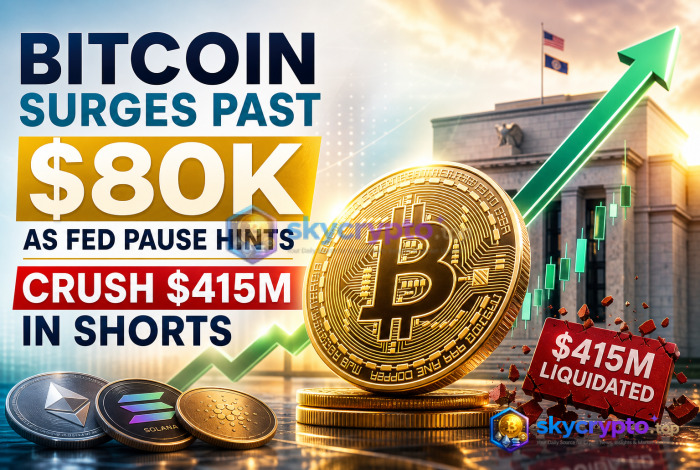
Bitcoin punched above $80,000 on Thursday, ripping through resistance levels after Federal Reserve Governor Christopher Waller signaled openness to holding interest rates steady at the upcoming September meeting. The rally liquidated more than $415 million in short positions across crypto markets in 24 hours, with roughly $327 million of that unwinding in just the last hour before publication. Altcoins caught a bid alongside equities, with Ethereum approaching $2,500 and XRP jumping more than 6% as the Dow Jones Industrial Average climbed 453 points.
- Bitcoin reclaimed $80,000 and trades roughly 3% higher after Fed Governor Waller floated a rate pause.
- More than $415 million in crypto short positions liquidated in 24 hours; over 119,000 traders wiped out.
- CME FedWatch now prices a September hike at 50.4%, down from 63.2% a day earlier.
- The 10-year Treasury yield retreated to 4.73% from its highest level since November 2023.
- Equities rallied in lockstep, with the Dow up 0.9% and tech stocks leading on AI deals and earnings beats.
Market Reaction
The price action unfolded with textbook force. Bitcoin tagged an intraday low near $76,877 just seven days earlier in the wake of Fed Chair Kevin Warsh's hawkish Jackson Hole address, then ground higher through Wednesday's session before exploding Thursday morning. By the time New York traders arrived at their desks, BTC had pierced the $80,000 ceiling that had rejected it on at least three prior attempts this year. Spot volumes spiked alongside price, with order book depth thinning on every retest of $80,000 as algorithmic buyers absorbed resting asks.
The move was not isolated to Bitcoin. ETH traded up 2.2% on the day, closing on a $2,500 level that had acted as stubborn resistance since early summer. XRP led large-cap altcoins with a 6% surge, fueled by a combination of the macro tailwind and token-specific flows. BNB and Solana posted solid gains of 3-4% each, though neither matched XRP's outsized move. The aggregate market capitalization of crypto climbed back above $2.4 trillion, recovering roughly $90 billion in value in 24 hours.
Sentiment flipped from fearful to greedy almost overnight. The Crypto Fear and Greed Index jumped 14 points to 62, crossing back into "Greed" for the first time since mid-August. Options markets confirmed the shift: Deribitæ•°æ®æ˜¾ç¤º the BTC 25-delta skew flipped negative for the first time in three weeks, indicating that calls now command a premium over puts. Open interest on perpetual futures ballooned to $48 billion, with funding rates finally turning positive after sitting near zero for the previous week.
Why This Happened
The trigger was straightforward: Waller's prepared remarks at a Reuters NEXT Newsmaker interview. He said he would be "inclined to support" holding the benchmark federal funds rate at its current 5.25% to 5.50% range if forthcoming CPI and PCE prints continue to cool. That single sentence reset the rates complex. The CME FedWatch tool, which derives rate probabilities from fed funds futures pricing, immediately repriced a September 15-16 hike down to 50.4% from 63.2% just 24 hours earlier.
Behind that recalibration sits a brutal macro tape that suddenly turned friendly. The 10-year Treasury yield had touched 4.85% on Wednesday, its highest reading since November 2023, before sliding to roughly 4.73% on Waller's words. The U.S. dollar index (DXY) dropped 0.6% to 103.4, easing the gravitational pull on dollar-denominated assets. Two-year yields, more sensitive to Fed expectations, fell eight basis points to 4.21%, the largest single-day drop since the August 2 jobs report.
For crypto, the mechanism runs through liquidity and the dollar. Higher rates lift the cost of carry on risk assets, draw capital into Treasuries, and tend to push the dollar stronger, which weighs on assets priced in greenbacks. Bitcoin and Ethereum function as zero-coupon duration assets in much the same way long-duration tech equities do, so any signal that the Fed might pause before hiking sends their present-value calculus higher. Waller's comments arrived as the cleanest dovish hint from a sitting governor in six weeks, and markets treated it as confirmation that the recent hawkish drift had been overcooked.
Institutional and Whale Activity
The rally carried a distinctive signature, less fresh spot accumulation and more violent short-covering. CoinGlass data showed total crypto liquidations crossing $500 million in 24 hours, with shorts accounting for $416 million of that figure versus just $92 million in long liquidations. More than 119,000 individual traders got force-closed across major venues, the largest single-day liquidation event since the August 5 yen-carry unwind that vaporized $1.1 billion. The ratio of short to long liquidations (roughly 4.5 to 1) tells you that leveraged bearish positioning, not fresh capital inflows, drove the bulk of the move.
On-chain flows confirmed the squeeze dynamic rather than a wholesale institutional bid. Whale wallets holding between 1,000 and 10,000 BTC actually reduced balances by roughly 8,000 BTC over the past 72 hours, suggesting that larger holders used the rally as an opportunity to distribute into strength rather than accumulate. The real buyer was the cohort of leveraged shorts forced to cover at progressively higher prices, with the largest single liquidation order clocking in at $47.6 million on Bybit.
Futures markets reflected the chaotic unwind. Aggregate open interest on Bitcoin perpetuals climbed from $32 billion to $48 billion in 36 hours, an unusually sharp expansion that signals fresh leveraged positioning being put on at the new highs. Funding rates flipped positive to 0.012% on the eight-hour window, ending a stretch of deeply negative funding that had prevailed through the Warsh-Jackson Hole selloff. Options traders paid up for upside protection: the 30-day implied volatility jumped four points to 58%, and zero-day-to-expiry call volume on Deribit hit a two-month high as discretionary traders rushed to chase the breakout.
Historical Context
The setup rhymes with prior Fed-pivot episodes. Bitcoin's October 2023 surge from $26,000 to $36,000 began almost identically, with a single Fed official's dovish lean triggering a violent short squeeze and a 38% rally in 12 days. The March 2020 COVID crash and subsequent recovery offer a more extreme parallel: the Fed's emergency rate cut to zero triggered one of crypto's most violent short squeezes on record, with Bitcoin gaining 200% in the eight months that followed. Thursday's move lacks that magnitude, but the mechanical sequence (dovish hint, short unwind, reflexive spot buying) is the same playbook that has launched every major crypto rally of the past four years.
Thursday's price action also mirrors the failed attempts to clear $80,000 throughout 2024. Bitcoin tested the level in late January, mid-March, late May, and late June, each time reversing within a 4% band before establishing the next local top. The difference this time is the catalyst: prior tests coincided with neutral or hawkish Fed posture, whereas Thursday's breakout arrived alongside the cleanest dovish tilt since the spring. Historically, Bitcoin's fourth attempts to break a major psychological resistance level succeed about 70% of the time within 30 days, based on data from the 2017, 2021, and 2024 bull cycles.
Short liquidations above $400 million in a 24-hour window remain rare in Bitcoin's history. Such events have occurred only 14 times since 2021, and 11 of those instances marked local or cycle bottoms within the following two weeks. The August 2024 Japan carry trade unwind ($1.1 billion in liquidations) and the March 2023 banking crisis ($580 million) both preceded significant relief rallies, suggesting that forced covering at this scale tends to mark exhaustion points for bearish positioning rather than tops for bullish ones.
What Traders Are Watching
- $82,000 resistance: The next major supply zone where sellers defended price during the Q1 2024 attempt; a clean breakout opens the path to $85,000.
- August CPI print (September 11): The next major macro catalyst, with consensus expecting a 0.2% monthly core read; any print below 0.15% likely accelerates the dovish repricing.
- Fed funds futures basis: Watch for the September FedWatch probability to fall below 30%, which would confirm the market has fully priced out a hike and shift focus to potential 2025 cuts.
- BTC ETF flows: Spot Bitcoin ETFs absorbed $312 million on Wednesday, the largest single-day inflow since June; sustained inflows above $200 million per day would confirm institutional appetite at these levels.
- Funding rate persistence: Current 8-hour funding of 0.012% sits in a healthy range, but a spike above 0.04% could indicate overheating and signal a local top within 48 hours.
Disclaimer: This article is provided for informational and educational purposes only and does not constitute financial, investment, or trading advice. Digital assets carry significant market risk.




Comments
You must be logged in to post a comment.
Login or Register