

Overview
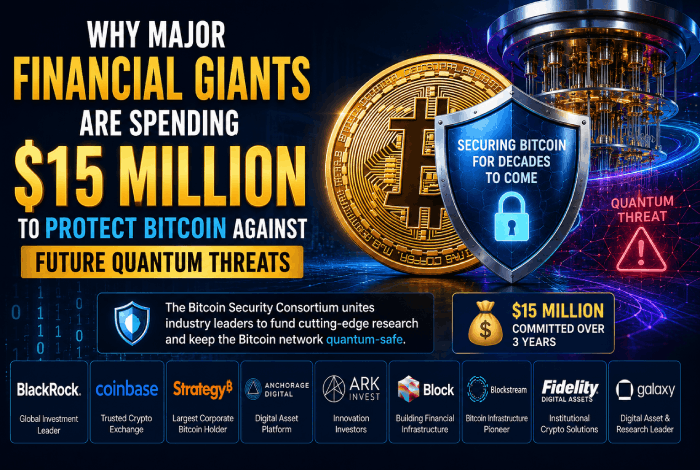
The biggest names in the Bitcoin world have joined forces to fund research that will keep the network safe for decades to come. This group, known as the Bitcoin Security Consortium, includes BlackRock, Coinbase, Strategy, Anchorage Digital, ARK Invest, Block, Blockstream, Fidelity Digital Assets, and Galaxy. Together they have pledged a total of $15 million over three years to support developers and researchers who work on making Bitcoin resistant to a new kind of computer called a quantum computer. The money is not held in a single pot; each company decides where its own contribution goes, focusing on projects that protect the network’s long‑term security.
What Is the Bitcoin Security Consortium
The consortium is a voluntary alliance rather than a formal foundation. Its purpose is to fill gaps in funding for Bitcoin‑related security research, especially work that is not yet covered by existing programs. Because Bitcoin’s development is deliberately slow, many security upgrades take years to move from concept to practice. The consortium’s role is to accelerate that process by providing money for the toughest technical challenges. Mike Schmidt, who currently serves as executive director on a volunteer basis, coordinates day‑to‑day activities. Schmidt also leads Brink, a nonprofit that supports open‑source Bitcoin developers. The consortium does not push for any single change to Bitcoin’s source code nor does it speak for the entire community of developers; it simply offers resources to a wide range of independent researchers and teams.
How the Funding Works
Each member’s $15 million commitment is split among several companies, but the total figure is $15 million when summed together. For example, Strategy, which holds more Bitcoin than any publicly traded company, has pledged a significant portion of that amount. BlackRock, whose iShares Bitcoin Trust ETF now manages billions of dollars in assets, has also contributed. The money is directed by the individual firms to projects they believe are most valuable. This structure preserves each company’s autonomy while pooling expertise and financial strength. The consortium’s members have made it clear that they will not dictate technical decisions; they will simply fund the work that already exists or is emerging in the Bitcoin ecosystem.
Why Quantum Computing Matters for Bitcoin
Bitcoin’s security today is based on a mathematical system called elliptic curve cryptography (ECC). ECC works by generating two keys: a public key that anyone can see and a private key that only the owner knows. When you send Bitcoin, you use the private key to sign the transaction, proving that you own the funds without revealing the key itself. This method has protected Bitcoin for more than a decade, but it relies on the assumption that solving the underlying mathematical problem is practically impossible for conventional computers.
Quantum computers, however, operate on a completely different principle. They use quantum bits, or qubits, which can exist in multiple states at once, allowing them to test many possibilities simultaneously. In theory, a powerful enough quantum computer could reverse‑engineer a private key from its public key in a matter of hours, something that would take a classic computer billions of years. While we are not yet at that point, the progression of quantum hardware is accelerating, and researchers predict that a “quantum‑ready†attack could become feasible as early as 2029.
What Is Post‑Quantum Cryptography
To protect against quantum threats, the Bitcoin community is looking at post‑quantum cryptography (PQC). PQC refers to new mathematical algorithms that remain secure even when an attacker has access to a quantum computer. These algorithms are often based on problems like lattice‑based mathematics, code‑based cryptography, or hash‑based signatures, rather than elliptic curves. The goal is to create digital signatures and key‑exchange methods that cannot be broken by quantum methods while still being practical for everyday use on Bitcoin wallets, exchanges, and mining equipment.
Developing and testing PQC is a slow, meticulous process. Researchers must prove that a new algorithm is mathematically sound, implement it in real software, and then verify that it does not break existing Bitcoin functionality. The consortium’s funding will help cover the cost of these steps, which include hiring graduate students, purchasing computing resources, and organizing conferences where ideas can be shared openly.
Why Some Bitcoin Is Already Vulnerable
ARK Invest conducted an analysis earlier this year and found that roughly 35% of all Bitcoin currently held in wallets might be at risk if a quantum attack becomes possible in the near future. The reasoning is simple: many users store their private keys on devices that could be compromised later, or they keep old software that does not yet incorporate quantum‑resistant defenses. While quantum computers are not yet able to break ECC, the window of opportunity is narrowing. The longer Bitcoin remains without quantum‑ready signatures, the larger the exposed balance becomes.
Galaxy’s Quantum Readiness Initiative
Two days before the consortium announcement, Galaxy made its own commitment public. The firm launched the Bitcoin Quantum Readiness Initiative, allocating up to $5 million in grants for developers working on quantum‑safe solutions. Galaxy also formed a Quantum Advisory Council that brings together academics from institutions such as the University of Calgary and Boston University. The council’s purpose is to provide scientific oversight, review progress, and help translate academic research into practical code that Bitcoin miners, wallet providers, and exchanges can adopt.
In a statement, Alex Thorn, head of research at Galaxy, described a gap between the rapid pace of quantum‑computing research and the slower tempo of Bitcoin development. He argued that institutional investors have a responsibility to help bridge that gap, both by funding researchers and by making the threat understandable to policymakers and other market participants. Whether Galaxy’s $5 million is counted inside the consortium’s $15 million total remains unclear; each member is free to treat its contributions independently.
Company Leaders Weigh In
Phong Le, CEO of Strategy, highlighted the long‑term nature of Bitcoin ownership. “As long‑term holders, we have every incentive to see Bitcoin remain secure for generations,†Le said. “Funding the people who do this work, and helping inform the conversation around it, is a natural way for us to contribute.†BlackRock’s Robert Mitchnick described the effort as filling a funding gap for developers who are already doing critical work. He emphasized that Bitcoin Core developers perform essential tasks that keep the network stable, and the extra funding will help those developers explore quantum‑safe options without worrying about immediate revenue constraints.
At Galaxy, CEO Mike Novogratz framed the initiative as a matter of institutional stewardship. “As leaders in the digital assets space, we believe it's important that we help be part of the solution to any potential threat quantum computing poses to Bitcoin,†he said. Novogratz added that the initiative creates practical steps to research, fund, and support work that keeps Bitcoin secure for the long run. His comments reflect a broader trend among large financial institutions: recognizing that the stability of a cryptocurrency depends not only on market dynamics but also on the underlying technical foundations.
Why This Effort May Take Years
Bitcoin’s development philosophy is deliberately cautious. Any change to the protocol requires consensus among miners, wallet providers, exchanges, and other stakeholders. Introducing quantum‑resistant signatures would need to be tested across thousands of independent implementations, each with its own security considerations. For example, a new signature scheme might work perfectly on a desktop wallet but could be vulnerable when rolled out to hardware security modules used by exchanges.
Furthermore, the process of moving from research papers to widely adopted code is long. Academic breakthroughs often sit in preprint servers for months or years before they are integrated into real software. The consortium’s funding will help shorten that timeline by providing resources for implementation teams, but the overall adoption could still take many years. Industry participants have already expressed the need for a clear roadmap, and the consortium says it will publish regular updates on Bitcoin’s security posture in the coming months.
What a Quantum Attack Could Mean for Users
If a quantum computer could break ECC, the implications would be enormous. A malicious actor could steal Bitcoin from any address whose private key can be derived. This includes not only large exchanges that hold millions of dollars but also individual users who store Bitcoin on personal hardware wallets. Unlike a typical cyber‑theft, which might be prevented by two‑factor authentication or encryption, a successful quantum attack would bypass those protections because it would reveal the private key itself.
However, the threat is still theoretical. Quantum computers today are still in the experimental stage, often requiring extreme cooling and vast amounts of energy. They can solve only very specific problems efficiently, and breaking elliptic curve cryptography is not yet within their capabilities. The work funded by the consortium is aimed at ensuring that when quantum computers become powerful enough, Bitcoin already has defenses in place. This proactive stance mirrors how the financial system prepares for other systemic risks, such as natural disasters or cyber‑attacks.
How Developers Can Apply the Funding
The consortium does not prescribe which projects receive money. Instead, each member decides how to allocate its share. This approach allows flexibility, encouraging innovative solutions that might not fit into a standard grant program. Developers can apply for grants to cover salaries, conference travel, software licensing, and hardware needed for testing. For example, a research group might use the funds to build a prototype quantum‑safe signature algorithm, while another team could focus on retrofitting existing wallet software to support multiple signature schemes simultaneously.
The consortium also emphasizes openness. All funded work is expected to be published, allowing other developers to review, improve, and build upon the results. This mirrors the open‑source nature of Bitcoin itself, where transparency is considered a security feature. By making research publicly available, the consortium hopes to accelerate the collective progress toward a quantum‑ready ecosystem.
The Broader Context of Institutional Involvement
The involvement of large financial institutions in Bitcoin security research signals a maturation of the cryptocurrency market. Early days saw little institutional participation, but as assets under management grew, so did the interest in safeguarding the underlying technology. BlackRock, for instance, already manages billions through its Bitcoin ETF, making it directly exposed to any security flaw. Strategy’s large Bitcoin holdings also give it a vested interest in long‑term stability.
These companies are not just donating money for public relations. They are investing in a technology that could become a foundational layer of future finance. By supporting quantum‑resistant research, they protect their own balance sheets and help ensure that Bitcoin can serve as a reliable store of value for generations. The consortium’s model—voluntary contributions without a central authority—reflects the decentralized ethos of Bitcoin while providing the coordination needed for large‑scale research efforts.
What to Expect in the Coming Months
The consortium has announced plans to release regular status reports and educational material about Bitcoin’s security. These publications will explain complex topics like post‑quantum cryptography in accessible ways, helping a broader audience understand why the research matters. They will also outline which projects have received funding, giving transparency to donors and the public alike.
In addition to written reports, the consortium may host workshops and hackathons where developers can experiment with quantum‑safe algorithms on testnets. Such events encourage collaboration across competing firms and foster a culture of shared responsibility for the network’s future. Over time, the consortium hopes to establish a sustainable funding model that can adapt as quantum technology evolves.
Conclusion
The Bitcoin Security Consortium represents a coordinated effort by the financial industry to protect the network against an emerging threat. By pledging $15 million over three years, its members aim to accelerate research into post‑quantum cryptography, ensuring that Bitcoin’s security remains robust even when quantum computers become mainstream. While the timeline for implementing quantum‑resistant signatures will likely span many years, the initiative demonstrates a proactive stance that could set a precedent for how the broader cryptocurrency ecosystem addresses future technological shifts. The careful balance of independent funding, open research, and transparent communication reflects both the technical complexity of the challenge and the decentralized values that underpin Bitcoin itself.







Comments
You must be logged in to post a comment.
Login or Register