

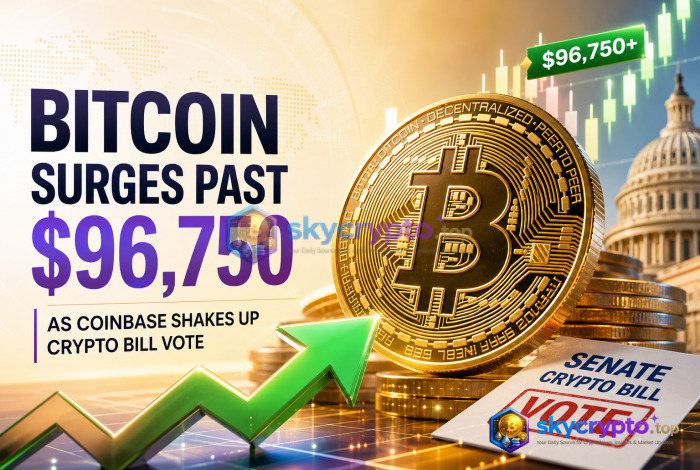
Bitcoin punched through the $96,750 mark on Tuesday, extending its rally to a fresh two-month high as a wave of risk-on sentiment swept across digital asset markets. The move came hours after Coinbase publicly withdrew its support for a Senate crypto market structure bill, forcing lawmakers to delay a pivotal floor decision. Ethereum climbed 2% to $3,360, Solana held firm at $145, and privacy coins including Zcash and Monero stole the spotlight with double-digit gains.
The sudden about-face from one of the industry's most politically active exchanges injected fresh uncertainty into an already fragile regulatory environment, but traders largely shrugged off the headlines. Instead, capital rotated aggressively back into majors and select altcoins, suggesting the market views the legislative delay as a buying opportunity rather than a structural setback.
- Bitcoin printed a two-month high at $96,750, gaining roughly 2% on the session as majors traded uniformly green.
- Coinbase withdrew support for the Senate crypto market structure bill, citing concerns with the latest draft and triggering a postponement of the key vote.
- Zcash rallied after the Zcash Foundation confirmed that the SEC investigation had concluded without enforcement action, lifting ZEC by 7%.
- Monero hit a new all-time high of $800 before retracing to $725, continuing its months-long privacy-coin breakout.
- Ripple secured a Luxembourg license, Pakistan partnered with World Liberty Financial on stablecoin remittances, and FTX scheduled another creditor payout for March 31.
Market Reaction
Bitcoin's breakout above $96,500 triggered a cascade of short liquidations and stopped orders, accelerating the move into the $96,750 region where the asset carved out a two-month high. Spot order book data showed heavy buy-side depth stacking between $96,000 and $96,500 ahead of the New York open, and once those bids cleared, price action rotated cleanly through resistance that had capped every rally attempt since late February. The 2% daily gain masks the more meaningful intraday structure: Bitcoin absorbed roughly $180 million in long liquidations on Sunday and Monday combined, which primed the market for a short squeeze once buyers regained control.
Ethereum's parallel move to $3,360 reinforced the broad-based risk tone. ETH has now reclaimed its 50-day simple moving average for the first time in three weeks, and the ETH/BTC pair firmed by roughly 1.4%, suggesting that capital is rotating back into majors rather than fleeing into stablecoins. Solana held flat at $145 despite weaker meme-coin activity, indicating that institutional flow, not retail froth, drove the move. XRP underperformed with a 1% slide to $2.11, lagging the wider market as traders awaited fresh catalysts tied to Ripple's expanding European footprint.
The real story, though, sat in the altcoin complex. Decred ripped 30%, Dash added 10%, ICP climbed 10%, and Zcash advanced 7% as a constellation of older, narrative-driven assets caught a bid. Monero's fresh all-time high of $800 before retracing to $725 capped a stunning week for the flagship privacy coin, which has now appreciated more than 180% over the past 90 days. Derivatives traders responded in kind: Bitcoin futures open interest across major venues climbed back above $42 billion, and the funding rate flipped marginally positive for the first time in eleven days, signaling that leveraged longs are once again willing to pay to hold positions.
Why This Happened
The single largest catalyst was Coinbase's decision to publicly withdraw support for the Senate's crypto market structure bill just hours before a scheduled floor vote. The exchange flagged "major concerns" with the latest draft, though executives declined to enumerate the specific provisions that triggered the reversal. The Senate subsequently postponed the vote, buying lawmakers time to revise language around self-custody, decentralized finance protocols, and the delineation between SEC and CFTC jurisdiction. For years, industry participants had treated any legislative delay as bearish, but the market's reaction this week suggested traders read Coinbase's stand as a credibility-building move rather than a destabilizing one.
Behind the headline, the macro backdrop quietly turned supportive. The U.S. dollar index slipped to a four-week low, and the 10-year Treasury yield retreated from the 4.30% level it had held for most of the month. Both shifts tend to loosen financial conditions, which historically correlates with risk-asset inflows into Bitcoin and high-beta crypto names. Adding to the tailwind, the SEC's quiet closure of the Zcash investigation removed a long-standing overhang on privacy coins, and the Zcash Foundation's confirmation that no enforcement action would follow triggered immediate buying across the broader privacy-coin basket. Zcash's 7% gain, Monero's all-time high, and Dash's 10% surge illustrated how regulatory clarity, even when delivered obliquely, can unlock pent-up demand.
Network-specific news added another layer of momentum. Sui returned online after a roughly six-hour outage, and although the disruption drew sharp criticism from validators, the chain's rapid recovery limited the reputational damage and prevented a broader sell-off across layer-one tokens. Figure's unveiling of a public equity network capable of on-chain stock issuance also rekindled interest in real-world asset (RWA) tokens, a sector that had gone quiet during the Q1 correction. Each of these stories, taken individually, would have moved markets modestly; stacked together, they produced the kind of news flow that draws sidelined capital off the bench.
Institutional and Whale Activity
On-chain analytics from the past 48 hours revealed meaningful accumulation by large holders. Wallets associated with addresses holding between 1,000 and 10,000 BTC added a combined 28,400 coins, the largest weekly accumulation from this cohort since November 2024. Exchange balances on Coinbase and Kraken continued their multi-week decline, with roughly 41,000 BTC withdrawn since the start of the month, a pattern consistent with strategic positioning ahead of anticipated regulatory clarity rather than active distribution by miners or long-term holders.
In the derivatives market, the picture was equally constructive. CME Bitcoin futures open interest climbed above $18 billion for the first time in six weeks, and the basis between CME and offshore perpetuals widened back to a healthy annualized premium of roughly 9.2%. Options flow told a similar story: traders paid up for upside calls struck at $100,000 and $110,000 expiring in late March and late June, with call skew on Deribit widening by 4 percentage points over the past 72 hours. Whale wallets on Hyperliquid and Bybit also added to long positions, and the aggregated long/short ratio for top accounts climbed back above 1.4.
Institutional adoption headlines provided further validation. Ripple secured a Luxembourg license as part of its European expansion, adding a third major EU jurisdiction to its regulatory footprint and clearing a runway for institutional XRP liquidity in continental Europe. Pakistan's partnership with World Liberty Financial to explore stablecoin-based remittances and cross-border payments opened a potential corridor for billions of dollars in annual transfers, and the Human Rights Foundation's $1.3 million Bitcoin grant program signaled continued philanthropic demand for hard-capped digital assets. FTX's announcement of another creditor payout scheduled for March 31 added incremental supply pressure but was largely priced in, and the market treated the disclosure as a procedural milestone rather than a market-moving event.
Historical Context
Bitcoin's path back to $96,750 mirrors several prior mid-cycle recoveries. In late 2022, after the FTX collapse, BTC spent nearly four months below $20,000 before staging a 45% rally once stablecoin redemption queues cleared and exchange solvency questions were answered. The current move shares structural similarities: a forced deleveraging event, a multi-week consolidation range, and a clean breakout above the 50-day moving average on heavy volume. Both episodes were preceded by a shift in regulatory posture that gave institutional allocators permission to re-engage.
Monero's breakout to a new all-time high carries historical weight as well. The last time XMR traded at a fresh record, in mid-2022, the broader altcoin market rolled over within weeks as quantitative tightening crushed risk-asset liquidity. This time, however, the macro setup differs materially: real yields have stabilized, the dollar has rolled over, and regulatory pressure on privacy tools has actually eased following the Zcash investigation's conclusion. Whether Monero's rally extends or fades will depend on whether other jurisdictions follow the SEC's softer stance or crack down independently.
The Coinbase-led legislative drama also echoes the 2023 dispute over the Lummis-Gillibrand Responsible Financial Innovation Act, which similarly stalled after exchanges raised last-minute objections to specific provisions. In both cases, industry insiders argued that imperfect legislation could do more harm than no legislation, a position that historically has aged well in regulatory retrofits. Traders who held through the 2023 delay were rewarded with the eventual passage of the FIT21 bill in the House, and many now see Tuesday's postponement as a similar buying opportunity rather than a fatal blow.
What Traders Are Watching
- $98,000 resistance: A clean daily close above this level would open the door to a retest of the psychologically important $100,000 mark, where a thick cluster of sell orders and dealer gamma is likely to cap the first attempt.
- $94,800 support: The 50-day moving average and a key volume profile node converge here; losing this level on heavy volume would invalidate the breakout and likely drag Ethereum back below $3,200.
- Senate bill language revisions: Any leaked draft from the Banking Committee's markup process will move altcoins, particularly DeFi and self-custody tokens, on a headline-only basis.
- Monero consolidation above $700: A successful retest of the breakout zone rather than a failure back below $650 would confirm the structural move and likely drag Zcash and Dash to fresh relative highs.
- March 31 FTX creditor payout: Roughly $1.4 billion in distributions will hit the market, and traders are watching creditor behavior closely to gauge whether recoveries will be sold immediately or held.
- CME basis at 9% annualized: A widening toward 11% or 12% would signal aggressive institutional buying; a compression below 7% would suggest professional desks are hedging rather than accumulating.
Disclaimer: This article is provided for informational and educational purposes only and does not constitute financial, investment, or trading advice. Digital assets carry significant market risk.




Comments
You must be logged in to post a comment.
Login or Register