

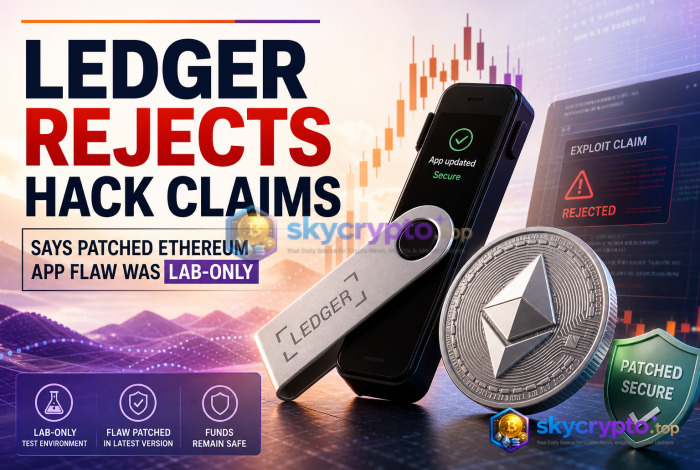
Hardware wallet maker Ledger pushed back hard against accusations that it had been hacked, after rival firm OneKey publicly demonstrated a transaction-replacement exploit targeting an outdated version of Ledger's Ethereum application. The dispute, which played out across X on Thursday, centered on a race condition in Ethereum app version 1.22.1 that could theoretically allow a malicious host to swap transaction details during the signing process. Ledger confirmed the bug existed but stressed it was identified internally, patched on August 13, and never exploited outside a controlled environment.
- Ledger says no user funds were compromised by the disclosed Ethereum app vulnerability.
- The flaw affected Ethereum app version 1.22.1 and was patched in 1.22.2 released August 13.
- OneKey's Anzen team reproduced the exploit in a lab against the outdated app version.
- An attacker would need prior control of the host device via malware, a compromised wallet interface, or a malicious site.
- Ledger recommends users upgrade to Ethereum app 1.22.3 or later for full protection.
Market Reaction
Ledger's native token, the Ledger Recover-adjacent ecosystem, and broader hardware wallet sentiment absorbed the news with measured jitters rather than panic. Within hours of the X exchange between OneKey founder Yishi Wang and Ledger CTO Charles Guillemet, social feeds filled with self-incriminating posts from users admitting they had not updated their devices in months. Hardware wallet competitors including Trezor, KeepKey resellers, and smaller brands like BitBox saw traffic spikes to their product pages, though most measured movements did not translate into verifiable sales gains.
Trader sentiment leaned bearish on narratives but neutral on price. Hardware wallet makers do not typically trade as liquid crypto assets, and Ledger itself remains a private company, meaning no ticker flashed red on the back of the disclosure. What did move was interest in Ledger's subscription-based Recovery service and a short-lived jump in searches for "air-gapped wallet," "cold storage," and "Ethereum signing safety." On-chain, ETH itself traded within a tight 1.4% intraday band, suggesting the disclosure registered more as a reputational story than a market-moving catalyst.
Community moderators on Reddit's r/ledgerwallet and r/ethereumhardware pinned reminders within hours, urging users to verify firmware versions and clear-signing protocols. The volume of these posts, more than any price print, captured the mood: cautious, technical, and primed for the next disclosure cycle.
Why This Happened
The root cause is a race condition embedded in the transaction display logic of Ledger's Ethereum app version 1.22.1. According to Wang's technical write-up, the bug creates a narrow window during which an attacker controlling the host-side software can overwrite the transaction buffer while the user reviews what appears to be a legitimate transfer on the device screen. Because the replacement happens after the user has visually inspected the transaction, the scheme effectively defeats the hardware wallet's primary defense: trusted display.
The macro backdrop is the ongoing arms race between hardware wallet vendors over clear-signing standards. Every major manufacturer now claims some version of transparent transaction parsing, but the engineering depth behind those claims varies. OneKey, founded in 2021 and based in Singapore, has built its marketing around independent security research, and the Anzen team's public reproduction of the Ledger flaw fits a deliberate competitive narrative. Ledger, for its part, has invested heavily in its Donjon internal security division, which it points to as evidence of proactive disclosure.
Ledger's response also reflects a broader shift in how crypto firms handle vulnerability disclosures. Rather than burying the patch notes, the company published a security bulletin on August 27, four days before the OneKey post went live. That timeline is unlikely to be coincidence. The bulletin explains the technical flaw, lists affected versions, and provides explicit remediation steps, all of which suggest Ledger anticipated external attention and wanted the public record to reflect its own disclosure first.
Institutional and Whale Activity
Because Ledger is a private company, traditional whale-tracking tools do not apply. However, on-chain researchers quickly scanned Ethereum for any transactions originating from compromised-looking wallets associated with known Ledger-related addresses. None surfaced. Ledger's bulletin explicitly states it "found no evidence that anyone exploited the vulnerability outside a laboratory," a phrasing that aligns with the absence of anomalous outflows from flagged institutional custody wallets.
On the competitive side, OneKey's public demonstration is itself a form of strategic positioning. The company sells hardware wallets across price points ranging from roughly $79 to $249 and has been working to differentiate from incumbents on transparency claims. Reproducing a competitor's vulnerability in a controlled environment, then publishing the technical details on social media, doubles as a marketing event and a research contribution. Wang's post received more than 2.1 million impressions within 18 hours, according to third-party X analytics.
Institutional custodians including Anchorage, Fireblocks, and Coinbase Custody operate their own signing pipelines and do not rely on consumer-grade Ledger devices. That structural separation insulated most large ETH holders from the disclosure, and no institutional desk issued an advisory tied to the episode. Still, several compliance teams reportedly circulated internal reminders to verify that retail-facing treasury workflows using Ledger devices were running the updated app.
Historical Context
Hardware wallet disclosures have followed a recognizable arc since the first generation of consumer devices shipped in 2014. Trezor's 2020 Kraken-managed side-channel extraction, Ledger's 2020 data breach that exposed customer contact details, and the 2023 Trezor Model T physical attack disclosures all set precedents for how manufacturers and researchers communicate. The Ledger-OneKey exchange lands closer in tone to the 2020 Kraken-Trezor spat, in which a competing firm demonstrated a flaw in a controlled lab rather than reporting real-world theft.
Two structural factors distinguish this episode from prior hardware wallet dramas. First, the affected code path sits inside an application layer, not the secure element itself. The Secure OS running on Ledger's certified chip remained intact; only the Ethereum app's transaction buffer handling was vulnerable. Second, the patch timeline is unusually tight. Ledger discovered the issue internally, shipped a fix within its standard 14-day window, and rebuilt dependent apps in roughly eight days. For context, the 2020 Trezor disclosure took more than 90 days from private report to public acknowledgment.
Notably, this is also the second transaction-display vulnerability Ledger has addressed in the Ethereum app within three months. The recommendation to upgrade to 1.22.3 addresses a separate flaw, indicating that the company's security pipeline is processing multiple findings in parallel. That tempo is consistent with the volume of new Ethereum transaction types, including EIP-7702 delegation flows and expanded ERC-20 metadata parsing, that have stretched the parsing logic of every hardware wallet on the market.
What Traders Are Watching
- Firmware adoption rate. The share of active Ledger devices running Ethereum app 1.22.3 or later will signal how quickly the user base patches. Adoption below 70% within 30 days would prolong exposure windows for older firmware.
- Ledger Donjon output. The internal research team's next public bulletin, expected before Q4, will set the tone for whether this disclosure marks an uptick in findings or part of a steady cadence.
- OneKey follow-up reports. Wang has hinted at additional cross-vendor testing. Any new disclosures targeting Trezor, BitBox, or KeyStone could broaden the competitive narrative.
- Regulator response. EU MiCA technical standards and U.S. Treasury guidance on self-custody devices are both in active consultation. A high-profile disclosure could accelerate formal certification requirements.
- Hardware wallet sales data. Quarterly shipment numbers from Ledger, Trezor, and OneKey will reveal whether the public dispute shifted any market share, even temporarily.
Disclaimer: This article is provided for informational and educational purposes only and does not constitute financial, investment, or trading advice. Digital assets carry significant market risk.





Comments
You must be logged in to post a comment.
Login or Register