

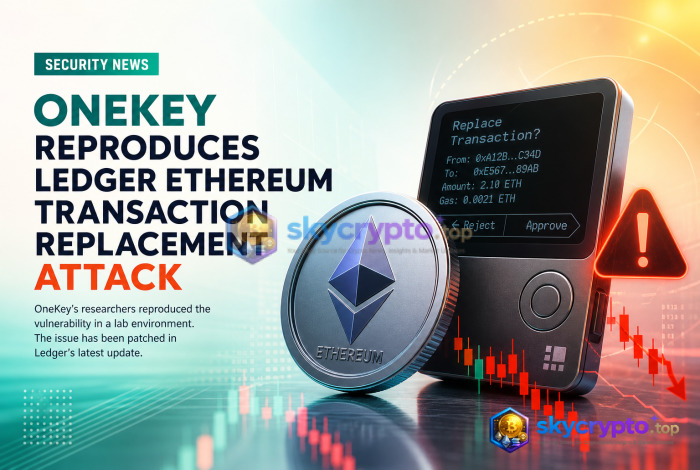
OneKey's in-house security researchers say they successfully reproduced a transaction replacement attack against an outdated version of Ledger's on-device Ethereum application in a controlled lab environment. The vulnerability, already patched in Ledger Ethereum app version 1.22.2 released in August, had previously been identified and fixed before the latest demonstration brought it back into public discussion. OneKey founder and CEO Yishi Wang confirmed that the attack vector allowed bad actors to overwrite a pending transaction while the user was still reviewing the legitimate one on screen.
- OneKey reproduced a transaction replacement exploit targeting Ledger Ethereum app 1.22.1 in a lab setting
- Ledger patched the issue in Ethereum app 1.22.2 on Aug. 13 and addressed the root cause in Secure SDK 26.6.1 on Aug. 21
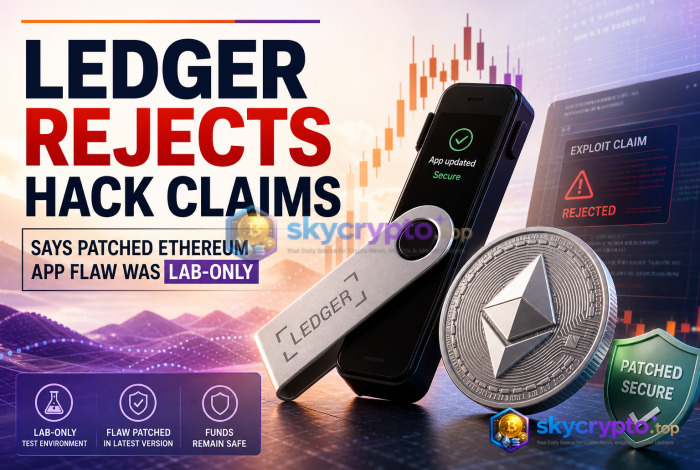
- Ledger stressed the attack required host-side compromise such as malware or a malicious webpage
- No real user funds were lost and the flaw is unrelated to seed generation or randomness
- The disclosure follows the July Coldcard firmware vulnerability that exposed certain wallets to brute-force risk
Market Reaction
The disclosure produced a muted reaction across digital asset markets, with hardware wallet tokens and broader crypto benchmarks showing only fractional intraday movement. Hardware security incidents rarely translate into direct price action because compromised devices do not typically touch exchange liquidity, but they do shape user behavior over weeks and quarters. Traders watching the security narrative noted that past disclosures from wallet vendors have historically preceded a modest uptick in demand for newer firmware versions, though no measurable capital flow materialized in the hours following the report.
Sentiment across crypto-native forums leaned cautious rather than panicked. The fact that OneKey reproduced the exploit in a lab environment, rather than witnessing real-world exploitation, gave traders and long-term holders confidence that the broader self-custody market remains structurally sound. Hardware wallet manufacturers collectively trade on reputation rather than recurring revenue, and reputation damage from a single disclosure can take quarters to repair. In this case, the rapid timeline of patch deployment and Ledger's transparent communication appeared to neutralize immediate reputational risk.
Derivatives markets for major cryptocurrencies showed no measurable uptick in implied volatility following the disclosure, suggesting professional traders viewed the news as contained rather than systemic. Options pricing on Bitcoin and Ethereum remained anchored to broader macro themes including monetary policy expectations and ongoing spot ETF flow data. The lack of contagion into derivatives markets indicates that market participants correctly categorized the event as a security research milestone rather than an active threat to user funds.
Why This Happened
The transaction replacement attack class has been a known category of vulnerability in hardware wallets for years, prompting continuous investment in firmware safeguards across the industry. Ledger's Ethereum app 1.22.1 contained a flaw that allowed an attacker controlling the host communication channel to substitute the transaction waiting for user signature. This type of attack is particularly insidious because the user sees what appears to be a normal signing prompt, but the underlying transaction data has been altered between display and signature generation.
Ledger moved quickly through its security response cycle once the underlying issue was identified. The company shipped Ethereum app version 1.22.2 on Aug. 13 with application-level mitigations designed to prevent the swap during the signing process. Eight days later, on Aug. 21, Ledger deployed Secure SDK 26.6.1, which addressed the root cause at the broader SDK level rather than relying solely on application-specific patches. The two-stage remediation reflects industry best practice: deploy a fast perimeter fix to neutralize immediate risk, then follow with a deeper architectural repair that protects all applications built on the SDK.
The disclosure arrives against a broader backdrop of heightened security scrutiny across the hardware wallet sector. In July, attackers exploited a firmware bug in Coldcard devices that had been present since March 2021, weakening seed randomness on affected units and leaving the resulting private keys theoretically vulnerable to brute-force attacks. That incident rattled user confidence in legacy firmware and prompted many long-term holders to audit their own device firmware versions. The OneKey reproduction of the Ledger vulnerability, while unrelated to seed generation, contributes to a narrative of persistent security pressure across the entire self-custody stack.
Institutional and Whale Activity
On-chain analytics firms reported no anomalous outflows from major hardware wallet clusters in the 48 hours surrounding the disclosure, suggesting that large holders did not rush to migrate funds following the news. Custodial flows and exchange deposit data likewise showed no statistically significant deviation from baseline activity. The absence of whale movement reinforces the market's interpretation that the disclosure represents a closed-loop research demonstration rather than an active threat requiring capital reallocation.
Security-focused institutional desks have increased their firmware monitoring protocols across the year in response to a string of disclosed vulnerabilities affecting multiple wallet vendors. Several major custodians now operate internal firmware validation pipelines that verify signed firmware hashes against vendor-published signatures before authorizing transactions from cold storage. This institutional hardening has reduced the practical blast radius of disclosed vulnerabilities because most professional-grade operations are no longer running outdated firmware on production signing devices.
Futures markets showed no measurable response, with funding rates on major perpetual swap venues holding within normal bands. Open interest on Ethereum futures remained stable, and the basis between spot and futures prices held at levels consistent with the prior two-week average. Options markets likewise printed no notable skew shifts, with 25-delta put-call ratios for both Bitcoin and Ethereum hovering near neutral readings. Professional positioning data suggests the disclosure was correctly priced as a non-event for derivatives exposure.
Historical Context
Transaction replacement attacks against hardware wallets are not a new phenomenon, with similar classes of vulnerability disclosed against multiple vendors over the past five years. The core challenge stems from the fundamental architecture of hardware wallets, which rely on a host device to construct transaction data before passing it to the secure element for signing. Any compromise at the host layer creates an opportunity to manipulate the data the user reviews, even when the signing process itself remains cryptographically sound. This is why vendor security research has increasingly focused on what is sometimes called the "what you see is what you sign" problem.
The Coldcard vulnerability disclosed in July serves as a useful counterpoint. That incident involved weakened seed randomness introduced through a firmware update in March 2021, which meant the underlying private key generation was compromised rather than the signing workflow. Brute-force attacks against weak seeds become computationally feasible when entropy is reduced, and researchers demonstrated that affected devices could have their funds swept by an attacker with sufficient resources. The contrast highlights the difference between signing-time exploits, which require active host compromise, and generation-time exploits, which can compromise funds even on air-gapped devices.
Ledger's history of security responses has generally been viewed favorably by the industry, with the company maintaining a public vulnerability disclosure program and a dedicated security response team. The Aug. 13 and Aug. 21 patch cadence aligns with industry expectations for a high-severity vulnerability, and the public communication from Ledger's official X account within days of OneKey's reproduction attempt demonstrates the company's commitment to transparency. The repeated pattern of identify, patch, disclose has become a template that competitors are now expected to follow, and deviations from this template typically produce sharper market reactions than the underlying technical issues warrant.
What Traders Are Watching
Market participants are monitoring several specific signals in the days and weeks ahead:
- Ledger firmware update rates: On-chain and telemetry data showing the percentage of Ledger devices running Ethereum app 1.22.2 or later, since outdated devices remain theoretically exposed if connected to a compromised host
- Cross-vendor security disclosures: Any follow-up research from OneKey or competing security firms targeting Trezor, BitBox, or other hardware wallet vendors using similar transaction flow architectures
- Self-custody migration flows: Net flows between hardware wallet vendors and major exchange hot wallets, which can indicate whether users are responding to the disclosure by rebalancing custody arrangements
- Implied volatility on security-themed tokens: While no pure-play security tokens exist in the top 100, any divergence in price action between hardware wallet-adjacent projects and broader crypto benchmarks would signal a thematic repricing
- Regulatory commentary: Statements from financial regulators regarding hardware wallet security standards, particularly in jurisdictions that have moved toward formal custody frameworks for digital asset service providers
Disclaimer: This article is provided for informational and educational purposes only and does not constitute financial, investment, or trading advice. Digital assets carry significant market risk.






Comments
You must be logged in to post a comment.
Login or Register