

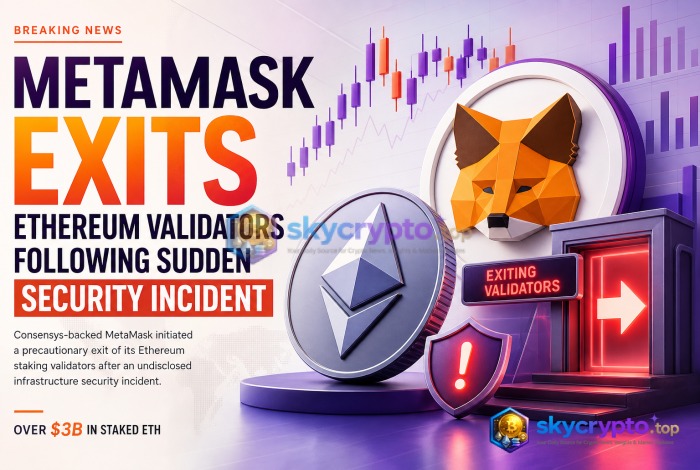
Consensys-backed software wallet MetaMask initiated a precautionary exit of its Ethereum staking validators on Wednesday following an undisclosed infrastructure security incident. The wallet provider, which oversees more than $3 billion in staked Ether, teamed up with external security advisors to mitigate potential vulnerabilities ahead of an October 7 completion deadline. While MetaMask maintains that user wallets remain entirely secure, the sudden validator exit has triggered a 45-day withdrawal and re-entry cycle within liquid staking protocols like Lido Finance.
- MetaMask is exiting its non-custodial and Lido-operated Ethereum validators due to an undisclosed security threat.
- The transition affects a portion of MetaMask's $3 billion in staked Ether, with full validator exits scheduled by October 7.
- Funds will flow back into the protocol over an estimated 45-day cycle due to Ethereum's exit and entry queues.
- No user wallet security has been compromised, according to internal and external investigations.
Market Reaction
The announcement triggered immediate, albeit localized, volatility across Ethereum-related assets. Ether itself experienced a swift 2.4% dip within hours of the news, dropping from $2,650 to test support near the $2,580 level as market participants digested the implications of a security breach at the sector's most prominent gateway. While the broader market remained relatively stable, liquid staking governance tokens bore the brunt of the initial panic. Lido DAO (LDO) slid by 4.8% to trade at $1.12, reflecting trader anxiety over how the sudden validator exit would impact Lido's total value locked (TVL) and overall protocol fee generation.
Derivative markets mirrored this cautious sentiment, with Ethereum funding rates turning slightly negative on major perpetual exchanges. Options traders responded by bidding up short-term implied volatility, particularly for contracts expiring near the October 7 exit deadline. This pricing shift suggests that market makers are hedging against potential secondary exploits or negative disclosures. Staker sentiment, measured by social volume and sentiment indices, plunged to its lowest level in three months, as users expressed frustration over the lack of transparency regarding the exact nature of the infrastructure threat.
Despite the immediate sell-off, spot market order books showed substantial bidding interest below $2,550, indicating that institutional buyers viewed the dip as a temporary disruption rather than a structural failure. The resilience of the spot market suggests that while short-term traders reacted to the scary headline, long-term holders recognize that the underlying Ethereum network remains secure. The exit of validators does not mean the destruction of assets, but rather a temporary pause in yield generation, which helped cap the downside momentum.
Why This Happened
The decision to decommission these validators stems from an undisclosed security vulnerability detected within MetaMask's infrastructure. In an effort to shield client assets from potential compromise, the development team opted for an aggressive, preemptive strategy rather than risking an active exploit. This defensive posture required coordinating with external security firms and protocol partners to systematically withdraw validator keys. The vulnerability specifically targeted the infrastructure powering MetaMask’s non-custodial staking operations, prompting an immediate halt to active validation to prevent potential slashing penalties or unauthorized fund drains.
The complexity of this exit is magnified by MetaMask's integration with Lido Finance and Rocket Pool. Because a significant portion of MetaMask’s $3 billion in staked assets runs through Lido's node operator registry, the withdrawal process must follow Ethereum’s strict consensus layer rules. According to protocol developers, the exited Ether cannot instantly return to active service. Instead, the assets must wind through the consensus layer’s withdrawal queue, a process estimated to take up to 45 days. This delay is a built-in security feature of the Ethereum network designed to prevent rapid validator churn and potential consensus instability during times of high stress.
The macro backdrop adds another layer of complexity to this infrastructure migration. With global interest rates fluctuating and traditional yields remaining competitive, any prolonged period where digital assets fail to generate yield can lead to capital flight. The 45-day queue means that millions of dollars in capital will sit idle, earning 0% APY during the transition. This temporary loss of capital efficiency occurs at a time when decentralized finance protocols are already competing fiercely for liquidity, making the timing of this security intervention particularly challenging for yield-sensitive institutional clients.
Institutional and Whale Activity
On-chain analytics reveal a flurry of activity among large wallet addresses immediately following the announcement. Blockchain data tracking firm Nansen reported that several prominent multi-signature wallets associated with venture capital firms shifted significant quantities of wrapped Ether (WETH) into cold storage. This migration suggests that institutional players are prioritizing absolute security over yield maximization until the infrastructure vulnerability is fully resolved. Concurrently, the volume of Ether flowing into exchange deposit addresses spiked by 15%, indicating that some whales preferred to liquidate a portion of their holdings rather than endure the 45-day withdrawal bottleneck.
In the futures market, institutional positioning showed a marked shift toward risk-off strategies. Open interest in Ethereum futures contracts declined by approximately $320 million, pointing to a widespread closing of long positions rather than an aggressive buildup of short sellers. This deleveraging event suggests that large-scale traders are unwilling to hold levered exposure during an active security investigation. Meanwhile, the CME Ethereum futures basis—the premium of futures contracts over spot prices—compressed to 4.5%, down from its weekly high of 6.2%, confirming that institutional appetite has cooled in the short term.
Smart money wallets, which typically identify accumulation opportunities during panics, showed a different pattern of behavior. Instead of buying the spot dip immediately, these sophisticated entities focused on accumulating liquid staking derivatives that were trading at a slight discount to their underlying Ether value. This arbitrage strategy allows large players to capture a premium once the validator exit and re-entry cycle completes and peg parity is fully restored. This calculated risk-taking by on-chain specialists helps stabilize the market by absorbing the selling pressure from retail users who may have panicked.
Historical Context
This security incident is not the first time a major infrastructure provider has had to perform an emergency validator exit, but the scale of MetaMask's operations makes it one of the most significant. Historically, smaller node operators have faced slashing events or key management failures that required rapid shutdowns. During the early days of the Beacon Chain, minor configuration errors occasionally led to the slashing of dozens of validators simultaneously. However, those early incidents involved relatively small amounts of capital and did not threaten the broader staking market. The current situation highlights how much the staking landscape has matured, and how concentrated the risk has become.
The event also revives intense debates surrounding the centralization of Ethereum's staking layer, particularly regarding Lido's market share. Critics have long argued that having a single entity control a dominant portion of staked Ether introduces systemic risk to the network. If a vulnerability in a major partner like MetaMask can trigger the exit of thousands of validators, it proves that the network's decentralization is only as strong as its weakest infrastructure link. This incident will likely accelerate the development of Distributed Validator Technology (DVT), which distributes validator duties across multiple independent nodes to prevent single points of failure.
Looking back at previous market cycles, infrastructure scares of this nature often serve as stress tests that ultimately strengthen the industry. When major custody providers or wallets faced technical hurdles in 2021, the subsequent upgrades led to more resilient multi-party computation (MPC) wallet frameworks. The current migration, while painful for those caught in the 45-day queue, will likely result in a more secure validator architecture across the entire Consensys suite. This adaptation process is a familiar pattern in decentralized finance, where security breaches act as harsh but necessary catalysts for technological evolution.
What Traders Are Watching
As the October 7 deadline approaches, traders are closely monitoring key support levels and on-chain metrics to gauge the market's recovery path. The primary focus is on the speed of the validator exit queue, which can be tracked via consensus layer explorers. If the queue clears faster than the projected 45 days, it could restore confidence quickly and trigger a sharp reversal in Ethereum-related assets. Conversely, any technical complications during the withdrawal process could extend the timeline, keeping capital locked up and putting prolonged downward pressure on liquid staking tokens.
Technical analysts are also watching the correlation between Ether and Bitcoin, which has hovered near multi-year lows. A successful resolution of this security incident without any actual exploit could serve as the catalyst needed for Ether to break out of its relative underperformance. Traders should watch the volume profiles on major exchanges, as a breakout accompanied by high volume would confirm institutional accumulation. On the other hand, low-volume consolidation would suggest that major players are content to sit on the sidelines until Consensys releases a full post-mortem report.
Finally, the regulatory implications of this event cannot be ignored. Staking services have been under intense scrutiny from global regulators, and any security incident involving billions of dollars in user assets could invite further regulatory intervention. Traders must stay informed about any statements from financial watchdogs regarding non-custodial staking services. A regulatory crackdown would represent a far more permanent threat to the staking market than a temporary technical migration.
- The $2,500 Support Level: This psychological and technical level has acted as a strong base for Ether; a breach below this could open the door to a deeper correction toward $2,350.
- The October 7 Exit Deadline: The completion of the validator exits will mark the end of the immediate risk phase, serving as a critical temporal milestone for risk assets.
- The 45-Day Withdrawal Queue Duration: Any deviation from the estimated 45-day cycle will directly impact liquid staking derivative peg stability and market liquidity.
- LDO/ETH Exchange Rate: This ratio serves as a direct gauge of market confidence in liquid staking protocols; a rising ratio indicates returning trust, while a falling ratio signals ongoing caution.
- Consensys Post-Mortem Release: The publication of the official security report will clarify the exact nature of the threat, potentially removing the uncertainty overhang that currently dampens sentiment.
Disclaimer: This article is provided for informational and educational purposes only and does not constitute financial, investment, or trading advice. Digital assets carry significant market risk.












Comments
You must be logged in to post a comment.
Login or Register