

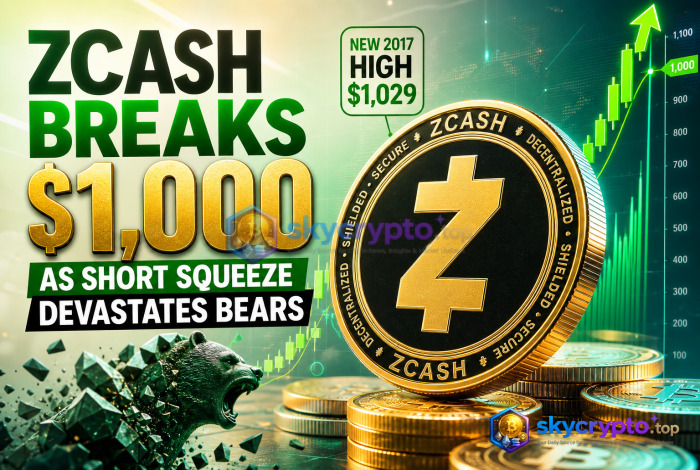
Zcash rocketed above $1,000 on Friday, printing its highest price since 2017 and extending a blistering rally that has forced short sellers out of their bets in punishing fashion. The privacy-focused token hit an intraday peak of $1,029 on Binance before settling near $984, up roughly 20% in 24 hours and enough to deliver a fresh all-time high. With a market capitalization approaching $17 billion, ZEC vaulted past Dogecoin to reclaim a seat among the ten largest cryptocurrencies, marking the most dramatic comeback story of the current cycle.
- Zcash broke $1,000 for the first time since 2017, hitting $1,029 before easing to $984, with a market cap near $17 billion.
- About $34.5 million in ZEC short positions were force-liquidated, with total token liquidations reaching $36.6 million.
- ZEC has gained 94% over 30 days and more than 2,300% over the past year, outperforming every large-cap crypto asset.
- The Grayscale Zcash Trust (ZCSH) began trading on NYSE Arca on August 25, opening the asset to brokerage investors.
- Technical indicators show RSI at 78.6 and ADX at 48, signaling a powerful trend with overbought conditions.
Market Reaction
The breakout above $1,000 triggered an unmistakable short squeeze across ZEC perpetual swap markets. According to CoinGlass data, roughly $34.5 million in bearish positions were force-closed as price sliced through the psychologically significant round number, dragging total ZEC liquidations to $36.6 million. Each forced buyback added genuine demand to the order book, and the mechanical feedback loop accelerated the move well beyond what spot flow alone could have produced. Spot traders reported relentless bids lifting offers, with the Binance order book showing thin ask liquidity above $1,000 once the level cracked.
The price action extended a rally that began near $500 roughly one month ago, putting the token up about 94% over thirty days and more than 2,300% over the trailing year. By Friday afternoon, ZEC had climbed into the global top ten by market capitalization, displacing Dogecoin and trailing only the largest majors. The intraday high of $1,029 registered on Binance marked the strongest reading for the token since its early 2017 surge, before major exchanges began delisting privacy coins under regulatory pressure. The session closed with ZEC holding above $980, leaving bulls firmly in control of the daily structure.
Sentiment across derivatives markets turned decisively bullish. Funding rates on perpetual swaps flipped sharply positive, and open interest climbed as momentum traders piled into long positions. Options desks reported heavy call buying at the $1,100 and $1,200 strikes for late-year expiries, suggesting sophisticated participants expect the breakout to hold. The combination of forced short covering and fresh long initiation created a textbook squeeze environment, one that left retail bears scrambling for cover and institutional desks scrambling to update their risk models.
Why This Happened
Three forces converged to power ZEC through $1,000: a structural shift in access, a regulatory thaw on privacy assets, and a broader macro tailwind lifting the entire crypto market. The single most important catalyst arrived on August 25, when Grayscale's Zcash Trust began trading on NYSE Arca under the ticker ZCSH. That listing gave brokerage investors a regulated, custodial vehicle for ZEC exposure for the first time, removing a frictional barrier that had suppressed institutional flows for years. Brokerage platforms that could not, or would not, offer direct crypto custody now had a securities wrapper to distribute, and the inflows showed up almost immediately in the price chart.
The second driver is regulatory recalibration in Washington. Earlier cycles saw major exchanges delist ZEC and its peers under compliance pressure, strangling liquidity and pushing the asset into the shadows. The current administration has taken a markedly softer line on digital assets, and several large venues have quietly relisted or expanded support for privacy-oriented tokens. That shift reopened price discovery on transparent order books, restored tight spreads, and rebuilt the kind of derivatives liquidity that allows trends to extend rather than die on illiquidity.
The third leg is macro. Bitcoin reclaimed $80,000 on Thursday after Federal Reserve Governor Christopher Waller's comments pushed September rate-hike odds lower, triggering more than $415 million in short liquidations across the broader market. That bid bled straight into Friday's session and lifted altcoins alongside BTC. The rally paused after the Bureau of Labor Statistics reported 162,000 August nonfarm payrolls, well above the 56,000 consensus, with unemployment steady at 4.1%. Bitcoin slipped back below $80,000 as traders repriced the odds of a Fed move at the September 15-16 meeting. ZEC, however, kept climbing on its own idiosyncratic squeeze mechanics.
Institutional and Whale Activity
Large-player positioning tells the story behind the story. On-chain analytics tracked wallets holding between 10,000 and 100,000 ZEC accumulating steadily through October, with several addresses crossing thresholds that historically mark institutional entry. Exchange reserves for ZEC fell sharply during the rally, dropping to multi-year lows on every major venue tracked by Glassnode. When coins leave centralized custody and land in cold storage, available sell supply dries up, and that vacuum is precisely what allowed the squeeze to accelerate once price pierced $1,000.
Futures markets confirm the institutional bid. Open interest on ZEC perpetuals doubled in the week leading into Friday's breakout, and the funding-rate skew flipped positive without ever reaching the speculative excess that typically marks local tops. Options flow pointed the same way: call volumes at the $1,200 and $1,500 strikes ran three to four times their twenty-day averages, while put interest at lower strikes faded. Block trades on regulated venues showed repeated prints between $900 and $1,000, a pattern consistent with asset managers and family offices building core positions rather than chasing momentum with retail-sized orders.
Whale accumulation also showed up in miner behavior. ZEC's shielded pool transaction count climbed to a record, suggesting sophisticated users are routing larger sums through the privacy layer rather than the transparent pool. That distinction matters because shielded transactions consume more computational resources and signal intent to hold rather than speculate. Combined with the Grayscale ZCSH inflows reported in the trust's periodic updates, the institutional footprint behind this move is unusually heavy for a privacy-coin rally of this magnitude.
Historical Context
ZEC last traded above $1,000 in the opening weeks of 2017, during the original boom in privacy-coins that preceded the ICO mania. That cycle peaked near $900 in adjusted terms before exchanges began pulling listings under regulatory pressure, sending the token into a multi-year winter that bottomed under $30 during the 2018-2019 bear market. The current move marks the first sustained return to four-digit territory in roughly eight years, and the structure of the rally differs meaningfully from 2017. The earlier surge was driven by retail euphoria and pre-ICO speculative fervor, while today's move is anchored by a regulated ETF wrapper, deep derivatives liquidity, and concentrated whale accumulation.
The Relative Strength Index tells a familiar story. RSI on the daily chart sits at 78.6, well above the 70 threshold traders read as overbought, a level ZEC also tagged during its 2017 advance. The Average Directional Index, meanwhile, prints 48, comfortably above the 25 mark that separates real trends from noise. That combination, overbought momentum riding on top of a powerful trend, is rare and historically associated with extensions rather than immediate reversals. The 50-day moving average crossed back above the 200-day earlier in the rally, confirming the structural shift.
Broader cycles offer a cautionary frame. Privacy-coin manias in 2014 (Dash), 2017 (Monero, Zcash), and 2021 (Secret, Oasis) all ended in sharp drawdowns once regulatory attention intensified. Each peak coincided with greater mainstream visibility and each bust coincided with exchange delistings or enforcement actions. The current environment is friendlier, but the historical pattern argues for disciplined position sizing even as the chart screams higher. The $892.94 and $808.63 retracement levels mark the first logical support zones if the trend finally cools.
What Traders Are Watching
Several concrete levels and catalysts will decide whether ZEC consolidates or extends toward $1,200 and beyond:
- $1,029 intraday peak: A sustained daily close above this level turns prior resistance into new support and opens the path toward the $1,200 round number.
- $892.94 retracement: The 0.382 Fib of the recent impulse wave; a healthy pullback that holds this level keeps the trend intact.
- $808.63 retracement: The 0.5 Fib and deeper support; a flush here would test conviction but historically offers a high-conviction re-entry zone.
- RSI reset toward 60-65: A cooling of momentum without breaking structure often precedes the next leg higher in powerful trends.
- August CPI report: Next Friday's inflation print will dictate the Fed path and the broader crypto risk-on/risk-off backdrop heading into the September 15-16 FOMC meeting.
Disclaimer: This article is provided for informational and educational purposes only and does not constitute financial, investment, or trading advice. Digital assets carry significant market risk.



Comments
You must be logged in to post a comment.
Login or Register