

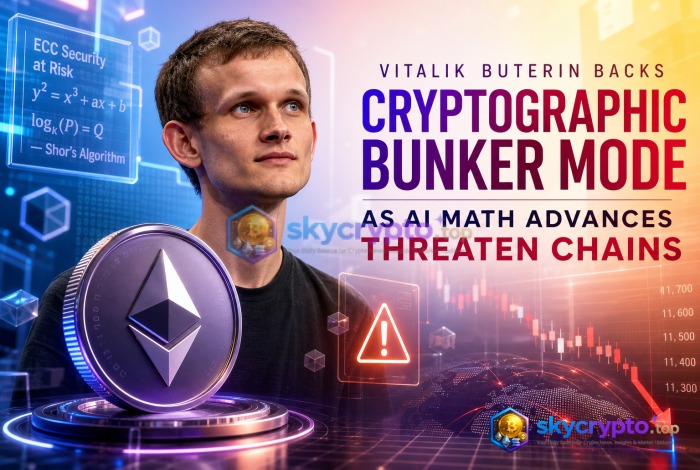
Ethereum co-founder Vitalik Buterin and protocol researcher Justin Drake have alerted the digital asset sector to an accelerating threat: artificial intelligence could dismantle the core mathematical foundations of modern blockchains long before quantum hardware matures. The advisory urges developers, institutional custodians, and retail participants to prepare for a defensive operational transition known as bunker mode to protect exposed digital capital. While Buterin stressed that users face no immediate emergency requiring chaotic asset transfers today, the realization that automated mathematical theorem proving can bypass conventional cryptanalysis timelines has sent shockwaves through technical and capital markets alike.
- Ethereum researchers urge an orderly, phased adoption of bunker mode to migrate capital away from addresses with exposed public keys.
- Artificial intelligence systems are solving complex algebraic structures far faster than expected, placing the Elliptic Curve Digital Signature Algorithm (ECDSA) in jeopardy.
- Vitalik Buterin warns that post-quantum lattice-based cryptography could also break under AI pressure, reinforcing Ethereum's strategic turn toward hash-based security models.
Market Reaction
The warning triggered immediate debate across trading desks, risk management divisions, and decentralized finance protocols. Ethereum traded defensively in the aftermath of the statements, hovering around key psychological support near $3,200 as market makers priced in the tail-risk scenario of accelerated cryptographic obsolescence. Deribit data showed a discernible uptick in 30-day implied volatility for Ether options, with the put-call skew shifting upward as institutional desks bought downside protection against systemic security developments. Traders responded not with acute panic selling, but with calculated hedging against long-dated smart contract exposures and custodial architecture.
Venture funds and prominent figures inside decentralized finance rallied around the technical reality presented by the core researchers. Dragonfly managing partner Haseeb Qureshi publicly validated Drake's warning, characterizing the advisory as a sober, measured wake-up call for an industry that has long treated elliptic curve encryption as an unassailable redoubt. Infrastructure tokens tied to identity verification, multi-party computation, and zero-knowledge infrastructure recorded mixed performances as market participants attempted to identify which cryptographic stacks would emerge intact from an era of AI-driven cryptanalysis.
Validator communities on Ethereum and rival Layer-1 networks began dissecting the immediate operational implications for staked capital. Node operators and liquid staking protocols manage hundreds of billions of dollars across fixed address sets, making structural key migration an operational hurdle rather than a minor software patch. The immediate reaction from decentralized finance treasuries was a collective pause on long-term multi-signature address reuse, prompting several prominent automated market makers to review their cold-storage and key-rotation policies.
Why This Happened
The technical catalyst for this urgent debate originated outside the digital asset sector. OpenAI published hundreds of discoveries across advanced algebra, mathematical logic, and theoretical computer science, showcasing an exponential leap in machine-assisted deduction. That announcement arrived just weeks after an automated cluster of 10,000 independent AI agents solved the famous Navier-Stokes fluid dynamics equations in a mere 88 hours. This demonstration obliterated previous benchmarks for human mathematical intuition and proved that complex mathematical barriers can fall in days when thousands of intelligent agents attack their internal symmetries.
Justin Drake pinpointed the exact structural danger facing distributed ledgers: the Elliptic Curve Digital Signature Algorithm (ECDSA) relies on mathematical curves that possess extensive internal algebraic architecture. Modern cryptographers have spent decades building analytical tools around Schoof's algorithm, Frobenius endomorphisms, and bilinear pairings. While these rich geometric properties make elliptic curves computationally efficient for signing transactions, they also provide footholds that a superintelligent mathematical engine can exploit. Hash functions, by contrast, are deliberately constructed without such algebraic elegance, functioning essentially as chaotic random oracles that resist analytical shortcuts.
Vitalik Buterin escalated the stakes of Drake's warning by cautioning that alternative cryptographic defenses might prove equally fragile. The broader cybersecurity community has long operated on the assumption that even if elliptic curves buckle under quantum or machine attacks, lattice-based cryptography would provide a secure post-quantum sanctuary. Buterin contested that confidence, asserting that concrete lattice security margins could suffer crippling blows over the next twenty-four months as AI math models advance. This assessment explains why Ethereum core development is intentionally shifting its lean, long-term roadmap toward hash-only primitives.
Institutional and Whale Activity
Institutional custodians such as BitGo, Fireblocks, and Coinbase Custody immediately turned their attention to the public-key exposure profile of cold storage reserves. Under standard ECDSA mechanics, a blockchain address is simply a truncated hash of a public key. The underlying public key remains hidden until the address sends its first outgoing transaction, at which point the digital signature reveals the public key to the public ledger forever. On-chain metrics indicate that over 64% of existing Ether supply and more than 50% of circulating Bitcoin sit in addresses that have executed at least one outbound transfer, exposing their raw public keys to potential algorithmic decomposition.
Whale entities began testing unexposed address generation across major networks, initiating small pilot transactions to verify clean operational chains. Large-scale holders who accumulated substantial balances during the 2016 to 2020 market cycles are particularly exposed, as legacy treasury practices rarely prioritized single-use address protocols. Custodial desks began distributing internal memos advising corporate treasuries to route incoming funds to brand-new, unspent addresses that have never broadcasted a transaction signature to the mempool.
Capital allocators in the venture capital space are actively reallocating capital toward companies building STARK-based cryptography, Winternitz one-time signature schemes, and hash-based transaction primitives. Futures order books reflected defensive posture adjustments, with CME Ether futures basis compressing slightly as institutional desks hedged their underlying spot holdings with short quarterly contracts. Rather than sparking aggressive capital flight, the warning triggered a quiet, disciplined re-evaluation of institutional custody parameters and asset defense mechanisms.
Historical Context
Cryptographic standards have broken down under computational expansion repeatedly across history, though the pace of destruction is now accelerating. The global financial sector previously relied on MD5 and SHA-1 hashing algorithms until collision vulnerabilities forced expensive, multi-year migrations to SHA-256 and newer primitives. Similarly, the factorization of RSA keys expanded steadily throughout the 1990s and 2000s as distributed computing clusters chipped away at prime numbers that theorists initially believed would stand for centuries. In every previous instance, the industry enjoyed the luxury of gradual Moore's law scaling to plan its defensive transitions.
The threat model facing blockchains today is qualitatively distinct. Previous technological shifts required physical hardware fabrication cycles, such as the gradual development of cryogenic dilution refrigerators for quantum processors. The threat posed by AI-accelerated mathematics operates entirely in software and pure logic. An algorithmic breakthrough does not require a multi-billion-dollar quantum laboratory to execute; it requires only a mathematical insight that transforms the discrete logarithm problem over elliptic curves from exponential complexity into polynomial or sub-exponential time.
Ethereum has encountered architectural crossroads before, most notably during the transition from Proof-of-Work to Proof-of-Stake via The Merge in 2022. That transition proved that decentralized networks can execute massive structural updates while preserving state, capital, and uninterrupted uptime. However, rewriting the cryptographic base layer of an entire ledger to replace ECDSA with hash-based signatures involves far greater engineering friction. It demands dramatic changes to transaction byte sizes, block gas limits, and signature verification costs, requiring years of coordination among developers, clients, and node runners.
What Traders Are Watching
Traders and fundamental analysts are tracking key technical thresholds, protocol milestones, and on-chain metrics to determine whether cryptographic vulnerability discussions begin affecting spot asset valuations or operational network health.
- ETH/USD Support at $3,050 and Resistance at $3,450: Technical analysts view the $3,050 level as the critical line defending the broader structural bull trend, while a breakout above $3,450 would confirm that market participants have dismissed near-term operational panic.
- ERC-4337 and Account Abstraction Deployment Metrics: Adoption rates of smart contract wallets that allow custom signature verification logic provide a tangible gauge of Ethereum's ability to switch cryptographic algorithms without hard-fork friction.
- Address Hygiene and Reused Public-Key Ratios: On-chain tracking of whale wallets migrating balances from reused public keys to virgin addresses will indicate whether institutional capital is executing bunker mode at scale.
- Ethereum Improvement Proposal (EIP) Hash-Only Roadmaps: Technical progress on hash-based STARK verification and lean roadmap specifications inside Ethereum All Core Devs (ACD) calls will signal the timeline for native base-layer defense implementation.
- Options Implied Volatility Spreads on Deribit: The spread between 3-month and 12-month Ether options volatility will highlight whether market makers view algorithmic cryptanalysis as a near-term disruption or a distant tail-risk event.
The dialogue sparked by Buterin and Drake marks a decisive pivot in blockchain risk modeling. For years, the sector treated the eventual obsolescence of elliptic curve cryptography as a distant headache reserved for the quantum computing era of the late 2030s. OpenAI's leap in machine-driven theoretical mathematics has shattered that complacency, pulling the timeline forward into the immediate strategic horizon. Markets will continue to digest the balance between near-term speculative momentum and long-term defensive engineering as the industry prepares its cryptographic foundation for an age of automated superintelligence.
Disclaimer: This article is provided for informational and educational purposes only and does not constitute financial, investment, or trading advice. Digital assets carry significant market risk.











Comments
You must be logged in to post a comment.
Login or Register