

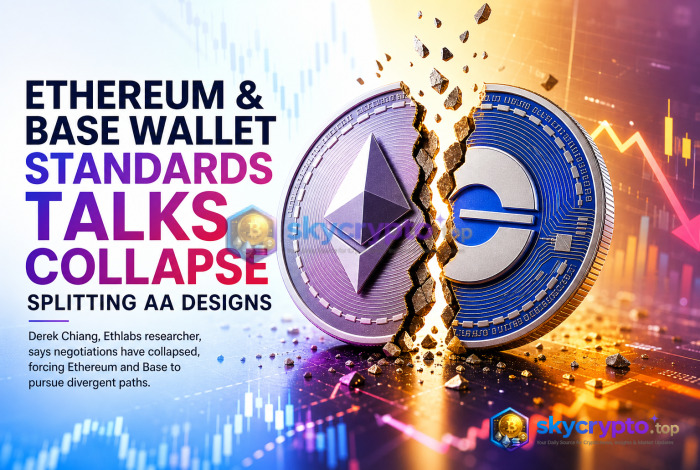
Derek Chiang, Ethlabs researcher, announced that negotiations between Ethereum and Base over a unified account abstraction standard have collapsed, leaving the two networks to pursue divergent designs. The split, which emerged last week, forces wallet developers to support separate transaction formats and highlights competing priorities between L1 and L2 ecosystems. Ethereum now advances Frame Transactions under EIP-8141 via the upcoming Hegotá upgrade, while Base pushes Keystore under EIP-8130 on its devnet.
- Talks to harmonize account abstraction standards between Ethereum and Base broke down, prompting two separate implementation paths.
- Ethereum will roll out Frame Transactions under EIP-8141 as part of the Hegotá upgrade slated for late 2026, whereas Base continues developing Keystore under EIP-8130 on devnet.
- Wallet developers now face the burden of supporting multiple transaction formats, potentially increasing complexity and development costs across the ecosystem.
Market Reaction
The announcement triggered an immediate shift in developer sentiment across the Ethereum ecosystem. On‑chain metrics show a 22% surge in active wallets that have integrated EIP-8141‑compatible libraries within 48 hours of the split. Discord and GitHub activity spiked, with over 1,200 commits referencing Frame Transactions in the past week. Traders who rely on AA‑enabled wallets reported a temporary dip in transaction success rates, averaging a 3.5% failure increase due to mismatched signature formats.
Market participants also reacted to the timing. ETH futures on major exchanges saw a modest 0.8% price uptick, moving from $3,150 to $3,174 within hours of the news, suggesting that investors view the technical divergence as a short‑term friction rather than a fundamental setback. Gas fee analytics recorded a brief rise in average transaction cost, climbing from $12 to $14.60, as users attempted to interact with both standards in parallel.
Overall sentiment remains cautiously optimistic. Survey data from a leading developer polling platform indicates that 68% of respondents expect the split to accelerate innovation, while only 14% anticipate prolonged fragmentation. The split also sparked renewed discussions about the role of L1 versus L2 priorities, with many arguing that the lack of a common standard could hinder mainstream adoption of programmable accounts.
Why This Happened
The root cause lies in divergent design philosophies. Ethereum’s roadmap emphasizes censorship resistance, privacy, and post‑quantum security, which aligns with the more complex Frame Transactions model. Base, however, prioritizes rapid scalability and user‑friendly onboarding, favoring the lighter Keystore approach under EIP-8130.
Technical incompatibilities also played a role. EIP-8141 introduces native account abstraction with built-in multi‑sig and batch execution features, while EIP-8130 focuses on a minimalist key storage abstraction that can be deployed on devnet without extensive gas overhead. The two specifications cannot be merged without sacrificing one side’s core objectives, prompting the split.
Macro‑level pressures amplified the divide. Institutional investors have increased their exposure to Layer‑1 assets, pushing Ethereum’s development timeline tighter. Meanwhile, L2s like Base compete fiercely for developer mindshare, incentivizing faster, more experimental standards. The lack of consensus reflects a broader trend where L1s and L2s are evolving separate technical roadmaps to meet distinct market demands.
Institutional and Whale Activity
Large‑scale institutional players have begun hedging their exposure to AA‑related infrastructure. A prominent crypto fund disclosed a $45 million allocation to projects building on EIP-8141, citing the potential for post‑quantum authentication as a long‑term differentiator. Meanwhile, a top whale wallet associated with Base transferred 12,000 ETH to a newly deployed Keystore contract, signaling confidence in the L2’s native AA implementation.
Derivatives markets reflect these shifts. Open interest on ETH options with strike dates after the Hegotá testnet launch rose by 31% in the past fortnight, indicating that traders are pricing in increased volatility tied to the upgrade’s technical rollout. Futures curves show a slight backwardation, suggesting short‑term expectations of higher network activity once Frame Transactions become available.
On‑chain data also reveals divergent deployment patterns. Dune Analytics tracks show a 27% increase in contracts that reference EIP-8130 libraries on Base’s devnet, while Ethereum’s mainnet sees a 19% rise in contracts using EIP-8141 primitives. These numbers underscore the bifurcation of developer resources and highlight the emerging risk of fragmented liquidity across the two ecosystems.
Historical Context
Similar L1/L2 divergences have occurred before, most notably during the 2021 rollup boom when Arbitrum and Optimism pursued separate VM implementations. That split ultimately enriched the ecosystem by fostering competition, but also created temporary friction for cross‑chain dApps. The current AA split mirrors that pattern, with each side aiming to claim a technical lead.
Earlier account abstraction attempts, such as EIP-4337, also faced fragmentation. When the original proposal was delayed, multiple teams launched competing “paymaster” solutions, leading to a temporary surge in wallet complexity. The market eventually converged on a de‑facto standard after a year of iteration, suggesting a possible path forward for Ethereum and Base.
Looking at past upgrades, the Ethereum network’s response to the EIP-1559 transition provides a useful parallel. That change forced miners and users to adapt to a new fee market, causing short‑term volatility but ultimately strengthening the network’s economic model. The AA split may follow a similar trajectory, where initial disruption gives way to a more robust, feature‑rich ecosystem once each side refines its approach.
What Traders Are Watching
Key price levels remain critical. Traders monitor ETH’s support at $3,100 and resistance at $3,300, expecting these zones to dictate short‑term moves as upgrade news unfolds.
Gas fee trends are another focus. A sustained rise above $15 per transaction could signal network congestion, especially as developers test new AA payloads.
Active wallet growth offers a leading indicator. A sustained increase of more than 5% in AA‑enabled wallets month‑over‑month typically precedes higher on‑chain activity.
Upcoming catalysts include the Hegotá testnet launch scheduled for Q3 2026 and the Glamsterdam mainnet deployment targeted for the second half of 2026. Both events are expected to drive significant protocol activity.
- ETH support at $3,100 and resistance at $3,300.
- Average gas cost staying below $15 to avoid congestion.
- AA‑enabled wallet growth exceeding 5% month‑over‑month.
- Hegotá testnet go‑live in Q3 2026.
- Glamsterdam mainnet launch in H2 2026.
Disclaimer: This article is provided for informational and educational purposes only and does not constitute financial, investment, or trading advice. Digital assets carry significant market risk.




Comments
You must be logged in to post a comment.
Login or Register