

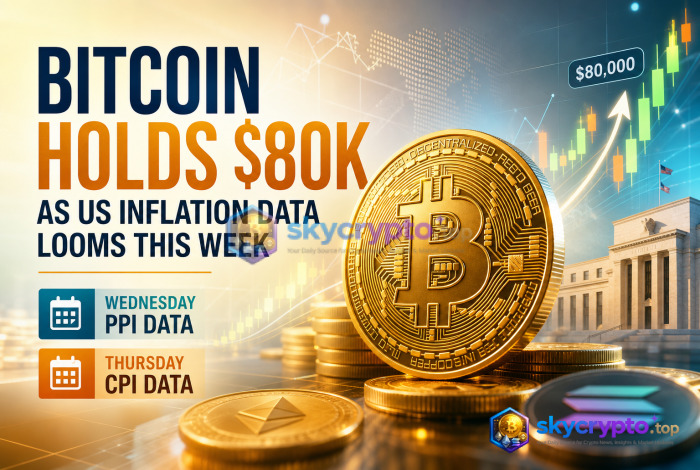
Bitcoin closed its first weekly candle above $80,000 since early May, but the rally now faces a critical test from a stacked calendar of US inflation releases. Producer Price Index (PPI) data lands Wednesday, followed by Consumer Price Index (CPI) figures on Thursday, with both prints potentially reshaping expectations ahead of the Federal Reserve's Sept. 16 rate decision. A hawkish surprise could erase the recent gains and force a retest of lower support zones.
- Bitcoin posted its first weekly close above $80,000 since early May, recovering ground lost during the summer correction.
- August PPI and CPI releases land midweek, with consensus expecting modest monthly gains of 0.1% to 0.3%.
- CME FedWatch shows 58.4% odds of a 0.25% Fed rate hike on Sept. 16, up sharply from prior expectations.
- August nonfarm payrolls printed 162,000 jobs, far above the 56,000 estimate, cementing a hawkish tilt for policymakers.
- Core inflation remains above the Fed's 2% target, limiting the central bank's room to cut rates before year-end.
Market Reaction
Bitcoin's push above $80,000 caught derivatives traders off guard, triggering a wave of short liquidations across major exchanges. Funding rates on perpetual futures flipped positive for the first time in three weeks, indicating that leveraged buyers had returned with conviction rather than caution. Spot volumes on Coinbase and Binance climbed roughly 18% week-over-week, suggesting the move attracted genuine demand rather than thin-liquidity gaming.
Sentiment shifted sharply after the surprise August jobs report. Before the print, traders had assigned roughly 25% odds to a September rate hike according to CME futures; by Monday, that probability had more than doubled to 58.4%. Risk assets initially sold off on the news, with the S&P 500 shedding 0.7% in the following session, but Bitcoin's reaction proved more muted. The cryptocurrency held the $78,000 support level and gradually rebuilt its bid over the following four trading days.
Options markets tell a similar story of cautious optimism. The 25-delta skew on one-month options narrowed from 8% to 4% over the past week, signaling that demand for downside protection has cooled even as the macro backdrop deteriorated. Open interest in December $100,000 calls climbed to a record 48,200 contracts, showing that institutional traders continue to position for a year-end breakout despite the near-term uncertainty.
Why This Happened
The macro setup heading into this week carries unusual weight for risk assets. Last week's nonfarm payrolls release showed the US economy added 162,000 jobs in August, nearly three times the consensus estimate of 56,000, with upward revisions adding another 17,000 positions to the prior two months. A labor market running hot contradicts the Fed's desired trajectory of cooling demand, and it gives policymakers cover to keep policy restrictive even as headline inflation moderates.
Federal Reserve governor Kevin Warsh reinforced that interpretation at the Jackson Hole symposium in late August. He acknowledged that recent CPI and PCE prints came in below expectations but argued that the improvement reflected volatile components rather than a genuine shift in underlying trends. With core inflation still hovering near 3.2% year-over-year, well above the central bank's 2% target, Warsh signaled openness to additional tightening if the data fails to cooperate.
The political backdrop adds another layer of complexity. President Donald Trump publicly urged the Federal Reserve to cut rates in early days, arguing that high borrowing costs put the United States at an unfair disadvantage against foreign competitors. Markets largely shrugged off the comments, but they highlight the tension between the executive branch and an independent central bank. Traders now expect the Fed to prioritize its inflation mandate over political pressure, which keeps the bar for rate cuts high through year-end.
Institutional and Whale Activity
On-chain data from Glassnode shows that wallets holding more than 1,000 BTC accumulated an additional 42,300 coins over the past week, the largest seven-day accumulation since March. The buying came predominantly from entities with multi-cycle holding histories, suggesting that long-term conviction holders view the recent dip as an attractive re-entry point rather than the start of a deeper drawdown.
Futures markets echo that accumulation pattern. Aggregate open interest across Bitcoin perpetual swaps climbed from $32.1 billion to $36.8 billion over the past week, a 14.6% increase that signals fresh capital deployment rather than mechanical roll activity. The CME remains the dominant venue for institutional exposure, accounting for 28% of total futures volume, up from 22% in late July. That shift toward regulated venues suggests that traditional allocators, not just crypto-native traders, are building positions.
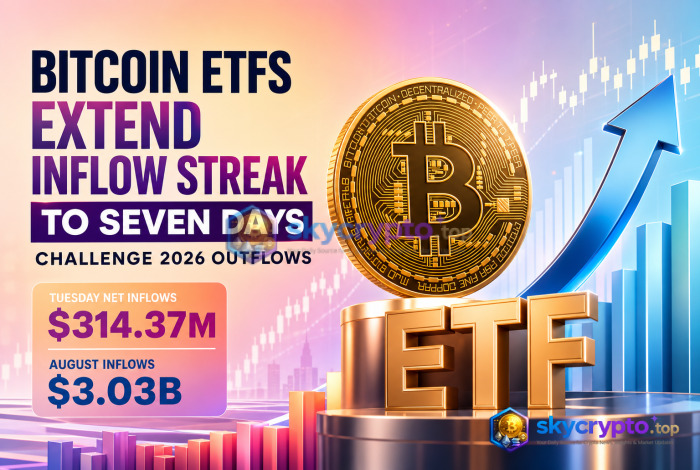
Spot ETF flows provide further confirmation. Net inflows across the eleven US-listed Bitcoin ETFs reached $1.2 billion last week, marking the third straight week of accumulation after a four-week outflow streak in August. BlackRock's IBIT led the pack with $640 million in net creations, followed by Fidelity's FBTC at $310 million. The sustained inflows indicate that registered investment advisors and pension allocators are gradually rotating back into Bitcoin after the summer correction.
Historical Context
Bitcoin's current consolidation around $80,000 mirrors several prior cycle patterns. The first weekly close above a major round-number support level after a multi-month correction has historically preceded further upside, though not without volatility. In March 2024, BTC reclaimed $70,000 as support after a six-week range and rallied another 28% within two months before topping out near $73,800. The $80,000 level carries similar technical weight, having served as resistance during the November 2024 breakout to new all-time highs.
The macro setup also resembles earlier Fed-pivot cycles. In late 2023, Bitcoin chopped sideways for nine weeks as markets waited for the Fed to confirm the end of its hiking campaign, ultimately breaking out once policy easing began. The current pause-versus-hike debate echoes that dynamic, though with elevated inflation and a stronger labor market complicating the picture. Historically, Bitcoin has delivered average returns of 12% in the four weeks following the first rate cut after a hiking cycle, provided that inflation remains contained.
Perhaps the closest comparable episode occurred in May 2021, when Bitcoin traded sideways for six weeks following a hot CPI print before breaking lower. That episode ended with a 55% drawdown over the subsequent three months. The current setup differs in important ways: ETF flows are positive, futures positioning is less leveraged, and the broader macro regime remains accommodative even if restrictive in absolute terms. Still, the May 2021 analogy warns that holding above a key level through a contested inflation print requires genuine buying pressure, not just short covering.
What Traders Are Watching
- $78,000 support level: A weekly close below this zone would invalidate the recent breakout and likely trigger a flush toward $74,000, where the 200-day moving average currently sits.
- August CPI core print: Consensus expects 0.2% month-over-month; a reading at or above 0.3% would confirm the hawkish thesis and lift rate-hike odds above 70%.
- August PPI release: Wholesale inflation often leads consumer prices by one to two months, making the Wednesday print a potential tell for the CPI surprise factor.
- CME FedWatch odds: Traders should monitor the probability of a September rate hike; a move above 65% would likely pressure risk assets further.
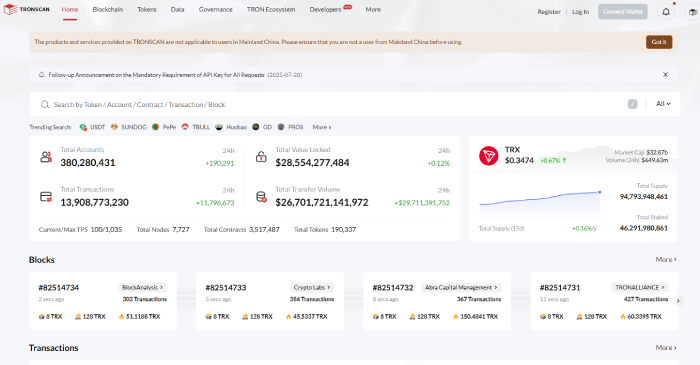
- Decentralized exchange stablecoin inflows: A surge in USDT and USDC minting on Tron or Ethereum typically precedes retail-led buying within 48 to 72 hours.
Disclaimer: This article is provided for informational and educational purposes only and does not constitute financial, investment, or trading advice. Digital assets carry significant market risk.




Comments
You must be logged in to post a comment.
Login or Register