

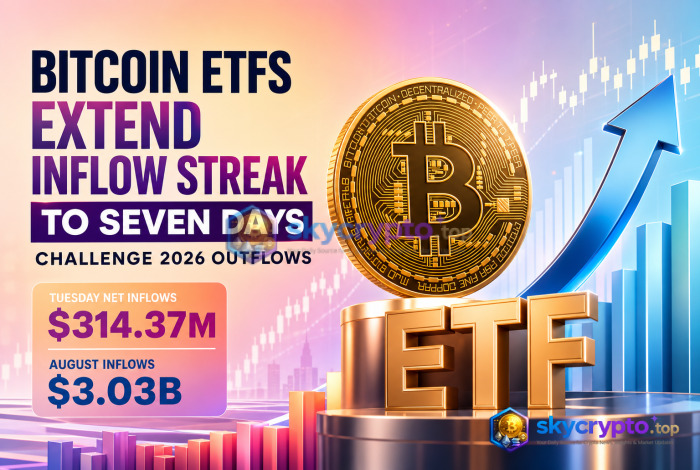
US spot Bitcoin exchange-traded funds (ETFs) extended their inflow streak to seven consecutive trading days on Tuesday, pulling in $314.37 million in net inflows. The sustained rally has pushed August inflows to $3.03 billion, positioning the month as the strongest since October 2025, with four trading sessions still left to go. At the heart of this momentum lies a sharp reversal in investor sentiment, as the funds trimmed their year-to-date net outflow deficit by more than half to $2.26 billion, signaling renewed confidence in Bitcoin’s long-term trajectory.
- Seven-day inflow streak totals $314.37 million on Tuesday, lifting August flows to $3.03 billion.
- Year-to-date net outflows reduced by over 50% to $2.26 billion; total net assets reach $99.05 billion.
- Bitcoin price dipped 2% to $78,880 despite intraday surge above $80,000; Fear & Greed Index drops to 65.
- US spot Ether ETFs match Bitcoin’s seven-day inflow run, adding $179.8 million and nearing $1 billion total.
Market Reaction
Bitcoin’s price action mirrored the broader market’s mixed reaction to the latest ETF data. After briefly breaking past the $80,000 mark during midday trading, the cryptocurrency pulled back to $78,880 by press time—a decline of roughly 2% over the prior 24 hours. Despite the dip, the failure to sustain gains above $80,000 suggests that while institutional demand remains firm, short-term profit-taking and technical resistance are capping upside. Traders appear cautiously optimistic, with many interpreting the consistent inflows as evidence that the worst of the post-ETF-launch correction may be behind us.
Market sentiment, as measured by the Crypto Fear & Greed Index, cooled slightly to 65 from 74 the previous day but stayed firmly within “Greed†territory. This indicates that although bullish momentum is intact, some hesitation lingers among retail participants. Order books across major exchanges showed increased liquidity around key support zones between $77,000 and $79,000, suggesting that deeper dips could attract fresh buying interest. Futures markets also reflected a nuanced backdrop, with open interest rising modestly alongside funding rates turning neutral after weeks of negative pressure.
Why This Happened
The catalyst behind the latest wave of inflows appears rooted in a combination of macroeconomic shifts and evolving investor psychology. Over the past week, U.S. Treasury yields have stabilized following a period of volatility tied to Federal Reserve policy expectations. With inflation cooling and no immediate signs of aggressive rate hikes, fixed-income assets have become less compelling relative to alternative investments like Bitcoin. Additionally, recent regulatory clarity regarding digital asset custody rules has eased concerns for institutional investors who were previously hesitant to allocate capital through traditional financial channels.
Another driving factor has been the growing recognition of Bitcoin as a potential hedge against currency debasement, particularly amid ongoing fiscal uncertainty in Washington. While gold continues to compete for the same store-of-value narrative, Bitcoin’s limited supply schedule and increasing adoption among corporations and sovereign entities provide a unique appeal. Analysts note that the convergence of positive flow dynamics and improving risk appetite has created a self-reinforcing cycle, where strong performance attracts more capital, which in turn fuels further price appreciation and validates the asset class to skeptics.
Institutional and Whale Activity
Large institutional players have played a pivotal role in shaping the current landscape, with several prominent asset managers increasing their exposures through both direct purchases and derivative positions. Data from blockchain analytics firms reveal that whales—defined as wallets holding over 10,000 BTC—have largely maintained their holdings throughout the recent rally, showing little inclination to offload even as prices rebounded. Notably, a handful of dormant addresses that had remained inactive since late 2024 quietly moved small batches of coins last week, sparking speculation about strategic repositioning rather than distribution.
In the derivatives space, CME Bitcoin futures open interest climbed to $18.4 billion, up nearly 6% from the prior week, indicating that sophisticated traders are building longer-dated positions. Meanwhile, options activity skewed heavily toward calls struck at $90,000 and above, underscoring expectations for continued upside. On-chain metrics paint a similarly bullish picture, with exchange reserves continuing to decline as holders migrate assets into cold storage. The MVRV ratio, which measures profit or loss relative to realized value, crept closer to breakeven levels, suggesting that while near-term volatility remains possible, the overall health of the network continues to improve.
Historical Context
This latest surge in ETF inflows echoes patterns seen during previous halving cycles, particularly those following the 2020 and 2021 bull runs. In each instance, the combination of shrinking exchange supplies and consistent institutional demand laid the groundwork for extended periods of upward price movement. What stands out this time, however, is the speed and scale at which inflows have materialized post-launch, far exceeding initial projections made by industry experts when the first wave of ETF applications was filed with the SEC.
Comparisons can also be drawn to the early days of global equity ETFs, where steady accumulation eventually gave way to explosive growth once critical mass was achieved. The parallel isn’t perfect—Bitcoin operates within a fundamentally different economic framework—but the behavioral similarities are striking. Just as equity ETFs democratized access to diversified portfolios, Bitcoin ETFs have lowered barriers to entry for mainstream investors, creating a feedback loop that reinforces itself with every new wave of inflows.
What Traders Are Watching
- $80,000 psychological resistance: A clean break above this level could set the stage for a move toward $85,000, especially if accompanied by sustained ETF inflows.
- August monthly close: Finishing the month with net inflows would mark the first positive August for US spot Bitcoin ETFs, a historically bearish period.
- Federal Reserve meeting minutes (due next week): Any hints of dovish policy shifts could bolster appetite for high-beta assets like Bitcoin.
- Crypto Fear & Greed Index trends: Continued stability in the mid-60s suggests room for sentiment to swing either direction without derailing the broader trend.
- Exchange reserve levels: Sustained outflows from exchanges indicate strong conviction among existing holders, supporting the case for higher valuations.
Disclaimer: This article is provided for informational and educational purposes only and does not constitute financial, investment, or trading advice. Digital assets carry significant market risk.




Comments
You must be logged in to post a comment.
Login or Register