

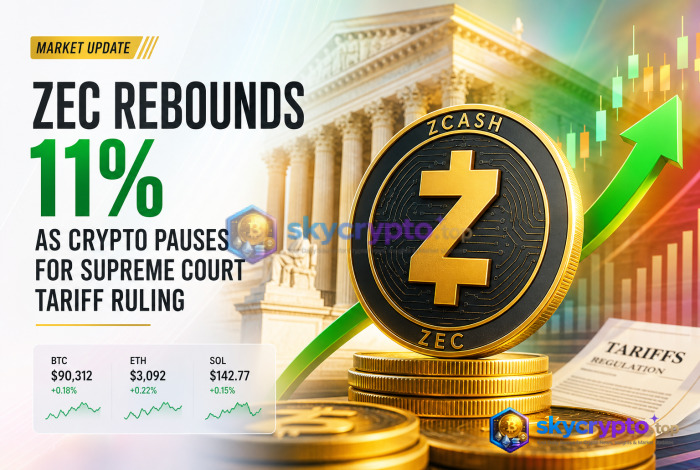
Crypto markets traded largely sideways on Tuesday as investors braced for a long-awaited Supreme Court opinion on the Trump administration's tariff regime, with Bitcoin clinging to the $90,300 level and Ether consolidating near $3,090. Privacy token Zcash stole the spotlight with an 11% rebound, while Polygon matched that gain on reports of an imminent acquisition targeting a major U.S. Bitcoin ATM operator. The muted tape belied a busy news flow spanning fresh institutional upgrades, a high-profile pardon refusal, and renewed state-level moves to stockpile Bitcoin.
- Bitcoin trades at $90,300, Ether at $3,090, with ZEC and Polygon each up 11% as top movers.
- JPMorgan says the recent BTC and ETH sell-off may be bottoming, citing improved positioning.
- Bank of America upgrades Coinbase to Buy, citing regulatory clarity and institutional adoption.
- President Trump rules out a pardon for disgraced FTX founder Sam Bankman-Fried.
- Florida lawmakers revive a state-level Strategic Bitcoin Reserve proposal.
Market Reaction: A Tense Pause Before the Court Speaks
Trading desks described a coiled, low-conviction session as the market awaited the Supreme Court's tariff ruling, a decision that could redraw the playing field for cross-border capital flows and digital asset policy in one stroke. Bitcoin's 1% gain to $90,300 looked unremarkable on the surface, but the muted range masked a subtle shift in intraday order flow, with bid depth thickening on Coinbase and Kraken as the New York afternoon progressed. Ether held firm at $3,090, holding the line above the psychologically important $3,000 threshold that bulls defended late last week.
Solana outperformed the majors with a 3% push to $138, while XRP crept 1% higher to $2.10 on light volume. The day's clear outperformers were Zcash and Polygon, each rallying 11%, with Maple Finance's SYRUP token adding 7% on the back of broader DeFi rotation. Traders attributed ZEC's surge to a combination of short-covering and renewed retail interest in privacy-preserving assets, while Polygon's move tracked deal chatter rather than spot demand. With the VIX hovering near multi-month lows, derivatives markets priced in a quiet session, but the tape set up for a sharp reaction to whatever the Court delivered.
Why This Happened: Tariff Anxiety, Pardon Refusal, and State-Level FOMO
The macro backdrop centered on the Supreme Court's pending opinion on the legal basis for the Trump-era tariffs, a verdict that carries direct implications for trade-exposed equities, the dollar, and risk assets broadly. Markets hate unresolved binary outcomes, and the crypto complex reflected that tension in compressed realized volatility. A ruling against the administration could trigger a relief rally across import-sensitive sectors and emerging market proxies, while a confirmation of executive authority may force a repricing of global growth assumptions. Either way, the Supreme Court opinion functioned as the gravitational center of Tuesday's risk-off undercurrent.
On the policy front, President Trump's public confirmation that he will not pardon Sam Bankman-Fried closed one of crypto's longest-running political question marks, removing a tail risk that had occasionally resurfaced whenever the disgraced FTX founder's appeal hit the headlines. The refusal also signaled, at least implicitly, that the administration's posture toward crypto fraud enforcement will not soften, even as it pursues more permissive rules around stablecoins and market structure. Layered on top, Florida's renewed legislative push for a Strategic Bitcoin Reserve added fuel to the state-level accumulation narrative, joining Texas and a handful of other states already weighing similar bills.
Institutional and Whale Activity: JPMorgan Sees a Bottom, BofA Flips on Coinbase
JPMorgan's global markets team told clients this week that the year-to-date sell-off in Bitcoin and Ether may be approaching an exhaustion point, pointing to cleaner futures positioning, reduced leverage in perpetual swaps, and an easing of systematic selling pressure that had dragged both assets lower in early-year trade. The bank's analysts highlighted that funding rates on CME Ether futures have normalized, while options skews have flattened, two technical signatures often associated with capitulation phases rather than fresh bearish impulses. While JPMorgan stopped short of issuing a formal price target, the tone represented a notable softening from earlier in the year when strategists had warned of deeper drawdowns.
Bank of America's equity research desk upgraded Coinbase to Buy from Neutral, citing three pillars: improved regulatory clarity following recent SEC guidance, accelerating institutional adoption of spot Bitcoin ETFs, and stronger visibility into long-term earnings as the exchange diversifies into stablecoin revenue, custody, and tokenization services. Separately, Morgan Stanley confirmed plans to launch a digital wallet later this year capable of supporting tokenized private equity, a move that would deepen the bank's footprint in the on-chain asset space and put competitive pressure on incumbent custodians. On-chain, Ethereum's validator exit queue fully cleared for the first time in months, removing a friction point that had throttled liquid staking withdrawals and contributed to stETH discount volatility across major DeFi venues.
Historical Context: Echoes of Past Tariff Shocks and Privacy Coin Cycles
Tariff-driven volatility is a familiar chapter in Bitcoin's relatively short macro history. During the 2018 trade war escalation, BTC experienced its first prolonged correlation spike with U.S. equities, a dynamic that repeated in 2022 when Fed tightening and tariff uncertainty combined to push the index to a 75% drawdown. Each time, the initial risk-off reaction eventually gave way to a recovery once the policy path became clearer, a pattern that bulls hope repeats if the Court delivers a definitive ruling. Privacy coins, meanwhile, have followed their own cyclical rhythm, with Zcash's prior double-digit rallies typically coinciding with regulatory crackdowns on centralized mixing services or renewed surveillance concerns, both of which tend to drive demand for shielded-transaction alternatives.
State-level Bitcoin reserve proposals have also been tried before, with Wyoming's 2019 special-purpose depository institution charter serving as a template, and Texas passing legislation last year allowing the state comptroller to hold Bitcoin under specific conditions. Florida's latest attempt draws directly on that momentum, though execution risk remains high given the volatility profile of the proposed reserve asset. The simultaneous arrival of traditional finance heavyweights like Morgan Stanley and Bank of America back into the crypto conversation also echoes the 2017 and 2020-2021 institutional adoption waves, with the notable difference that the regulatory environment, while still imperfect, has matured enough to support sustained product launches rather than speculative one-offs.
What Traders Are Watching
- Bitcoin resistance at $92,000 and $95,000: A clean break above the latter would invalidate the recent lower-high structure and likely trigger short-covering toward the $100,000 round number.
- Ether support at $3,000: Losing this level on a daily close would re-open the path toward the $2,800 zone, where heavy options open interest clusters as a downside magnet.
- ZEC continuation above $400: An 11% move with low float can extend sharply, but traders will watch for a retest of prior resistance as new support before committing to further upside.
- Coinbase post-upgrade price action: Bank of America's Buy rating adds a credibility halo; a decisive break above recent highs would confirm institutional accumulation rather than short-term tactical positioning.
- Supreme Court tariff opinion timing and language: A narrow ruling limits market fallout, while a sweeping opinion either upholding or striking down executive tariff authority would force a cross-asset repricing, with Bitcoin's correlation to the Nasdaq likely to spike on the headline.
Disclaimer: This article is provided for informational and educational purposes only and does not constitute financial, investment, or trading advice. Digital assets carry significant market risk.


Comments
You must be logged in to post a comment.
Login or Register