

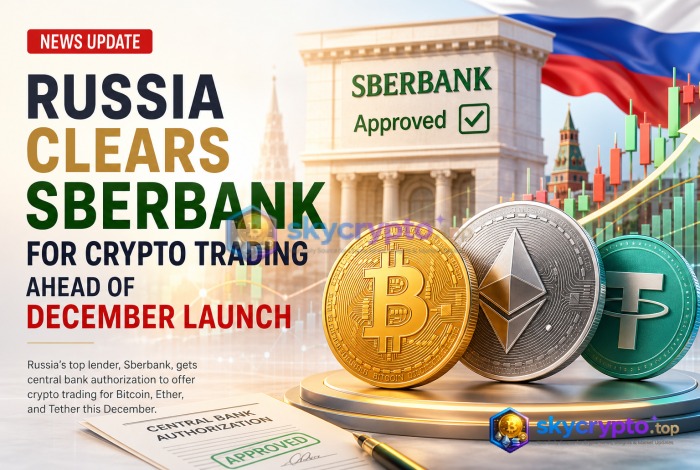
Russia's dominant financial institution, Sberbank, has officially secured central bank authorization to offer cryptocurrency trading services. The state-backed lender plans to roll out digital asset trading for Bitcoin, Ether, and Tether in December, marking a monumental shift in the nation's financial policy.
This regulatory clearance brings institutional-grade digital asset access directly to millions of retail and corporate account holders across the country. The move highlights an aggressive acceleration in state-sanctioned crypto integration as authorities work to bypass traditional Western financial corridors.
- Sberbank secured official central bank authorization to operate a regulated digital asset exchange in Russia.
- The platform will support Bitcoin, Ether, and Tether USDt starting in December.
- Ten exchange operators and six digital custodians now populate the updated Bank of Russia regulatory register.
Market Reaction
Russian market participants and local trading desks responded with immediate optimism following the central bank registry update on Tuesday. Domestic liquidity providers anticipate a surge in localized trading volume once Sberbank integrates digital assets into its primary consumer applications, including SberBank Online and SberInvestments. Traders have begun positioning themselves ahead of the December launch window, speculating that domestic demand will create persistent buying pressure for benchmark assets.
Despite the bullish sentiment surrounding retail access, professional desks maintain a cautious stance due to ongoing domestic restrictions. Domestic regulations strictly prohibit using digital assets for settling everyday goods and services within Russian borders. Therefore, traders view the upcoming Sberbank rollout strictly as an investment and wealth-preservation mechanism rather than a medium of exchange for retail commerce.
Derivatives markets showed mild upward momentum following the announcement, though global liquidity pools remained largely indifferent to regional Russian developments. International desks continue to weigh the potential compliance risks associated with sanctioned Russian banking entities entering the digital asset arena. Nevertheless, local OTC desks report an uptick in inquiries from high-net-worth individuals seeking compliant avenues to accumulate Bitcoin and Ether before the official platform debut.
Why This Happened
The regulatory greenlight stems directly from sweeping legislative changes that took effect on September first. These new rules established a formal framework for cryptocurrency exchange operators and digital custodians, placing them under the direct supervision of the Bank of Russia. By legalizing and containing the sector within state-monitored channels, Moscow aims to capture tax revenue and maintain tight oversight of capital flows moving in and out of the jurisdiction.
Geopolitical isolation and severe international sanctions forced Russian financial authorities to rethink their hostile stance toward decentralized assets. Traditional cross-border payment rails remain heavily restricted, compelling the state to embrace alternative settlement systems. Sberbank and competitor VTB now serve as instruments of state financial strategy, utilizing digital currencies to facilitate international trade and mitigate the impact of Western banking exclusions.
The central bank registry expanded rapidly over the course of a single week, jumping to ten authorized exchange operators from just four. This sudden bureaucratic expansion demonstrates a coordinated policy push to onboard major financial institutions quickly. Sberbank secured digital custodian status early in the process, laying the groundwork for safe storage solutions before opening retail trading portals to the public.
Institutional and Whale Activity
On-chain analytics firms note early accumulation patterns among domestic wallets linked to Russian financial institutions during testing phases. Sberbank confirmed that internal testing of purchases, sales, deposits, and withdrawals is already underway inside the SberBank Online mobile environment. These preliminary technical runs generate distinct blockchain footprints as developers test liquidity routing and custodial security protocols.
Large capital holders inside the region are preparing for the December launch by establishing custodial accounts with authorized nonbank entities and newly licensed banks. T-Invest Lab and Atomyze also secured spots on the updated regulatory register, offering alternative channels for corporate whales looking to diversify treasury reserves. Futures open interest on local platforms has ticked upward, signaling that institutional participants are actively deploying capital ahead of the official go-live date.
Compliance officers across global exchanges are monitoring these developments closely to screen for potential sanctions evasion vectors. Because Sberbank remains under strict Western sanctions, international liquidity pools must enforce strict separation from the newly authorized Russian crypto infrastructure. This bifurcation creates a parallel domestic market operating under strict state oversight.
Historical Context
Russia's journey toward institutional crypto integration represents a complete reversal of official policy from prior years. As recently as 2022, the Bank of Russia proposed a total ban on all cryptocurrency mining and trading activities, citing systemic risks to financial stability. Financial authorities argued that digital assets threatened the ruble's dominance and facilitated illicit capital flight out of the country.
Sanctions pressure fundamentally altered the central bank's risk calculus, shifting the institutional perspective from outright prohibition to tightly controlled adoption. Comparing current policies to the 2022 regulatory drafts reveals a pragmatic pivot born out of necessity. Instead of destroying the domestic digital asset industry, Moscow chose to absorb, regulate, and weaponize it against external economic pressure.
This state-directed integration mirrors historical precedents where isolated economies turned to alternative financial networks to survive embargoes. However, Russia's model differs by creating a heavily centralized framework where private citizens can trade major assets like Bitcoin and Tether, provided the activity remains anchored within state-approved banking applications.
What Traders Are Watching
- The official December 1 launch date and any potential regulatory delays announced by the central bank.
- Sberbank transaction volume metrics and user adoption rates reported through subsequent quarterly earnings releases.
- Potential secondary sanctions announcements from Western regulators targeting Russian digital asset custodians.
- Domestic liquidity trends and premium spreads between local ruble-denominated crypto pairs and global dollar markets.
Disclaimer: This article is provided for informational and educational purposes only and does not constitute financial, investment, or trading advice. Digital assets carry significant market risk.



Comments
You must be logged in to post a comment.
Login or Register