

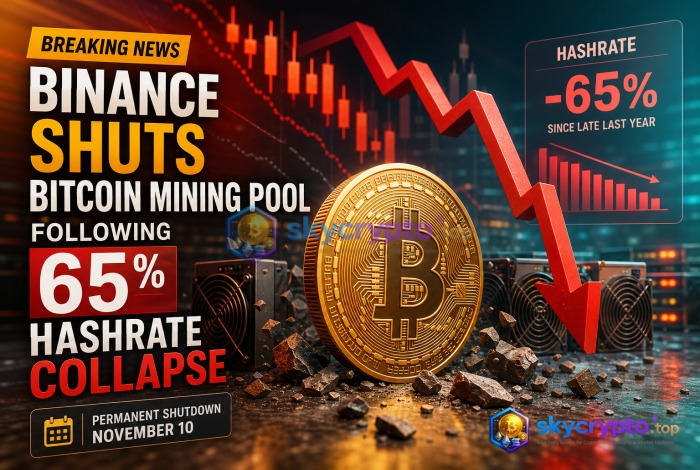
Binance will permanently shut down its Bitcoin mining pool on November 10 after computing power directed at the service dropped 65 percent from late last year. The exchange notified participants that Binance Pool, Pool Savings, Cloud Mining, and its proprietary transaction accelerator will cease operations at 7 a.m. UTC following an internal product review. The shutdown marks the complete exit of major crypto exchanges from collective mining operations, leaving the sector entirely to dedicated infrastructure specialists.
- Binance Pool had an estimated 26 exahashes per second (2.3% of the network) in December, but has dropped to 9.2 EH/s, ranking 11th globally.
- All pool services, cloud mining packages, and transaction acceleration tools close permanently on November 10, with user dashboards disappearing on November 24.
- The closure follows similar exits by SBI Crypto in July and OKX in February, alongside Poolin's bankruptcy proceedings.
- Full Pay-Per-Share (FPPS) payout models exposed the exchange to variance risk during post-halving revenue compression.
Market Reaction
Bitcoin markets absorbed the news with calculated calm, treating the closure as an operational realignment rather than an existential threat to network security. Spot prices held steady around key support ranges, reflecting market confidence that computational capacity will seamlessly migrate to rival pools rather than unplug completely. Because mining pools aggregate computing power rather than owning all the physical Application-Specific Integrated Circuit (ASIC) hardware themselves, an operator shutdown merely forces participants to point their stratum connections to alternative endpoints. The overall network hashrate did not suffer an immediate drawdown following the notice.
Miners faced immediate operational shifts as trading desks analyzed hashprice compression. Hashprice, which measures the daily dollar value expected from each petahash per second of compute, hovered near multi-year lows following the April block reward halving. That halving cut the baseline block emission from 6.25 BTC to 3.125 BTC, squeezing operations that lacked rock-bottom electricity rates. ASIC operators using Binance took to community forums to coordinate switches to independent operators, balancing payout fees against counterparty risks.
Sentiment across the mining sector indicates a broader flight to dedicated infrastructure. Independent operators view the retreat of financial conglomerates as a return to specialization. For months, retail miners complained about delayed payouts, stringent identity verification hurdles, and exchange-side capital requirements. With Binance setting an absolute cutoff for final payouts at 11:59 p.m. UTC on November 10, small-scale participants are scrambling to verify their accounts, liquidate remaining balances from Pool Savings, and avoid trapped balances before the interface vanishes entirely on November 24.
Why This Happened
The core catalyst behind the pool closure lies in the unsustainable economics of the Full Pay-Per-Share (FPPS) model during periods of declining pool market share. Under FPPS, pool operators guarantee payments for every valid share submitted, compensating miners for both block subsidies and estimated transaction fees regardless of whether the pool actually discovers a block. When Binance controlled 26 exahashes per second (EH/s), or 2.3 percent of global computing power, the law of large numbers protected the balance sheet. However, as compute fell to 9.2 EH/s, block discovery became sporadic, turning variance risk into an active cash bleed for the exchange.
Escalating network difficulty compounded the problem. Bitcoin hashrate hit record highs above 700 EH/s throughout late 2024, driving the threshold for profitable block discovery beyond the reach of marginal pools. Binance found itself competing against purpose-built entities like Foundry USA and AntPool, which together command more than half the total network compute. As institutional miners migrated their fleets to pools offering direct white-glove hosting, treasury management, and custom firmware integration, Binance lost the scale required to make a zero-fee or low-fee pool commercially viable.
Corporate restructuring under new regulatory settlements also accelerated the product cull. Following executive turnover and sweeping global compliance agreements, Binance launched extensive audits of capital-intensive, high-liability business lines. An October 2022 initiative to deploy a $500 million lending facility for distressed miners burdened the platform with uncollateralized default risk as machine values plummeted. Shuttering the pool, alongside high-risk consumer products like Cloud Mining, reduces regulatory exposure and sheds non-core balance-sheet burdens without harming spot trading revenue.
Institutional and Whale Activity
Institutional mining operations long ago began abandoning exchange-hosted mining pools in favor of domestic, compliant pools and custom treasury architectures. Publicly traded mining titans in North America, including CleanSpark, Riot Platforms, and Marathon Digital, prioritize pool operators capable of delivering audited financial statements and segregated wallet structures. These corporations cannot afford the counterparty risk of leaving hashrate tied to offshore exchange pools whose primary business lies in token trading. The departure of these commercial accounts stripped Binance Pool of tens of exahashes over the past eighteen months.
On-chain data reveals that large miners have maintained defensive postures, selectively liquidating mined reserves to finance high-efficiency hardware upgrades. Whale tracking services show periodic transfers from miner addresses to centralized trading desks, coinciding with difficulty adjustments that priced out legacy Antminer S19 units. At the same time, institutional liquidity providers have expanded their operations in the Chicago Mercantile Exchange (CME) Bitcoin futures market, using derivative contracts to lock in operational profits rather than relying on the yield-generation features once promoted through Binance Pool Savings.
The redistribution of Binance Pool’s remaining 9.2 EH/s will reinforce existing oligopolies among top mining organizations. Industry tracking desks report steady inflows of hashrate into non-custodial and specialist entities such as F2Pool, ViaBTC, and MaraPool. Whales who control multi-megawatt facilities are opting for direct connections that bypass intermediary custody accounts entirely. This migration away from exchange custody insulates operational capital from regulatory freezes and account-level trade restrictions.
Historical Context
The rise and fall of Binance Pool illustrates the life cycle of the exchange-mining hybrid model that emerged at the peak of the 2020 bull market. Four years ago, top cryptocurrency exchanges sought to control every link in the value chain, from raw ASIC hash discovery to spot order books and derivative settlement. OKX, Huobi, Binance, and SBI Crypto all launched dedicated mining operations, offering discounted trading fees and integrated lending facilities to lure miners onto their platforms. This vertical integration promised automated revenue loops where mined coins would flow straight into exchange order books.
That thesis has now completely fractured under competitive and macroeconomic pressures. OKX shuttered its mining pool operations in February 2024 after struggling to maintain adequate participation. SBI Crypto, backed by Japanese financial giant SBI Holdings, closed its pool on July 31 after its global network share tumbled from roughly 2 percent to irrelevance. Earlier, pioneer pool operator Poolin collapsed into bankruptcy in July owing approximately $173 million, crushed by frozen liquidity, debt disputes, and stalled infrastructure sites in Texas. Binance Pool stood as the last surviving exchange-operated pool from that expansionary era.
Bitcoin’s history shows that mining centralization cycles frequently peak and then reset through market discipline. In 2014, Ghash.io famously controlled over 51 percent of the network hashrate before public backlash and economic realities triggered a voluntary community defection, leading to its eventual demise. In 2017 and 2018, hardware manufacturer Bitmain dominated global hashrate through Antpool and BTC.com. Today, power has consolidated inside institutional, North American public miners and professional software providers, showing that multi-service cryptocurrency exchanges cannot effectively compete against dedicated mining firms.
What Traders Are Watching
Traders and market analysts are monitoring several critical indicators to evaluate the health of the mining sector following this consolidation:
- Bitcoin Hashprice Index: Analysts track whether hashprice can hold above the critical $40 per petahash per day baseline, the break-even threshold for operators running previous-generation hardware.
- Network Difficulty Adjustments: The upcoming bi-weekly difficulty adjustments will indicate whether high production costs force a broader surrender of older hardware across smaller mining operations.
- Key Support and Resistance Levels: Bitcoin spot price action centered around the $60,000 structural support zone, with institutional bulls watching for a sustained breakout above the $68,500 resistance band to re-expand miner profitability.
- Exchange Reserve Inflows from Miner Wallets: Real-time tracking of miner wallet reserves on Glassnode and CryptoQuant to detect potential inventory offloading ahead of the Binance Pool final closure.
- Hashrate Redistribution to Foundry and AntPool: Monitoring whether the top two global mining pools exceed 60 percent aggregate network share, a threshold that raises network centralization concerns.
The ultimate closure of Binance Pool on November 10 closes a distinct chapter in cryptocurrency market structure. Mining operations have transformed into an industrial, capital-intensive infrastructure trade governed by energy contracts, hardware efficiencies, and regulatory compliance. Exchange platforms are retreating to their core businesses of order execution, derivatives clearing, and custodial settlement, accepting that the extraction of blocks belongs to hardware specialists rather than digital brokerages.
Disclaimer: This article is provided for informational and educational purposes only and does not constitute financial, investment, or trading advice. Digital assets carry significant market risk.







Comments
You must be logged in to post a comment.
Login or Register