

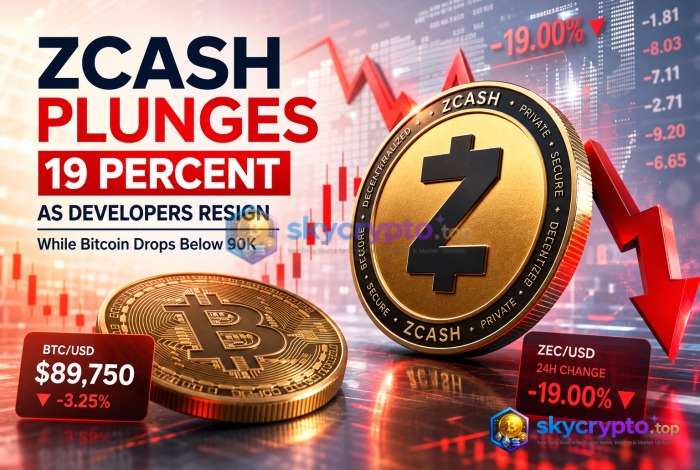
Digital asset markets experienced sharp selling pressure as ZCash tumbled 19 percent following the sudden resignation of its core development team amid an escalating dispute with the project board. Simultaneously, Bitcoin slid below the critical $90,000 psychological threshold to trade at $89,900, triggering broader liquidations across major alternative cryptocurrencies. The market turbulence coincides with accelerating institutional adoption announcements and mounting legislative pressure in Washington ahead of a pivotal Senate Banking Committee vote next week.
- ZCash (ZEC) fell 19 percent after core developers resigned following an intractable corporate governance conflict with the board.
- Bitcoin dipped below $90,000 to trade at $89,900, dragging down Ethereum, Solana, and XRP in a broader market pullback.
- Institutional mega-banks JPMorgan and Barclays advanced major digital asset and stablecoin initiatives despite market weakness.
- Starknet suffered a multi-hour network outage caused by a block production bug, forcing a state rollback before resuming operations.
Market Reaction
The cryptocurrency market faced aggressive liquidation across multiple asset classes over the past 24 hours. ZCash bore the primary impact of the selling, falling 19 percent in a matter of hours as news of the internal developer exodus spread across trading desks. Panic selling forced prices lower as market participants raced to de-risk, dumping spot holdings and liquidating margin long positions. The sudden plunge broke key technical support levels, leaving ZCash exposed to further downside volatility as order book liquidity thinned significantly across major centralized exchanges.
The contagion spread into larger market cap assets, where Bitcoin surrendered the $90,000 handle to touch $89,900, marking a 2 percent daily decline. Ether declined 3 percent to trade near $3,100, while Solana dropped 3 percent to $134. Ripple's XRP suffered a steeper 7 percent drop, falling to $2.08 as traders locked in profits from previous rallies. Total derivatives market liquidations surged as long positions were caught off guard by the abrupt turn in sentiment across top-tier spot platforms.
In contrast to the broader market decline, selective assets demonstrated localized strength. Monero gained 3 percent as capital rotated directly into alternative privacy assets following the structural uncertainty surrounding ZCash. Small-cap tokens Litentry and World Liberty Financial also managed 3 percent gains each, demonstrating that capital flows remained highly selective and driven by specific headline catalysts rather than broad sector buying.
Why This Happened
The primary catalyst behind the collapse in ZCash was an irreconcilable governance dispute between the core development engineering team and the governing board. Tensions culminated in the collective resignation of key developers, creating immediate operational and technical uncertainty for the privacy protocol. Although the departing developers publicly promised to launch a new commercial enterprise to continue their technical mission, traders immediately priced in the risks associated with fractured community support, potential brand fragmentation, and unclear long-term protocol maintenance.
Compounding the specific corporate drama at ZCash, broader technical infrastructure failures weighed on overall market sentiment. Starknet experienced a severe multi-hour service disruption triggered by a critical block production bug. The Layer 2 scaling protocol was forced to completely halt sequence operations and perform a network rollback to fix the state corruption before resuming normal operations. The outage highlighted recurring operational risks within emerging layer-2 scaling architectures, diminishing risk tolerance across speculative assets.
Macroeconomic uncertainty and regulatory scrutiny also played a prominent role in suppressing buy-side demand. Traders adjusted positions ahead of next week's highly anticipated Senate Banking Committee vote regarding market structure legislation. With regulatory compliance standards tightening and geopolitical tensions maintaining pressure on risk assets, institutional capital hesitated to defend key price levels, allowing short sellers to push Bitcoin below $90,000.
Institutional and Whale Activity
Despite public market weakness, institutional infrastructure development continued at a remarkable cadence. Banking giant JPMorgan announced plans to deploy its proprietary JPM Coin framework on the Canton Network, expanding its corporate settlement capacity. Concurrently, global banking institution Barclays acquired an equity stake in Ubyx, a United States stablecoin settlement provider focused on enabling regulated institutions to transfer digital sovereign currencies across disparate blockchain issuers and institutional wallets seamlessly.
Public sector and regulated entities also signaled structural growth in tokenized payments. Wyoming launched the Frontier Stable Token, marking the first officially state-issued stablecoin made accessible to the public. Meanwhile, a subsidiary of World Liberty Financial submitted a charter application to the Office of the Comptroller of the Currency to establish a national trust bank. The application aims to secure federal regulatory coverage for issuing and custodying its USD1 stablecoin within a recognized banking framework.
On-chain intelligence reveals significant whale rebalancing activity amid these announcements. Large capital allocators reduced exposure to governance-heavy altcoins like ZEC, redirecting funds into institutional-grade infrastructure projects or defensive cash equivalents. Futures market data indicates that institutional desks maintained balanced hedge positions, using the dip below $90,000 in Bitcoin to execute automated spot accumulation strategies while buying downside protective options.
Historical Context
Internal governance rifts and developer splits carry a long, contentious history in digital assets, often serving as critical inflection points for network valuations. Historical precedents include the 2017 Bitcoin Cash hard fork and the 2020 Hive fork from Steem. In each instance, severe internal governance conflicts created short-term price drawdowns and long-term division of community resources. ZCash now faces a similar structural test as market participants weigh whether the protocol can survive without its original core engineering collective.
Bitcoin's struggle around the $90,000 price level mirrors previous market behavior during major numerical milestones. Historically, psychological barrier levels such as $10,000 in 2017 or $50,000 in 2021 required extensive consolidation and multiple retests before establishing definitive support. Brief pullbacks below major round numbers frequently shake out excessively margin-extended derivatives positions, building a healthier foundation for subsequent price discovery cycles.
The regulatory and banking initiatives observed today represent a stark departure from previous crypto market pullbacks. In prior market cycles, institutional entities typically withdrew capital and paused technical integration during periods of high volatility. Today, mega-banks like JPMorgan and Barclays continue expanding operational blockchain deployments regardless of short-term spot token price fluctuations, highlighting a fundamental decoupling between infrastructure development and speculative token valuation.
What Traders Are Watching
Market participants are focusing on specific key levels and upcoming catalysts to gauge whether current price action represents a temporary correction or a deeper trend reversal across digital asset markets.
- Bitcoin Price Levels: Defense of the $88,000 support level is vital to prevent a deeper drawdown toward $85,000, while reclaiming $90,000 remains the critical trigger for bullish momentum.
- ZCash Governance Developments: Traders are tracking official announcements regarding the newly formed developer firm, legal intellectual property disputes, and prospective technical roadmaps for ZEC.
- Senate Banking Committee Vote: Outcome of next week's crucial vote on crypto market structure legislation in Washington, which could dictate institutional regulatory clarity in the United States.
- Starknet Network Health: Monitoring post-rollback block production stability and transaction throughput metrics to confirm complete resolution of the block bug.
- World Liberty Financial Charter Application: Regulatory updates regarding the OCC trust bank application for the USD1 stablecoin.
Disclaimer: This article is provided for informational and educational purposes only and does not constitute financial, investment, or trading advice. Digital assets carry significant market risk.


Comments
You must be logged in to post a comment.
Login or Register