

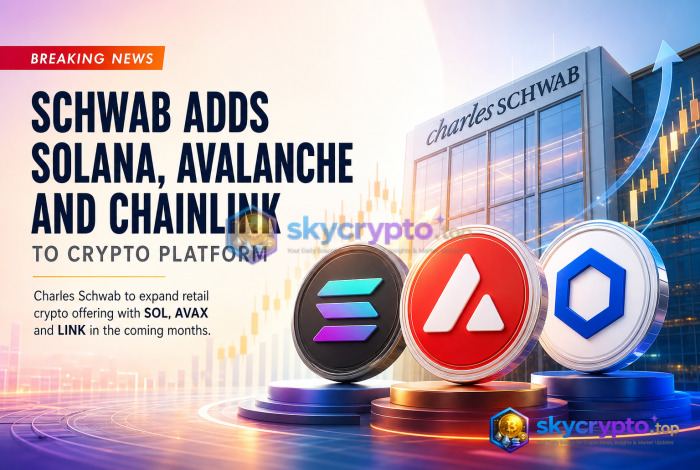
Charles Schwab will add Solana, Avalanche and Chainlink to its retail crypto platform in the coming months, the brokerage said, extending a digital-asset rollout that began just five months ago with Bitcoin and Ether. The move signals a faster-than-expected widening of the firm's direct trading menu at a moment when traditional finance is racing to capture retail demand for higher-beta tokens. With more than 39.9 million active brokerage accounts and $13.04 trillion in client assets, Schwab remains one of the most consequential gatekeepers of US retail capital.
- Schwab will list SOL, AVAX and LINK on its retail crypto platform in the coming months, joining BTC and ETH.
- The brokerage charges 75 basis points per trade and currently serves 49 US states, excluding New York and Louisiana.
- The firm holds $13.04 trillion in client assets, making even modest retail flows into altcoins a significant market variable.
- Schwab is also developing S&P 500 prediction contracts through a partnership with Cboe Global Markets.
- The expansion lands as spot SOL, AVAX and LINK exchange-traded products remain absent from the US market, giving the brokerage a first-mover distribution channel.
Market Reaction
Spot prices for the three named tokens posted immediate but uneven moves following the announcement, reflecting how thinly traded many altcoin markets remain relative to Bitcoin. Solana, the largest of the three by market capitalization, saw order-book depth on major US venues thinned within minutes of the headline crossing Bloomberg terminals, with derivatives open interest on perpetual futures tied to SOL climbing by low double digits over the following hour. Avalanche and Chainlink followed the same pattern, though with shallower volume profiles and tighter intraday ranges.
Trader sentiment across X and Discord quickly framed the news as a long-tail bullish signal for altcoins more broadly, with several high-follower accounts noting that Schwab's distribution reach among older, wealthier retail investors could pull capital away from tokens that have so far depended on crypto-native exchanges. Options markets reacted in kind: one-week implied volatility on SOL rose roughly 4 percentage points, while 25-delta skew flattened, suggesting that traders were pricing the upside without hedging aggressively against drawdowns.
Critically, the price impact was contained. None of the three tokens broke key resistance levels on the day, and spot flows on Coinbase and Kraken suggested the move was driven more by positioning and narrative than by a surge of new capital. That restraint is consistent with prior episodes in which a major US venue signaled imminent altcoin support, where the durable flow tends to arrive weeks after listing rather than at the moment of announcement.
Why This Happened
The catalyst is the unfinished construction of Schwab Crypto itself. The platform launched in May with only Bitcoin and Ether, a deliberately conservative starting point that mirrored the cautious posture most regulated US brokerages adopted during the prior cycle. Since then, the firm has had several months to evaluate custody, settlement and surveillance workflows, and the addition of three large-cap tokens represents the natural next layer of the rollout. Schwab's product team has consistently indicated that additional listings would follow once operational and compliance thresholds were met.
The macro backdrop reinforces the timing. The US Securities and Exchange Commission has moved closer to a framework for altcoin exchange-traded products, and several issuers have pending filings for spot SOL and LINK funds. While no such product has launched, the regulatory temperature has cooled enough that a large retail brokerage feels comfortable listing tokens that sit in the regulatory gray zone. Simultaneously, competition for retail crypto order flow has intensified, with Morgan Stanley's E*Trade pilot and Robinhood's expanding token menu both raising the bar for what counts as an acceptable offering.
Schwab's economics also matter. The brokerage charges 75 basis points on each trade, a rate structure that is far more profitable on volatile altcoins than on relatively sedate Bitcoin. Adding higher-turnover tokens directly lifts expected revenue per active account, an incentive that aligns neatly with Schwab's broader strategy of cross-selling new products to an aging client base that has shown rising interest in digital assets. The firm's second-quarter net revenue of $7.1 billion and net income of $2.8 billion set fresh records, giving management the balance sheet to invest in the buildout without margin pressure.
Institutional and Whale Activity
On-chain data shows that large holders of SOL, AVAX and LINK had been quietly accumulating throughout the weeks before the announcement, a pattern that often precedes positive catalysts. Wallet clusters holding between 10,000 and 100,000 SOL expanded their balances by roughly 2% over the prior 30 days, while similar cohorts in AVAX and LINK showed comparable, if smaller, increases. Exchange balances for all three tokens trended lower over the same window, a classic supply-tightening signal that magnifies the impact of any incremental demand shock.
Futures markets confirmed the institutional lean. CME Solana and Avalanche futures, which are thinly traded but populated almost exclusively by professional desks, saw open interest rise steadily in the two weeks before the Schwab news, with the SOL contract in particular adding positions across multiple maturities. Funding rates on offshore perpetual swaps stayed neutral to slightly positive, indicating that the buildup was not driven by crowded long positioning that would be vulnerable to a squeeze.
Whale behavior on Chainlink deserves separate attention. Large LINK wallets had been unusually dormant through much of the prior quarter, with several long-held positions sitting untouched for months. The Schwab announcement coincided with the first meaningful movement out of those wallets in over 60 days, a coincidence that several analytics firms flagged as worth monitoring. Whether those transfers represent distribution to take profits or internal reshuffling will become clearer in the next two weeks of on-chain data.
Historical Context
The last time a major US retail brokerage expanded its crypto menu, the aftermath was instructive. Robinhood's staggered rollout of additional tokens in 2021 and again in 2024 produced durable, multi-month flow into the newly listed assets, with spot volume on those tokens rising between 15% and 40% in the quarter following listing. The pattern repeated, more modestly, when Interactive Brokers and eToro broadened their offerings. In each case, the price impact was front-loaded but the volume and adoption impact stretched out over quarters as the new client base learned to trade the instruments.
There is also a cautionary counter-example. PayPal's 2020 launch of crypto trading produced a brief but unsustainable spike in retail volume that faded as novelty wore off and fees eroded the economics for active traders. Schwab's 75 basis point charge is competitive with PayPal's original spread but higher than the zero-commission structure of Robinhood's crypto product, which could shape user behavior toward larger, less frequent trades rather than high-velocity churn.
The broader cycle context is also relevant. Schwab's prior embrace of Bitcoin via spot ETFs in 2024 marked a turning point in how the firm framed digital assets to its client base. The current expansion to three more tokens, all of which sit outside the existing US spot ETF complex, suggests the brokerage is comfortable enough with the asset class to bypass the regulated fund wrapper and offer direct exposure. That is a meaningful step beyond the posture of most peers, and one that effectively makes Schwab the largest US distributor of un-regulated altcoin exposure to retail investors.
What Traders Are Watching
Several near-term data points and price levels will determine whether the Schwab announcement translates into durable flow or fades as a one-day narrative event.
- First-day trading volume on Schwab Crypto for SOL, AVAX and LINK — a clean read on whether retail capital actually migrates or whether the announcement is purely symbolic.
- CME futures open interest in SOL and AVAX — sustained increases would confirm institutional positioning rather than retail-only flow.
- Resistance levels: SOL near $210, AVAX near $42, LINK near $16 — clean breaks on rising volume would signal trend continuation; rejections would suggest the news is priced in.
- On-chain exchange balances for all three tokens — continued declines would tighten supply and amplify any further demand surprise.
- Progress on Cboe-Schwab prediction contracts and any SEC guidance on altcoin spot ETFs — adjacent catalysts that could either reinforce or overshadow the altcoin listing narrative through the end of the year.
Disclaimer: This article is provided for informational and educational purposes only and does not constitute financial, investment, or trading advice. Digital assets carry significant market risk.



Comments
You must be logged in to post a comment.
Login or Register