

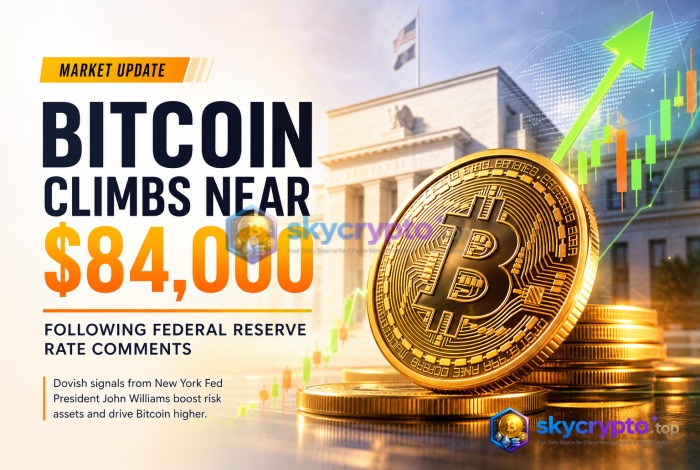
Bitcoin advanced 1.5% to trade just beneath $83,900 during Wednesday Asian morning hours, driven by dovish monetary policy signals from New York Federal Reserve President John Williams. Risk assets across global markets caught an immediate bid as the dollar softened, allowing digital assets to mount a steady recovery from recent macroeconomic jitters.
The broader digital asset complex joined the upward momentum, with select alternative tokens outperforming the pioneer cryptocurrency on strong volume. Traders welcomed the breathing room after a bruising week of liquidations tied to equity market sell-offs in Asia.
- Bitcoin climbed 1.5% to approach the $84,000 threshold during Wednesday trading sessions.
- Fed President John Williams signaled no further interest rate hikes are necessary by 2027.
- Zcash led large-cap tokens with a 7% surge, while equities and oil indices showed mixed reactions.
- Upcoming U.S. inflation data and major tech earnings remain critical catalysts for the next directional break.
Market Reaction
Price action surrounding the $84,000 handle reflects persistent buying interest from spot market participants who view monetary policy stabilization as a green light for risk accumulation. Order books on major spot exchanges show thick bids clustered between $82,500 and $83,000, absorbing selling pressure whenever minor profit-taking occurs. Sentiment indicators have shifted out of extreme fear territories, though participants remain cautious about chasing momentum too aggressively ahead of upcoming economic prints. Funding rates across perpetual swap markets have ticked upward but remain well below the speculative excess observed during previous bull market peaks.
Alternative cryptocurrencies captured significant inflows during the Asian trading window, led by Zcash surging nearly 7% to change hands at approximately $1,270. Solana and Dogecoin added 2.5% each, while Ether advanced 2% to reclaim the $2,520 mark. Mid-cap assets such as XRP, Binance Coin, and HYPE registered modest gains between 1% and 2%. Tron lagged the broader market with an increase of less than 1%, pointing toward sector-specific rotation rather than blind indiscriminate buying across all tokens. Market makers report steady institutional block accumulation, confirming that larger entities are quietly building positions during periods of intraday consolidation.
Derivatives data highlights a measured approach from leveraged traders, who are avoiding the extreme margin deployment that previously triggered cascade liquidations. Open interest in Bitcoin futures expanded by roughly 3.2% over a twenty-four-hour window, accompanied by stable basis rates that suggest healthy cash-and-carry demand. Options desks note a bias toward out-of-the-money call options expiring at the end of the month, indicating that market participants anticipate a test of psychological resistance near $85,000 if macroeconomic conditions remain favorable.
Why This Happened
The primary catalyst for the mid-week relief rally stems from comments delivered by New York Federal Reserve President John Williams, who explicitly stated he sees no economic justification for further interest rate hikes in 2027. This forward-looking guidance punctured the persistent bear narrative that central banks might keep monetary conditions restrictive for an extended duration. Although Williams acknowledged that one additional rate increase might still be warranted later this year depending on incoming data, the medium-term horizon outlined by the central banker reassured investors that peak policy rates are firmly established.
Macroeconomic crosscurrents also provided a supportive backdrop for risk-on positioning. U.S. stock indices pared recent losses, with S&P 500 futures rising 0.2% as the underlying benchmark hovered near record territory. In Asia, equity markets found stability after a brutal five-day losing streak that had severely damaged leveraged positions in regional chipmakers such as Samsung Electronics and SK Hynix. MSCI’s Asia Pacific equities index rebounded 0.7%, halting a slide that had dragged regional valuations to multi-month lows. Meanwhile, commodity markets told a different story; Brent crude climbed 0.7% to approximately $106 per barrel as escalating geopolitical friction in the Middle East stoked supply disruption fears.
Currency markets reacted swiftly to the shifting interest rate outlook, with the U.S. dollar index retreating from recent highs. A softer greenback traditionally serves as an immediate tailwind for hard assets and fixed-supply digital currencies. Foreign exchange traders adjusted their portfolio weightings, reallocating capital into growth-oriented sectors and alternative stores of value. This shifting monetary baseline diminishes the opportunity cost of holding non-yielding assets, directly benefiting Bitcoin as institutional allocators reassess risk parameters for the upcoming quarter.
Institutional and Whale Activity
On-chain analytics reveal a distinct pattern of accumulation among high-net-worth wallet addresses holding between 1,000 and 10,000 Bitcoin. These entities absorbed significant coin volume during the recent dip below $82,000, neutralizing retail distribution and establishing a strong floor. Exchange inflow metrics show a net negative balance change over the past forty-eight hours, confirming that large holders continue moving assets into cold storage solutions rather than preparing to dump inventory on spot markets. Over-the-counter desks report steady institutional inquiries, particularly from corporate treasuries and private wealth funds seeking tactical exposure to digital asset beta.
Derivatives positioning among institutional participants points to a preference for structured yield products and cash-secured put selling rather than naked directional speculation. Real-world asset integration continues to mature quietly in the background, with diversified stablecoin yields holding steady between 5% and 7% sourced from private credit markets. As traditional crypto funding rates compress toward 4%, protocols bridging off-chain yield mechanisms are capturing substantial liquidity. Total addressable market projections suggest these structured yield products could scale significantly over the next three years, drawing institutional capital that demands predictable returns insulated from extreme crypto volatility.
Futures volume on regulated institutional exchanges such as the Chicago Mercantile Exchange expanded notably alongside the spot price advance. Premium spreads between CME futures and spot prices widened slightly, indicating that institutional arbitrageurs are actively capturing basis yield. Liquidations remained relatively subdued, with short positions absorbing minor losses during the initial breakout above $83,500. This absence of violent short squeezes suggests that the current price trajectory is driven by organic spot accumulation rather than forced derivatives liquidations.
Historical Context
Comparing the current market structure to previous cyclical periods reveals a notable maturation in how digital assets absorb macroeconomic shocks. In prior tightening cycles, any hint of hawkish central bank commentary triggered immediate panic selling and severe deleveraging across crypto lending platforms. Today, the market treats Federal Reserve communications with sophisticated nuance, separating short-term adjustments from long-term structural trends. This resilience underscores the broader institutionalization of the asset class, where capital allocators possess longer investment horizons and lower sensitivity to daily noise.
The current price recovery mirrors the consolidation phases observed during mid-cycle bull market transitions, where macroeconomic catalysts serve as the primary ignition points for new legs higher. Historical analogues from prior liquidity expansion cycles demonstrate that once central banks signal an end to aggressive tightening campaigns, digital assets experience sustained multi-month expansions driven by capital rotation out of cash equivalents. However, unlike the retail-driven euphoria of past eras, current price appreciation is heavily correlated with institutional balance sheet expansion and structural demand from exchange-traded product inflows.
Equity market correlations also provide important historical context for the current move. While crypto assets historically exhibited perfect correlation with high-growth technology stocks during periods of monetary tightening, recent weeks show moments of decoupling where digital assets respond more aggressively to dollar weakness than equities do. This evolving correlation matrix suggests that global macro funds are increasingly treating Bitcoin as an independent asset class rather than merely a leveraged proxy for the Nasdaq index, validating its role as a distinct macroeconomic hedge.
What Traders Are Watching
Market participants are maintaining laser focus on several upcoming data points and technical thresholds to determine the sustainability of the current rally:
- U.S. Consumer Price Index (CPI) Report: Thursday's inflation print stands as the ultimate test of John Williams' dovish projections. A cooler-than-expected reading will likely cement expectations that no further rate hikes are coming, providing the necessary catalyst for Bitcoin to challenge and retest the $85,000 resistance level.
- Key Support and Resistance Levels: Immediate technical support is established between $82,500 and $83,000, while firm resistance waits at the $85,000 psychological barrier. A decisive daily close above $84,500 would open the path toward fresh all-time highs.
- Major Tech Earnings Reports: Chip-equipment manufacturer ASML reports earnings on Wednesday, followed by Taiwan Semiconductor Manufacturing on Thursday. These reports will dictate whether the equity recovery in Asian tech sectors holds, directly impacting broader risk sentiment.
- Perpetual Swap Funding Rates: Traders are monitoring funding rates across major derivatives platforms to ensure excessive leverage does not re-enter the system prematurely. Sustainable upward momentum requires spot-led demand rather than leveraged overhang.
- Crude Oil Price Trajectory: Brent crude hovering near $106 per barrel remains a critical wildcard. Sustained energy inflation could complicate central bank calculations and reintroduce macro volatility into risk asset valuations.
Disclaimer: This article is provided for informational and educational purposes only and does not constitute financial, investment, or trading advice. Digital assets carry significant market risk.




Comments
You must be logged in to post a comment.
Login or Register