

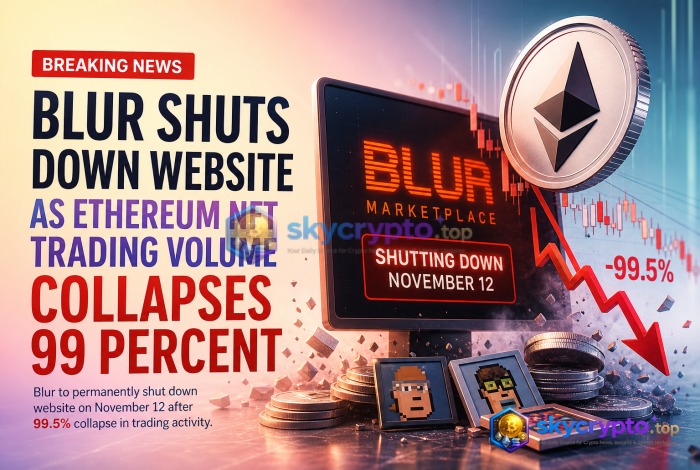
Blur, the dominant Ethereum marketplace founded by Tieshun Roquerre that once commanded more than 70% of non-fungible token trading, will permanently shut down its website on November 12 following a 99.5% collapse in trading activity. The decision follows the closure of Layer 2 network Blast ten days prior, marking an abrupt retreat for Roquerre's crypto ventures after years of aggressive token incentives failed to generate sustainable platform revenue. While the underlying Ethereum smart contracts and token-governed fee switches will remain operational on-chain, the termination of the web interface and the shutdown of the Blend lending facility mark the formal end of the sector's most aggressive liquidity experiment.
- Blur will shutter its primary web interface on November 12 and wind down its Blend NFT lending platform after monthly volumes plummeted from $1.43 billion to under $7 million.
- The announcement represents the second platform closure in ten days by developer Tieshun Roquerre, following the October 2 shuttering of Ethereum Layer 2 network Blast.
- Underlying smart contracts and token-governed fee switches remain live on Ethereum, but the zero-fee structure generated $0 in platform trading revenue across three years of operation.
Market Reaction
The market reaction arrived swift and punishing across digital asset exchanges and on-chain liquidity pools. The native BLUR governance token suffered immediate double-digit price declines as speculators rushed to exit spot and derivatives positions, viewing the frontend shutdown as a fatal blow to protocol viability. Liquidations triggered cascade events across decentralized lending books, particularly as borrowers scrambled to evaluate their debt positions on Blend before the November 12 deadline. Market makers pulled liquidity depth from order books, widening spreads for both token pairings and correlated collections that previously relied on Blur's automated bidding pools.
Across high-value collections including Bored Ape Yacht Club, CryptoPunks, and Pudgy Penguins, the announcement triggered defensive positioning rather than outright panic selling, primarily because liquidity had already evaporated over the preceding quarters. Traders who used the platform's bid-wall system to capture liquidity discovered that bidding depth dried up within hours of the announcement. Yield farmers who earned token points by posting aggressive bids withdrew their capital en masse. This rapid withdrawal of bids exposed fragile floor prices across mid-tier collections, leaving holders with wide bid-ask spreads and limited avenues for rapid liquidation.
Derivatives markets registered intense short-side positioning immediately after the release, with perpetual futures funding rates sinking deeply negative on major venues. Traders treated the news as a structural unwinding of Roquerre's entire market footprint. Analysts across decentralized finance desks pointed out that while decentralized protocols rarely experience pure corporate insolvencies, shutting down user-facing applications produces identical economic outcomes for retail liquidity. For tokenholders, the prospect that the protocol fee switch might ever activate has transitioned from an ambitious long-term thesis to an improbable scenario, driving deep discounts across the asset's secondary trading volume.
Why This Happened
The roots of Blur's sudden collapse lie in an unsustainable business architecture that prioritized mercenary trading metrics over genuine platform revenue. When the platform launched in late 2022, it waged total economic warfare against OpenSea by slashing marketplace fees to zero, introducing aggressive token airdrops, and making creator royalties optional. The playbook succeeded in capturing over 70% market share by March 2023, generating $1.43 billion in monthly volume. Yet that volume was sustained entirely by artificial liquidity providers farming governance tokens. When the token reward emissions diminished, the volume simply evaporated.
Financial metrics reveal the structural flaw at the heart of the enterprise: Blur generated precisely zero protocol revenue from marketplace trading throughout its entire three-year lifespan. According to Token Terminal metrics, the protocol processed billions of dollars in gross merchandise value without capturing a single basis point for its treasury. While traditional venture-backed software firms can afford extended cash-burn phases to capture market share, Blur relied on speculative market capital to subsidize platform activity. Once market participants realized no sustainable economic engine existed beneath the token emissions, user retention crumbled, bringing monthly volumes down by more than 99.5% to sub-$7 million levels.
The platform's closure also mirrors the operational distress seen across Roquerre's broader portfolio, specifically the recent failure of Blast. Blast, an Ethereum scaling network introduced by the same development team, announced its own shutdown on October 2 after its total value locked plummeted from over $2 billion to just $32 million. The core team stated that running the Layer 2 network cost substantially more than the revenue it generated. While Blur did not explicitly cite operational deficits for its own frontend shuttering, maintaining infrastructure for an audience that vanished along with token incentives proved economically non-viable.
Institutional and Whale Activity
On-chain forensics reveal that a tight circle of whale wallets and institutional market makers drove the vast majority of Blur's peak volume, rather than organic collector interest. Elite trading desks ran automated wash-trading algorithms designed solely to churn capital across floor-level assets to harvest seasonal airdrop allocations. As token prices dropped and reward yields shrank, these institutional participants shifted capital to higher-yielding decentralized finance opportunities. Blockchain tracking services show that the top fifty wallets responsible for over 40% of Blur's historical volume had reduced their on-chain balances on the platform to negligible amounts months before the official closure.
Blend, the platform's peer-to-peer perpetual lending service, has now become the epicenter of whale balance-sheet management. Blend allowed high-net-worth speculators to borrow substantial sums of ETH against digital collectibles without fixed expiration dates. With the November 12 deadline approaching, borrowers holding large debt positions must decide whether to repay outstanding principal or abandon their pledged collateral to default. On-chain data indicates that several distressed whale wallets hold loans that currently sit underwater relative to current market floor prices, creating an elevated probability that millions of dollars in collateral will be liquidated or abandoned to lenders.
Large tokenholders face a complex governance dilemma surrounding the surviving smart contracts and the platform's fee switch. Because the core exchange contracts remain permanent on the Ethereum blockchain, tokenholders theoretically retain the technical authority to vote on activating protocol trading fees. However, institutional custody desks and funds holding significant token positions acknowledge that voting to impose fees on an abandoned frontend will generate negligible returns. On-chain voting records show muted participation, indicating that major token stewards view the protocol's governance mechanism as functionally stranded without an active, proprietary interface to direct user order flow.
Historical Context
Blur's rise and fall echoes the speculative cycles that defined early decentralized exchange experiments, particularly the aggressive liquidity wars of 2021 and 2022. Platforms like LooksRare and X2Y2 previously deployed token distribution models to siphon trading activity away from dominant incumbent OpenSea. Each of these attempts achieved temporary spikes in gross volume, followed by precipitous collapses once token inflation crushed the underlying secondary market prices of the reward tokens. Blur executed this playbook on a much larger scale, armed with institutional venture funding and professional-grade order execution software, yet it ultimately succumbed to the identical structural trap.
The strategy also inflicted lasting damage on the broader digital collectible sector by eviscerating creator royalties. In an effort to maximize trading velocity for algorithmic desks, Blur reduced royalty compliance to discretionary levels, forcing OpenSea and other competitors to follow suit to maintain liquidity. This race to the bottom stripped artists and project creators of continuous secondary revenue streams, discouraging new collection launches and contributing to the secular decline of the Ethereum profile picture market. By treating non-fungible tokens strictly as fungible financial instruments, the marketplace alienated the artistic and community bases that fueled the original 2021 market boom.
Historical market data demonstrates that liquidity driven solely by mercenary incentives cannot sustain digital asset platforms over multi-year cycles. When capital costs zero and token values expand exponentially, subsidized marketplace models masquerade as sustainable network effects. When broader financial conditions tighten and participants demand real protocol yields, speculative volumes contract violently. Blur's eventual demise confirms that high transaction volume devoid of fee generation is an illusion of growth, leaving OpenSea, Magic Eden, and decentralized aggregate protocols to divide a shrunken, sobered market landscape that values sustainable unit economics over inflationary reward schemes.
What Traders Are Watching
As the November 12 shutdown deadline draws closer, market participants are monitoring on-chain movements for signs of liquidation cascades, collateral dumping, and capital migrations. The sudden removal of the dominant trading frontend on Ethereum shifts focus directly toward competing venues and decentralized aggregators capable of interfacing directly with Blur's underlying smart contracts. Traders and analysts are tracking several key indicators to assess the fallout across both fungible governance assets and non-fungible collectibles.
Market liquidity profiles will undergo an immediate test as alternative platforms attempt to capture what little organic volume remains in the sector. Traders are positioning for potential volatility spikes across secondary markets, keeping close watch on smart contract redemption flows and debt reconciliation across the Blend protocol. The following structural levels, deadlines, and metrics now command the attention of professional market observers:
- November 12 Blend Debt Expiration: The hard deadline for borrowers to settle outstanding loan obligations or trigger automated collateral liquidations, which could flood secondary markets with high-tier profile picture inventory.
- BLUR Token Support Levels: Secondary market price action around historical lows as liquidity providers pull capital from decentralized pools on Uniswap and centralized order books.
- OpenSea and Magic Eden Market Share Absorption: The percentage of surviving organic Ethereum trading volume that rotates back to fee-charging competitors following Blur's interface deprecation.
- Direct Smart Contract Interaction Volumes: The volume of algorithmic trades routed directly through Blur's immutable contracts via third-party aggregation tools, determining whether the protocol retains utility without a centralized web client.
- Blast Capital Redirection: Final capital outflow figures from the October 2 Blast shutdown, tracking whether residual liquidity re-enters the Ethereum mainnet or exits the broader digital asset landscape entirely.
Disclaimer: This article is provided for informational and educational purposes only and does not constitute financial, investment, or trading advice. Digital assets carry significant market risk.

Comments
You must be logged in to post a comment.
Login or Register